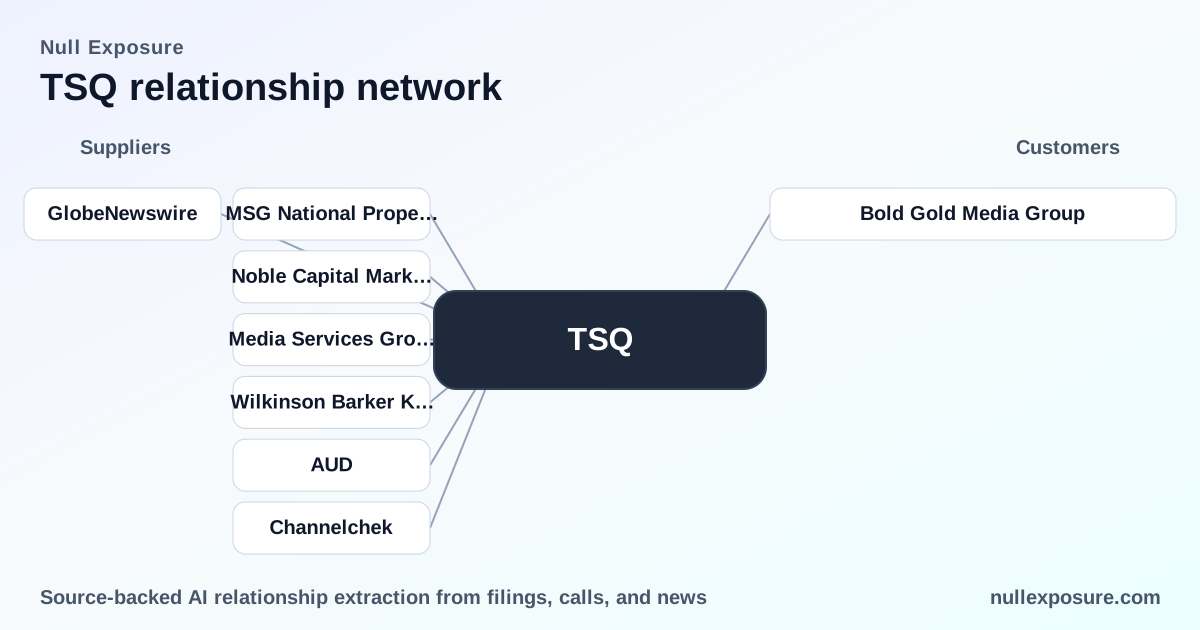
Townsquare Media (TSQ): Customer Relationships and What They Mean for Investors
Townsquare Media operates a hybrid local-media and digital-marketing business centered on small- and mid‑market communities outside the top 50 U.S. radio markets. The company monetizes through three complementary channels: subscription digital marketing services (Townsquare Interactive) sold to small businesses, digital advertising (Townsquare Ignite and programmatic inventory) sold across owned-and-operated sites and partner properties, and broadcast advertising sold on local radio stations and streaming. This mix produces recurring subscription revenue and higher‑turnover advertising revenue, giving Townsquare both predictability from SaaS-style contracts and sensitivity to advertising cycles. For a focused view of customer relationships and near-term commercial strategy, see Null Exposure’s summary: https://nullexposure.com/.
How Townsquare’s customer model operates in practice
Townsquare runs a dual commercial posture: it is a subscription software and services provider to SMBs while simultaneously acting as an advertising seller to local, regional and national advertisers. Company disclosures identify three operating segments—Subscription Digital Marketing Solutions, Digital Advertising, and Broadcast Advertising—which map directly to the revenue streams investors should track. The subscription side creates recurring cash flow, while the advertising side generates higher-margin but short‑term contracts and revenue volatility.
Key company-level signals:
- Contracting posture: Subscription relationships underpin the digital marketing business with a high confidence of subscription-based contracts; advertising contracts are generally short-term and transactional.
- Customer concentration: No single customer represented more than 1% of revenue in 2024 or 2023, indicating diversified revenue sources rather than dependence on a small set of buyers.
- Customer profile and criticality: Primary buyers for the subscription business are SMBs (typically <20 employees and <$5M revenue), making these relationships numerous and low individual criticality but collectively important for recurring revenue.
- Geographic focus: Townsquare is concentrated in U.S. markets outside the top 50, which shapes pricing power, competitive dynamics, and advertising demand cycles.
- Business maturity: The company is a mix of mature broadcast advertising assets and a growing software/subscription business, implying different margin and growth characteristics across segments.
For more on competitive positioning and relationship intelligence, visit https://nullexposure.com/.
Relationship inventory: recent named customer and partner activity
Kroenke Sports & Entertainment — strategic digital advertising partnership (FY2026)
Townsquare announced a strategic alliance to integrate Townsquare Ignite’s data-driven platform with Kroenke Sports & Entertainment’s radio and digital assets in Denver, enabling KSE to scale digital advertising offerings and provide measurable results for KSE’s clients. This is a business-to-business partnership that elevates Townsquare’s role from local SMB vendor to a digital-solutions provider for larger media operators. Source: GlobeNewswire press release (Apr 15, 2026) and industry coverage (Ramp247, May 2026) — https://www.globenewswire.com/news-release/2026/04/15/3274469/0/en/townsquare-forms-strategic-alliance-with-kroenke-sports-entertainment.html and https://ramp247.com/sales/townsquare-inks-digital-deal-with-kroenke-sports/.
Bold Gold Media Group — station asset sale filing (FY2025)
Townsquare filed an asset purchase agreement to transfer two stations in Walton (WDLA-AM 1270 and WDLA-FM 92.1) to Bold Gold Media Group, reflecting a targeted divestiture of market-level broadcast assets. This transaction is a routine portfolio optimization consistent with Townsquare’s strategy to manage local station footprints while focusing investment on digital and higher-growth segments. Source: RBR report on FCC filing (Mar 10, 2026) — https://rbr.com/silent-townsquare-media-pair-acquired-by-benedetto/.
Why these relationships matter to valuation and risk
The Kroenke alliance is strategically significant because it signals Townsquare’s ability to sell enterprise-grade digital solutions to non‑SMB partners, expanding the addressable market for Townsquare Ignite and validating product-market fit outside strictly local retail buyers. For investors, that translates into a pathway to higher average contract values and improved monetization of audiences across sports and entertainment verticals.
The Bold Gold station sale is equally informative: Townsquare is actively managing its broadcast portfolio, pruning assets that do not align with strategic priorities or market returns. Divestitures of smaller stations reduce fixed-cost exposure in low-growth markets and free capital for digital initiatives, supporting the company’s pivot toward subscription and programmatic revenue.
Combined, these developments reinforce two central themes:
- Revenue diversification through product mix expansion — subscription SaaS + programmatic/digital advertising + core broadcast sales.
- A lower customer concentration risk profile, given stated disclosures that no single customer exceeds 1% of revenue; growth now depends on execution in digital product sales and cross‑sell to larger partners.
Operational consequences for investors and operators
Expect the following operating characteristics to persist and inform near-term results:
- Revenue volatility from short-term advertising remains a key driver of quarterly swings; monitor sell-through across local markets and political/event-driven ad cycles.
- Subscription revenue provides a stabilizing floor, but scalability requires continued investment in sales (Townsquare Interactive’s >120 sellers) and product enhancements to retain SMB clients.
- Geographic concentration outside Top‑50 U.S. markets reduces exposure to national ad rate dynamics in top markets but increases sensitivity to localized economic conditions.
- Immaterial single-customer risk improves predictability of downside; the business is not dependent on a handful of large buyers.
Investment takeaways
- Positive: Townsquare is building a hybrid model that captures recurring revenue via subscriptions while scaling higher‑value digital advertising products to partners such as Kroenke, supporting margin expansion if adoption accelerates.
- Watch: Advertising cyclicality and the short-term nature of many ad contracts impose earnings volatility; execution on digital product upsell and retention of SMBs will determine multiple expansion.
- Structural advantage: Broad diversification across thousands of SMB clients and owned local media properties reduces counterparty concentration risk, while selective asset sales indicate disciplined capital allocation.
For a concise briefing on how these relationship signals affect comparable valuations and commercial diligence, see our site: https://nullexposure.com/.
Overall, Townsquare’s named customer activity over the last two fiscal periods shows a company transitioning from a broadcast-first operator into a software-enabled local media platform, with partnership deals and portfolio actions that collectively de‑risk concentration while building routes to higher-margin digital revenue. Investors should track adoption metrics for Townsquare Ignite, subscription ARR trends for Townsquare Interactive, and quarterly advertising sell-through as proximate indicators of execution against this strategy.