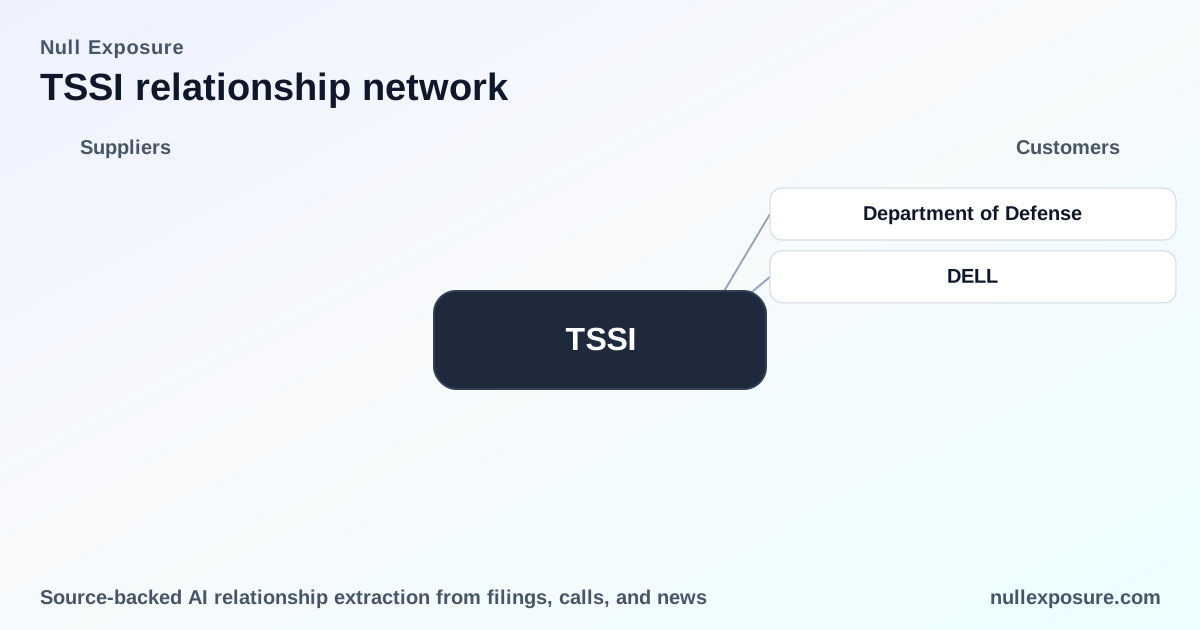
TSS, Inc. (TSSI) — Customer Relationships and Strategic Concentration
TSS, Inc. operates as a systems integrator and facilities/IT services provider that monetizes primarily by delivering integration, procurement and maintenance services to enterprise IT OEMs and government customers. Revenue flows from a mix of short-term maintenance contracts billed in advance, gross procurement deals where TSS takes title and records gross revenue, and a small but growing set of multi-year systems-integration agreements for AI-enabled rack solutions. For investors, the key investment thesis is simple: high-margin, service-led revenue underpinned by deep commercial dependence on a single OEM customer, combined with opportunistic government procurement work that diversifies the go-to-market footprint only marginally.
If you want a structured view of TSS’s customer exposures and their operational implications, review our analysis below or visit Null Exposure for a broader set of commercial signals: https://nullexposure.com/
Why customer composition drives valuation more than headline growth
TSS’s financials show modest revenue growth and positive operating margins, but the company’s commercial risk profile is dominated by customer concentration. The firm reports nearly all revenues in the U.S., and its operating model mixes short-duration maintenance revenue (annual billing cycles) with intermittent, higher-value systems integration work. That combination produces steady cash conversion from services while exposing the company to single-counterparty revenue volatility and procurement timing risk.
Relationship snapshots called out on the 2025 Q3 earnings call
Below are the explicit customer relationships management discussed on the 2025 Q3 earnings call. Each listed result from the call is summarized in plain English with a source reference.
Department of Defense
The bulk of TSS’s procurement business is conducted with the U.S. Department of Defense, indicating material engagement with federal procurement channels for goods that TSS acquires and transforms on behalf of clients. According to the 2025 Q3 earnings call (transcript, March 7, 2026), management said the Department of Defense represents the main end market for its procurement activity.
Dell (DELL) — mention 1
Management referenced Dell’s leadership in modernizing data centers and AI innovation during the same earnings call, implying a commercial alignment where TSS supports OEM-led data center modernization projects. The 2025 Q3 earnings call (transcript, March 7, 2026) included this discussion of Dell’s role in data-center and AI initiatives.
DELL (DELL) — duplicate mention on call
The call included a second, identical reference to Dell’s industry position, reinforcing that Dell-related solutions and OEM partnerships are a thematic driver of TSS’s pipeline. This is another entry from the 2025 Q3 earnings call (transcript, March 7, 2026) and should be treated as a duplicate mention that underscores OEM engagement.
What the filing-level constraints reveal about how TSS operates
Company disclosures provide a consistent set of operational characteristics that explain the commercial exposures above. These are company-level signals — not tied to any single named customer unless the filing explicitly did so.
-
Contracting posture is mixed but skewed short-term. The company reports deferred revenue and remaining performance obligations for maintenance contracts that are expected to be recognized within one year, and facilities maintenance contracts that typically run one to three years and are billed annually in advance (company filings as of December 31, 2024). This creates stable, near-term cash flow but limited long-term revenue visibility.
-
A small set of long-term commitments coexist with short-term billing. Management disclosed a multi-year agreement signed in October 2024 to provide systems integration for AI-enabled racks with a minimum monthly volume — a sign of targeted long-duration work within an otherwise short-contract mix.
-
Extreme customer concentration is the dominant commercial risk. Filings show that a U.S.-based IT OEM accounted for 99% of revenues in 2024 (and 96% in 2023). That level of concentration is material and critical to TSS’s earnings profile; any disruption to that OEM relationship would materially impair revenue.
-
Counterparties are large enterprises and Fortune-scale OEMs. The company characterizes its principal customer as a large US-based IT OEM and a global Fortune 100 computer technologies company, indicating a partner-driven business model where TSS’s economics are tied to OEM channel activity.
-
Geography and market focus are narrow. Revenue is substantially all U.S.-sourced, with only an immaterial contribution from Canada in service of U.S.-based customers, which concentrates geopolitical and procurement risk to North America.
-
Role in the value chain is productively broad. TSS lists itself as a seller, service provider, and occasional reseller when it takes possession of hardware for “gross deals.” This blended role allows higher revenue capture on transformed goods but increases working capital and fulfillment complexity.
-
Relationship maturity and activity are real and trackable. Integration services for AI racks began in June 2024 and continued through the October multi-year agreement; filings and call commentary indicate these relationships are active.
Together these constraints paint a clear operational model: highly concentrated, service-heavy revenue that is cash-friendly in the short term but fragile if OEM alignment falters.
If you want to monitor these customer signals and their evolution in near real time, see our platform for continuous relationship intelligence: https://nullexposure.com/
Investment implications and risk checklist
- Upside lever: the October 2024 multi-year AI-rack contract converts episodic integration work into a recurring minimum-volume stream, improving revenue visibility if volumes hold.
- Primary risk: near-total dependence on a single OEM for nearly all revenue — this is a binary operational dependency that significantly increases downside volatility.
- Cash dynamics: annual upfront billing on maintenance contracts supports working capital, but gross procurement deals where TSS takes title increase balance-sheet funding needs.
- Diversification signal: modest DoD procurement activity provides alternative revenue, but current disclosures show it is not large enough to materially reduce OEM concentration.
Final read
For investors, TSS is a classic concentration play: operationally efficient and profitable on a per-contract basis, but economically tethered to one dominant OEM relationship. The company is executing in the growing niche of AI-rack integration and services, which provides a growth vector, but strategic value hinges on whether TSS can broaden its customer base beyond the single OEM and expand its government procurement footprint into a material second pillar.
For ongoing monitoring of TSS’s customer landscape and to see how relationship-level signals evolve, visit Null Exposure: https://nullexposure.com/