Trane Technologies (TT): Customer Relationships Drive a Hybrid Hardware + Recurring Services Model
Trane Technologies operates as a global designer, manufacturer and seller of HVAC, transport refrigeration and building controls, and it monetizes through point-of-sale equipment sales complemented by growing recurring service and long-term warranty revenue. The company’s commercial strategy blends capital equipment margins with predictable service streams, and its customer relationships range from large retail and tech incumbents to specialty component partners that embed Trane technology into next‑generation systems. For investors, the thesis is simple: durable aftermarket economics and expanding services offset cyclicality in equipment sales, while strategic partnerships accelerate penetration into emerging markets such as data-center thermal management. Learn more at https://nullexposure.com/.
How Trane’s operating model actually works — contracting posture, geography and revenue mix
Trane’s core economics combine two complementary revenue pools. Equipment sales are recognized at a point in time when control transfers, while extended warranties and long-term service agreements are recognized over time, creating recurring revenue streams and higher lifetime customer value. The company reports a global footprint, selling in roughly 100 countries with meaningful exposure across Americas, EMEA and APAC; Asia Pacific and Europe are explicit centers of innovation and revenue concentration. Trane discloses that no single external customer accounted for more than 10% of consolidated net revenues in recent years, signaling a diversified customer base that reduces counterparty concentration risk.
These facts produce several actionable operating-model signals for investors:
- Contracting posture: A meaningful share of revenue derives from long-term service agreements and extended warranties, which smooth cash flow and lift visibility into future earnings.
- Concentration and criticality: Revenue concentration is low at the customer level, but contractual relationships with large platform customers or component partners can be strategically critical for market access.
- Geographic maturity: Trane is a mature global operator with established manufacturing and sales in NA, EMEA and APAC, supporting scale economics and currency exposure.
- Business mix: The firm is a hybrid of hardware (equipment) and services, where services growth is a strategic priority to expand recurring revenue and margins.
The customer map: Amazon, GTX and NVIDIA — what each relationship means
Amazon — field trials scaling into broader roll-outs
Trane Technologies participated in an AI-driven energy-efficiency project at Amazon Grocery fulfillment sites that reduced energy use by nearly 15% at three facilities, with plans to extend to more than 30 additional U.S. sites and pilot in grocery stores starting in 2026. This engagement positions Trane as a systems integrator across HVAC controls and services for major retail infrastructure. According to reporting by Simply Wall St, the work leveraged BrainBox AI and AWS in FY2026.
GTX — supplier and strategic collaborator on next‑gen compressors
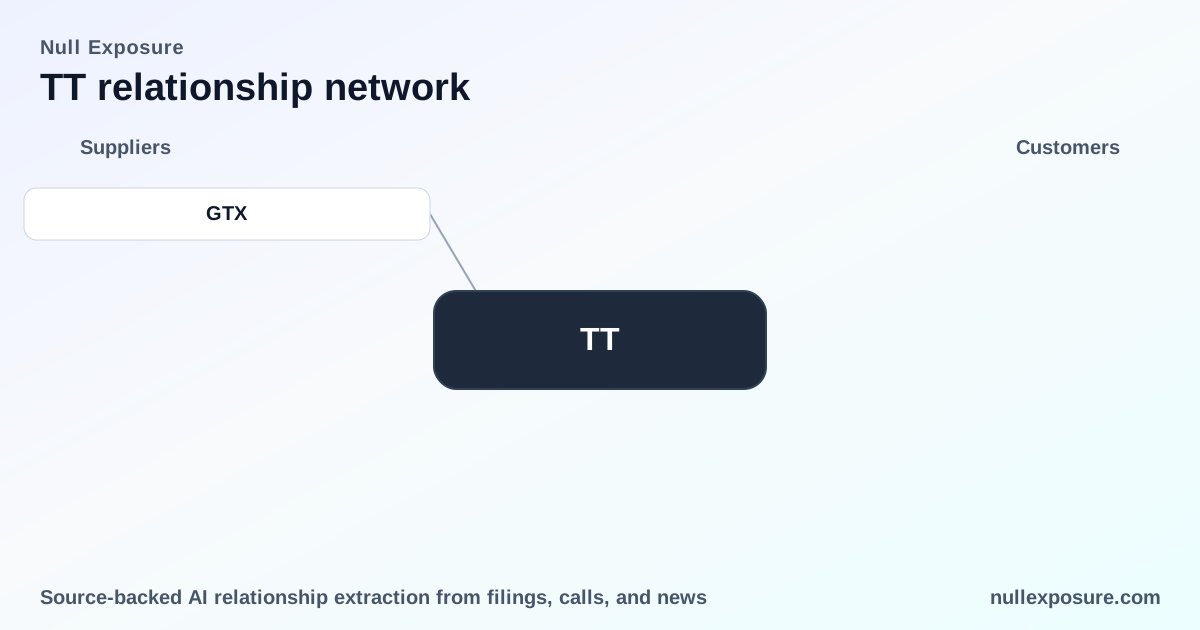
GTX’s public filings and commentary show two dimensions of interaction. GTX’s FY2024 10‑K notes occasional purchases of goods and services from Trane, confirming a supplier‑customer relationship. Separately, GTX’s Q4 2025 earnings call described a strategic collaboration to integrate GTX’s oil‑free, high‑speed centrifugal compressors into Trane’s commercial HVAC applications, touting up to 10% energy savings versus older applications. Together these disclosures indicate both transactional procurement and joint product development that can accelerate product performance and energy-efficiency claims.
NVIDIA — thermal management for AI data centers
Market commentary highlights Trane’s strategic positioning to supply thermal management solutions for artificial‑intelligence data centers, with partnerships referenced alongside NVIDIA. TradingKey coverage in FY2026 underscored investor enthusiasm around Trane’s ability to capture the high-margin, high-growth opportunity in data-center cooling, a market driven by accelerated compute density and stringent performance requirements.
What these relationships imply for growth, margins and risk
These customer ties illuminate concrete operational dynamics. The Amazon engagement demonstrates services-led adoption at scale, where controls and AI-driven optimization deliver immediate energy savings and a route to recurring services across a major operator’s estate. The GTX collaboration signals component-level innovation and product differentiation, which protects margins on new equipment cycles and creates technical barriers to entry. The NVIDIA‑adjacent positioning targets a structural growth market—data-center cooling—that commands premium pricing and rapid adoption if Trane wins design‑win cycles.
At the same time, company disclosures that no single customer exceeds 10% of revenues remain an important risk mitigant: revenue is broad-based, lowering the probability that any single contract failure would materially impair results. The long-term service accounting and recurring‑revenue strategy also raise overall revenue visibility and cash flow resilience in economic slowdowns.
Investment implications: catalysts and watch‑items
Key investment positives:
- Recurring revenue trajectory from long-term service agreements enhances cash-flow stability and valuation multiple support.
- Product differentiation via compressor partnerships and controls integrations enables both share gains and margin expansion.
- Exposure to data-center cooling is a high-ROIC growth vector if Trane converts pilot projects into fleet-level deployments.
Watch-items and risks:
- Although customer concentration is low at the corporate level, winning design‑wins with hyperscalers and major retailers is binary for certain high-margin adjacencies; execution matters.
- Global operations expose Trane to currency swings and regional macro cycles across Americas, EMEA and APAC.
- Competitive technology adoption curves in AI cooling and controls place a premium on speed of commercialization and proven energy savings.
Constraints as signals — how they shape valuation and operational due diligence
Treat the disclosed constraints as company-level signals rather than isolated statistics. The recognition policy for long-term service and warranty revenue implies higher revenue visibility and less cyclicality relative to pure equipment makers. Geographic disclosures confirm diversification across major macro regions, which supports resilience but requires monitoring of regional margin dispersion. Role disclosures—manufacturer, seller and service provider—emphasize that Trane’s valuation must reflect both capital-intensive equipment cycles and asset-light recurring services growth. Finally, segment disclosures show a deliberate push to expand services and rentals, which transforms the revenue base over time and justifies premium multiples if execution matches guidance.
For a deeper read on customer-level dynamics and how Trane converts pilots into recurring revenue, visit https://nullexposure.com/.
Bottom line
Trane Technologies combines scale manufacturing, targeted component partnerships and an accelerating services franchise to create a resilient revenue mix that is attractive to long‑term investors. Amazon pilots validate a services sales motion at scale, GTX collaborations underpin product differentiation, and market commentary around NVIDIA signals strategic positioning in a growing addressable market. The company’s global footprint, immaterial single-customer concentration, and explicit long-term contract recognition are constructive for valuation, while execution on design-wins and regional dynamics are the primary execution risks to monitor.