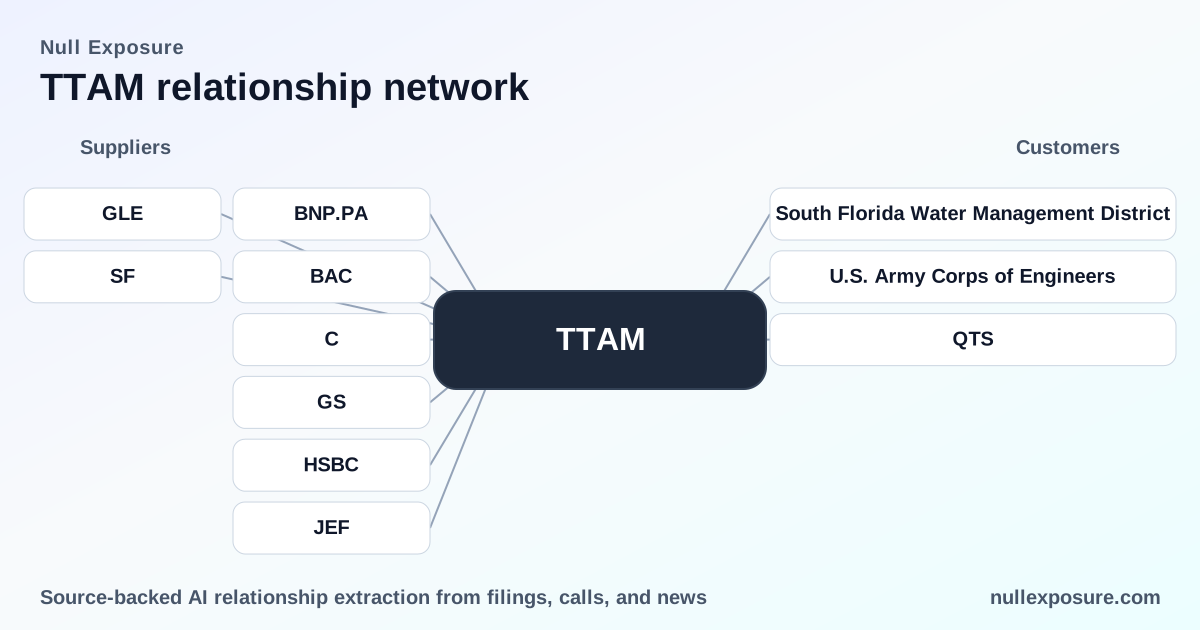
TTAM customer relationships: strategic public projects and targeted commercial demand
Titan America (TTAM) operates and monetizes by manufacturing and selling cement and allied construction materials into project-driven markets — principally large-scale public infrastructure and specialized commercial developments. Revenue derives from project contracts and long-cycle supply agreements tied to infrastructure programs and private construction activity; margin and free-cash-generation are driven by plant location, logistical reach, and the mix between steady public work and higher-margin private construction. For a concise view of TTAM’s relationship set and potential investor implications, see the actionable highlights below and the company-level analysis that follows.
Explore further company-context research at https://nullexposure.com/.
How TTAM competes: project focus, contracting posture, and distribution edge
Titan America is a classic project-oriented supplier in building materials: contracts are typically awarded on a project basis, where volumes are lumpy but predictable once awarded, and delivery logistics — proximity of plants to demand centers — create a durable competitive edge. Public-sector projects such as ecosystem restoration are critical, large-ticket buyers with extended procurement and payment timelines, while commercial developers (including data center operators) generate geographically concentrated spikes in demand that support incremental pricing and utilization gains.
From the customer-relationship signals in TTAM’s filings and calls, derive these company-level operating-model characteristics:
- Contracting posture: Project-driven contracting dominated by public procurement and negotiated private contracts; revenue recognition is tied to contract delivery milestones and physical shipments rather than recurring subscription-like receipts.
- Concentration: Customer concentration can be meaningful at the project level — a single large restoration or infrastructure program will represent a substantial portion of near-term production needs.
- Criticality: Materials are mission-critical to civil works and construction schedules; suppliers to large public programs are strategically important and therefore can achieve structural stickiness once on a program.
- Maturity and predictability: Public projects are mature, long-duration revenue sources with lower counterparty substitution during execution; private commercial pockets such as data centers are cyclical but tied to secular demand for compute infrastructure.
No discrete contractual constraints were disclosed in the customer-scoped relationship extract provided, which indicates limited public evidence of binding supply-side restrictions or unusual covenants in customer disclosures for these named relationships.
Customers and named relationships cited in the 2025 Q3 earnings call
Everglades restoration — South Florida Water Management District
TTAM referenced the South Florida Water Management District in relation to the Everglades restoration project, identifying the District as a managing authority for a cornerstone restoration program. This ties TTAM into large-scale, state- and federally-managed ecosystem infrastructure work that demands significant volumes of cement and aggregates. According to the TTAM 2025 Q3 earnings call (transcript published March 2026), the project is managed by the South Florida Water Management District as part of the comprehensive restoration plan.
Federal partner — U.S. Army Corps of Engineers
The U.S. Army Corps of Engineers was named alongside the South Florida Water Management District as a co-manager of the Everglades restoration initiative. Inclusion of the Corps signals TTAM’s exposure to federal-level contracting rules and the extended procurement and compliance processes that accompany Corps-managed civil works. The company referenced the Corps during the 2025 Q3 earnings call (reported March 2026), noting the project’s management structure and strategic importance.
Commercial development demand — QTS
TTAM called out QTS in the same earnings-call context, referring to QTS’s expansion in Virginia (Richmond and Manassas). QTS represents a commercial end-market buyer tied to data center construction, which generates localized surges in cement demand and supports incremental plant utilization in those markets. The mention of QTS appeared on the 2025 Q3 earnings call (transcript, March 2026).
What these relationships say about revenue quality and operational leverage
- Public infrastructure relationships (SFWMD and USACE) underpin revenue stability and scale. Large, multi-year programs reduce short-term revenue volatility once contracts are secured, and they support long-term planning for plant utilization and capital allocation.
- Commercial customers like QTS provide upside to utilization and pricing in concentrated markets. Data center buildouts produce sharp local demand and create opportunities for incremental margin capture through spot pricing and optimized logistics.
- Counterparty profile is mixed: federal/public clients reduce credit risk but increase administrative and timing complexity; commercial clients accelerate cycle sensitivity and geographic concentration. Investors should view this mix as complementary: public programs provide a revenue floor while commercial projects drive incremental upside.
Key investor takeaways:
- Scale and project concentration are asset advantages for TTAM; plants near large projects allow the company to convert capacity into cash quickly.
- Regulatory and procurement complexity is a governance and working-capital consideration when calculating project cash conversion cycles.
- Commercial demand pockets (data centers) create short-term volatility but enable margin expansion when timing aligns with supply flexibility.
Risks to monitor and practical signals investors should watch
- Contract award cadence and backlog disclosures: track quarterly commentary on awards tied to major public programs and large commercial customers.
- Payment terms and receivables from public agencies: monitor receivable days and any disclosure of disputed billings on long-duration projects.
- Geographical utilization: watch plant-level utilization and shipping distances in quarterly reports; QTS-driven demand, for example, concentrates pressure in Virginia markets.
- Policy and funding shifts: federal or state funding changes for restoration and infrastructure projects will directly affect loadings.
Conclusion and recommended investor actions
The earnings-call references map TTAM squarely into large public infrastructure programs and targeted commercial construction demand. For investors, that combination signals stable baseline cashflows from public programs with episodic upside from private-sector construction cycles. Maintain focus on project awards, backlog transparency, and plant utilization trends as primary monitoring metrics.
For deeper company relationship mapping and to track updates to these customer ties, review TTAM’s transcript coverage and filings regularly at https://nullexposure.com/.