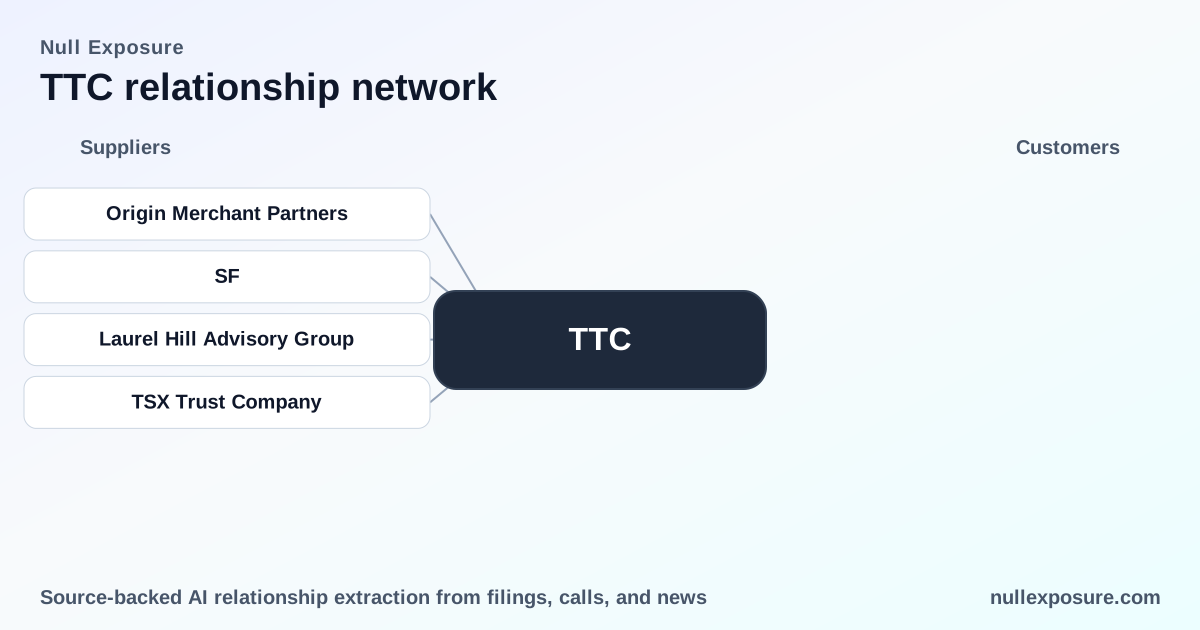
Toro Company (TTC): Customer Relationships, Concentration and the Red Iron Exposure
Toro designs, manufactures and distributes professional and residential outdoor equipment and irrigation systems worldwide and monetizes primarily through product sales, replacement parts and service. Revenue is recognized at shipment to a broad network of distributors, dealers and large retail partners; the company’s customer mix spans governments, rental fleets, large retailers and retail consumers, producing predictable aftermarket revenue and resilient cash generation. For a focused read on counterparty risk and channel health, this note synthesizes relationship-level signals and company-level constraints that matter to investors. For more on third‑party customer intelligence, visit https://nullexposure.com/.
Distribution-first model that drives top-line resilience
Toro’s go-to-market is distribution-led. The company sells finished equipment and irrigation products and recognizes revenue when control transfers at shipment to distributors, dealers and mass retailers. This model creates a clear monetization path: upfront equipment sales followed by recurring parts and service economics that lift gross margins and steady cash flow.
Financial context supports the model: revenue of $4.55 billion (TTM) with a ~9.8% operating margin and ~7.3% net margin. Management reports that no single customer accounted for 10% or more of consolidated sales in recent fiscal years, which establishes low customer concentration as a structural advantage for credit and equity investors.
Company-level constraints that shape counterparty risk
The firm disclosures and derived signals present a composite portrait of Toro’s customer posture and execution risks:
- Counterparty mix: government, individuals and large enterprises. Toro sells into municipal and government accounts (professional turf), homeowners through retail channels, and large enterprise customers such as equipment rental chains and large retailers — a multi‑segment footprint that diversifies demand drivers.
- Geographic footprint: global but North America‑centric. Net sales are concentrated in the United States (~$3.63 billion of $4.51 billion in FY2025), with international sales representing a smaller but strategic portion of revenue.
- Materiality: diversified customer base. Management discloses that no customer exceeded 10% of sales in fiscal 2023–2025, signaling immaterial single‑counterparty concentration for revenue.
- Relationship role: distributors and resellers dominate. The majority of products flow through distributors, dealers and mass retailers, which makes channel health and inventory dynamics a primary lever for revenue volatility and working-capital needs.
- Segment and service mix: product sales augmented by services. The business is built on manufactured equipment and irrigation products, with services and aftermarket parts providing margin stability.
- Relationship stage and maturity: active, well‑established channels. Brands like Toro, Ditch Witch and others indicate a mature distribution network with institutionalized dealer relationships.
These constraints imply a contracting posture dominated by standard sales contracts and distributor terms rather than long‑duration, bespoke customer contracts; concentration risk is low, criticality of distribution partners is high, and business maturity is high given established brands and consistent margin profile.
Relationship coverage: Red Iron — what investors need to know
Red Iron is captured in recent industry reporting tied to Toro’s receivables program. The reporting shows a decline in originations and lower balances owed to Toro under the program.
Red Iron recorded a reduction in amounts owed to Toro: Toro’s receivables exposure to Red Iron fell to $22.6 million, down 28.5% year‑over‑year; outstanding receivables under the broader program declined 17% YoY to $797.4 million (Equipment Finance News, May 2026). This indicates reduced direct counterparty exposure from Red Iron while the overall program contracted modestly year‑over‑year. Source: Equipment Finance News report on Toro’s Red Iron originations, May 4, 2026 — https://equipmentfinancenews.com/news/agriculture/toros-red-iron-originations-dip-1-1-yoy/.
Why the Red Iron datapoint matters in context
That $22.6 million exposure is a small component of the program balance and negligible relative to Toro’s consolidated revenue and receivables capacity. Given Toro’s disclosure that no single customer contributed 10%+ of sales, the decline in Red Iron’s balance should be read as credit concentration reduction rather than a systemic channel failure. The 17% drop in program receivables highlights a tightening in equipment originations in that financing channel, which investors should track as a leading indicator of dealer demand and end‑market appetite for financed equipment.
What to watch next — practical investor checklist
- Receivables and financing programs: monitor quarterly commentary on originations and balances in captive or partner financing programs to detect softening demand early.
- Inventory and dealer stocking: watch dealer inventory levels and shipment timing; distribution-led businesses show revenue sensitivity to channel stocking cycles.
- Geographic mix: track the U.S. vs international revenue split; heavy U.S. exposure concentrates macro and policy risk.
- Customer concentration disclosures: continue to confirm that no single customer approaches 10% of sales; this underpins credit stability.
- Aftermarket service trends: recurring replacement parts and service revenue provide margin stability — growth or contraction here is a leading margin signal.
For ongoing signal tracking and comparative customer analytics, see https://nullexposure.com/.
Bottom line for investors
Toro’s customer relationships are structurally diversified, anchored on a distribution network that reduces single‑customer concentration and supports recurring aftermarket economics. Key strengths: low customer concentration, mature brands, and a monetization model that combines upfront equipment sales with higher‑margin services and parts. Key monitoring items: dealer receivables programs, channel inventory dynamics, and originations trends in partner financing (as illustrated by the Red Iron update). The Red Iron exposure is measurable but immaterial to consolidated sales; it serves as a near‑term barometer of financed equipment demand rather than a fundamental credit concern.
Overall, Toro’s customer portfolio supports stable cash flow and predictable aftermarket margins, while investors should prioritize timely monitoring of distribution channel indicators and receivables program disclosures.