The Trade Desk (TTD): Customer Relationships That Define Reach and Risk
Trade Desk operates a cloud-based digital ad-buying platform and monetizes primarily through transaction-linked platform fees plus upsells for value-added services and data. Its business model is built around long-term master service agreements with large advertisers and agencies, high client retention, and international expansion—factors that drive predictable fee revenue as customers allocate more spend to the platform. For investors, the question is whether recent partnerships and client friction change the underlying economics of a high-margin, software-plus-services operator.
If you want a concise map of Trade Desk’s live commercial links and what they imply for revenue durability and reputational risk, start here or visit the NullExposure home page for more relationship intelligence: https://nullexposure.com/
Why customer relationships matter more than ever
Trade Desk’s platform is a two-sided revenue engine: it charges a percentage of client spend while offering measurement and targeting services that encourage additional platform adoption. That creates high gross margins and operating leverage, but also concentration risk because revenue scales with a relatively small set of large enterprise clients. Recent headlines show both offensive expansions into retail and audio, and defensive shocks stemming from agency-level scrutiny—both meaningful for guidance and margin visibility.
Below I synthesize each relationship mention from the latest coverage and what it signals for investors.
Detailed relationship snapshots (each item from the coverage)
Dollar General (DG)
Trade Desk is part of a new retail-media solution that links Dollar General’s onsite retail inventory with offsite activations across open web channels, leveraging Kevel’s retail media technology to connect the two environments. This is a commercial integration designed to expand Trade Desk’s retail-media addressable spend. According to a GlobeNewswire release on April 30, 2026, the partnership explicitly combines Dollar General inventory with Trade Desk offsite activation.
Publicis Groupe — report one (agency fallout)
Reports emerged that Publicis advised clients to halt spending on Trade Desk following a third-party audit raising concerns about fee practices and transparency; that created immediate selling pressure and client-exit headlines. A Sahm Capital report dated March 30, 2026, highlights this as a material reputational overhang for Trade Desk.
Comscore (listed as SCOR in the feed)
Comscore announced a technical integration enabling content-level audio insights to be used within The Trade Desk’s environment, allowing targeting and measurement without relying on traditional identifiers—an important product expansion into audio advertising. Comscore’s press release (January 2026) described the capability as a privacy-conscious targeting solution built with Trade Desk content signals.
Stagwell (STGW)
Stagwell publicly committed to adopt Trade Desk’s Koa Agents (an ML/agent offering), signaling agency-side product adoption that can increase platform spend through advanced optimization tools. A Marketscreener notice (published in April 2026 coverage) reported Stagwell’s adoption of these Trade Desk capabilities.
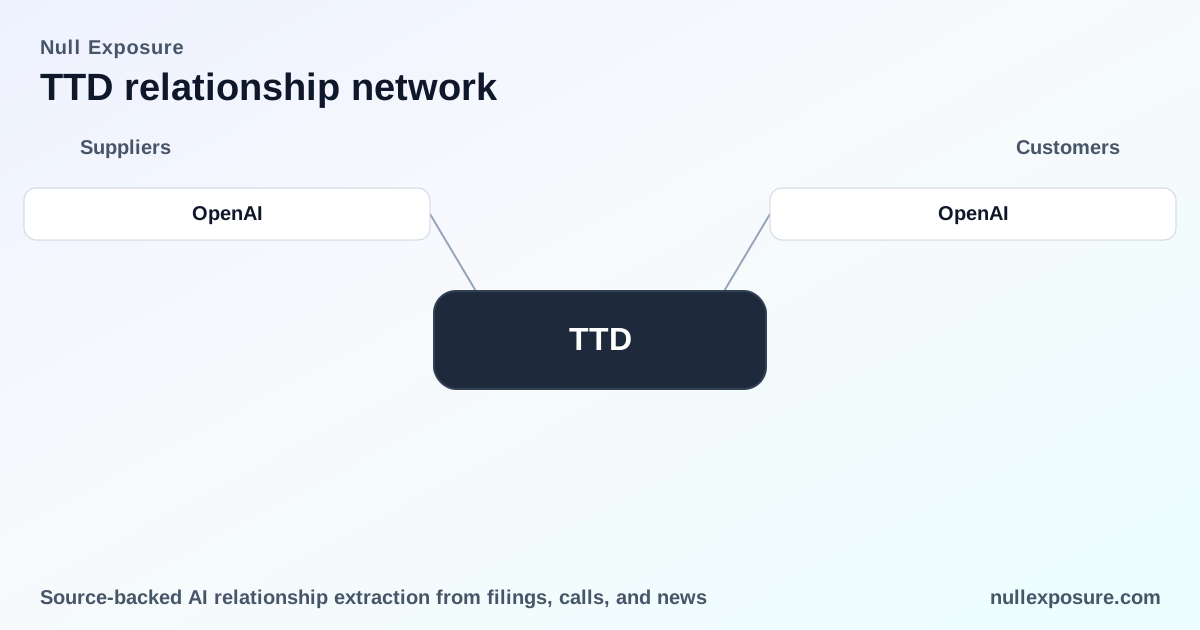
OpenAI
Media reports credited Trade Desk with being in talks with OpenAI about ad sales opportunities, a headline that supported a near-term share-price rerating and underscores Trade Desk’s strategy to integrate with adjacent content platforms. A FinancialContent article from March 10, 2026, cited market chatter that Trade Desk benefited from reports of OpenAI ad-sales discussions and insider buying.
Home Depot — integration mention one (Chain Store Age)
Home Depot has integrated third-party environments for activating retailer audiences, and Trade Desk is among the platforms Home Depot works with to deliver those audiences to non-endemic advertisers. Chain Store Age coverage (early May 2026) lists The Trade Desk as one of the DSPs Home Depot has partnered with to broaden advertiser reach.
Home Depot — integration mention two (RetailDive)
RetailDive, covering Home Depot’s retail-media roadmap, explicitly notes that Home Depot’s OAM has worked with The Trade Desk (and Yahoo’s DSP) to bring retail-media audiences to display, video and connected TV channels—an explicit use case for Trade Desk’s cross-channel activation. RetailDive reported this integration in a May 3, 2026 article.
Publicis Groupe — report two (follow-up)
A second Sahm Capital item reiterated that clients were instructed to pause TTD spend after a third-party audit flagged fee practices and markups, reinforcing the reputational and revenue-risk narrative. The evening note from April 8, 2026, emphasized client exits as the primary conduit for short-term revenue downside.
What the relationships collectively mean for the business model
- Commercial breadth with depth. Partnerships with Dollar General and Home Depot illustrate Trade Desk’s ongoing push into retail media, which converts retailer inventory into addressable spend accessible through its platform—an important incremental growth vector that complements traditional ad buyers.
- Product expansion into audio and agents. Comscore’s audio integration and Stagwell’s adoption of Koa Agents show product-level adoption that supports higher client spend per relationship through enhanced targeting and measurement.
- Concentration and counterparty profile. The relationship set reinforces Trade Desk’s client base of large enterprise advertisers and agencies, where a small number of counterparties drive meaningful revenue—consistent with company disclosures about MSAs and high retention.
- Reputational and revenue risk from agency scrutiny. The Publicis items are a direct operational risk: agency-led pauses in spend can create outsized near-term revenue and guidance volatility for Trade Desk given its percentage-of-spend fee model.
Company-level constraints that shape operations and risk
Based on company disclosures and the relationship set, the following are firm-level signals:
- Contracting posture: Trade Desk operates under ongoing master services agreements and framework arrangements, which favors predictable revenue but requires upkeep of agency trust.
- Counterparty concentration: Clients include many large enterprises and global agencies; this is a concentration risk that amplifies agency-driven headlines.
- Geographic footprint: Trade Desk is explicitly pursuing global expansion to serve multinational clients—revenue is not U.S.-centric.
- Role and monetization mix: The company is both a buyer-facing technology provider and a services seller; revenue comes from a mix of platform fees tied to client spend and value-added services.
- Relationship maturity and criticality: Client retention is high and relationships are typically mature, which supports revenue durability, but mature relationships also mean reputational shocks—like the Publicis audit—have outsized effect.
- Product segmentation: Trade Desk straddles both software and services economics: a cloud-based platform with service layers for measurement, data, and advanced agent tooling.
Investment implications and final takeaways
- Bull case drivers: Expansions into retail media (Dollar General, Home Depot), audio measurement (Comscore), and agency tooling (Koa Agents adoption) increase the addressable spend and stickiness of the platform, reinforcing the revenue multiple profile of a high-margin software operator.
- Key risks: Agency-level friction—most notably the Publicis audit and client spend pauses—introduces near-term revenue risk and shows the business is sensitive to trust and transparency perceptions. Given Trade Desk’s fee model, even modest client spend slowdowns produce outsized P&L effects.
- Watchlist: Monitor reinstatement of client spend from Publicis and peers, the revenue contribution from retailer integrations, and any formal disclosures or remediations addressing fee transparency.
For a deeper read on how these relationships translate to exposure across sectors and revenue scenarios, see NullExposure’s relationship intelligence hub: https://nullexposure.com/
Bold gains are possible if retail-media and audio adoption accelerate—but investors must balance growth upside against agency-concentration and reputational risk that can compress near-term earnings.