TTEC: Customer Relationships, Contracting Patterns, and What Investors Should Know
TTEC is a global customer experience (CX) services and technology company that designs, builds and operates technology-enabled customer interactions for large and mid-market brands. It monetizes through a mix of usage-based BPO fees (per minute, per transaction, per FTE) for operational services and multi-year software and managed services contracts for its TTEC Digital offerings, producing recurring revenue streams, materially exposed to global client volumes and renewal cycles.
For direct access to customer-level signals and relationship coverage, visit https://nullexposure.com/.
Executive summary thesis: business model in one paragraph
TTEC combines high-volume, variable-fee operations (contact centers and BPO) with higher-margin, contractually-bound software and managed services — a dual revenue engine where usage variability drives short-term revenue and multi-year contracts drive visibility and RPO. The firm’s economics depend on scale, global delivery footprint, and contract structure: short-term unit economics from per-minute/per-call billing, offset by multi-year CX technology and managed services agreements that smooth revenue and protect margins.
What investors should look for in customer relationships
TTEC’s customer base is broad — spanning government, enterprise, mid-market and small business — and its delivery is global. Key operating characteristics to evaluate:
- Contracting posture: A mix of usage-based (predominant) and long-term contracts (notable for top clients and software/managed services) creates both revenue variability and backlog. The company reports an RPO of $410.8 million as of December 31, 2024, which underpins revenue visibility.
- Concentration and criticality: Top Engage clients have multi-year, multi-program relationships (5–25 years), indicating high criticality for those accounts and higher switching costs; however, broad exposure to variable-volume client segments increases top-line sensitivity to business cycles.
- Maturity and renewal behavior: Many relationships are mature and renewing, especially among the top five Engage clients that have completed multiple renewals, while the majority of BPO contracts remain terminable for convenience, reflecting mixed renewal risk.
- Global delivery and geography: TTEC operates onshore, nearshore and offshore across 22 countries on six continents, implying operational diversification but also exposure to global macro and currency dynamics.
Customer relationships covered (each relationship summarized with source)
DailyPay — Fin-TTEC engagement to boost fintech CX
DailyPay engaged TTEC’s newly launched Fin-TTEC practice to improve customer satisfaction (CSAT) and expand its service offering, demonstrating TTEC’s strategy of industry-focused CX practices for fintech clients. According to a GlobeNewswire press release in March 2026, DailyPay is cited as an example client for Fin-TTEC’s ability to combine speed, efficiency and CX outcomes; the same announcement was republished by Sahm Capital on March 16, 2026. (GlobeNewswire, March 16, 2026; Sahm Capital, March 16, 2026)
Volkswagen Group UK — new contract and Leeds contact centre expansion
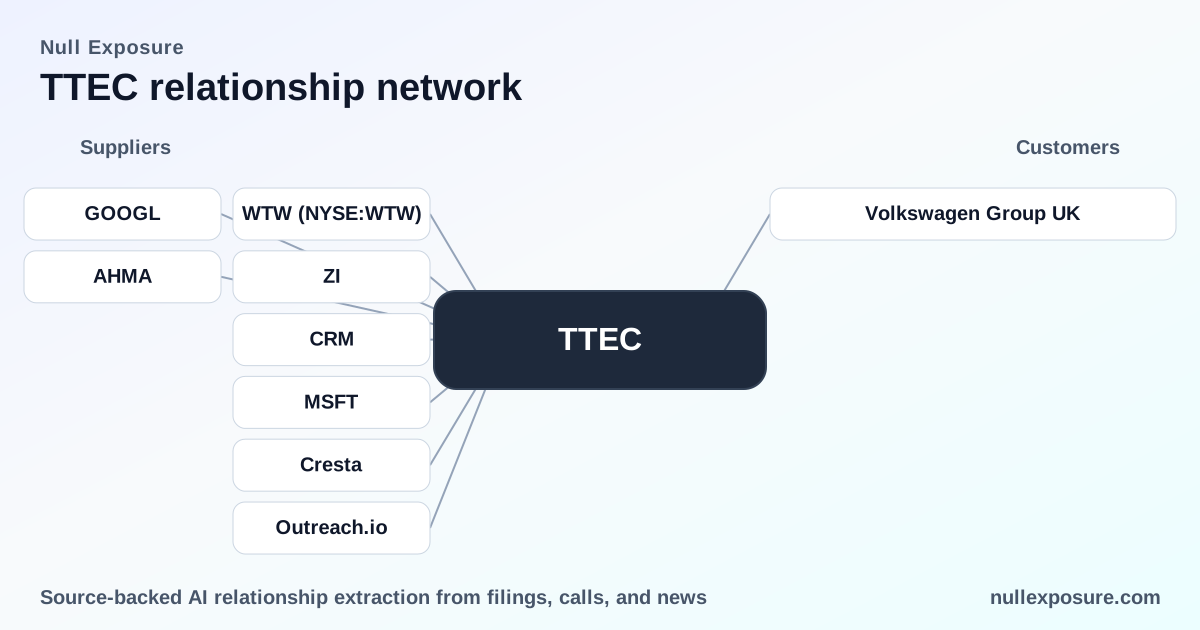
TTEC announced a new contract win with Volkswagen Group UK and opened a contact centre in Leeds, reflecting a geographically focused operational expansion tied to a large enterprise client and reinforcing TTEC’s Engage capability to win and operate scale contact centre programs in EMEA. The contract and centre opening were reported on trading platforms in March 2026 under FY2025 coverage. (TradingView / company announcement, March 10, 2026)
How these relationships map to the operating model (company-level signals)
The relationship evidence and company disclosures combine into clear operational constraints and strengths:
- Contract mix drives cash flow profile. Usage-based BPO fees represent the majority of contracts and produce high revenue elasticity; software and managed services contracts typically have three‑year average terms with early termination penalties, creating pockets of recurring, higher-margin revenue.
- Backlog and visibility exist but are weighted. The company’s RPO of $410.8 million (Dec 31, 2024) provides meaningful revenue visibility across the next six years, with ~63% expected to be recognized within 12 months — this is a near‑term revenue anchor rather than a full hedge against demand shocks.
- Client tenure reduces churn risk for marquee accounts. Top Engage clients average 5–25 years of relationship history with multiple renewals, signaling low churn and embedded criticality for those accounts, which supports pricing leverage and upsell potential.
- Global delivery provides scale but adds macro exposure. Operations across 22 countries and six continents reduce single-country concentration but expose cash flows to global economic cycles, regulatory regimes, and workforce dynamics (onshore/nearshore/offshore mix).
- Counterparty diversity. TTEC serves government, large enterprise, mid-market and small business segments, which implies diversified demand drivers but also differing contract stability and procurement dynamics across segments.
- Relationship lifecycle is mixed. Many agreements are active and renewing; some contracts allow termination for convenience, so operational execution and client satisfaction metrics (CSAT, cost-to-serve) are critical to retain usage-based revenue.
Investment implications: upside drivers and risks
-
Upside drivers:
- Cross-sell of digital and software services into mature Engage accounts increases revenue per client and enhances margin.
- Industry-focused practices (e.g., Fin-TTEC) create differentiated offerings that accelerate new contract wins with fintech and other verticals.
- Scale and geographic diversification allow aggressive bid pricing on large enterprise programs and portfolio-level margin optimization.
-
Key risks:
- Revenue cyclicality from usage-based contracts can compress top-line and operating leverage during macro slowdowns.
- Concentration in marquee clients creates single-account risk despite long tenures; loss or downsizing of a large program would have outsized impact.
- Execution risk in delivery expansion, especially in new contact centre openings and global staffing, could pressure margins if utilization falls.
Practical actions for investors and operators
- For investors: monitor quarterly RPO trends, CSAT/performance metrics for top Engage clients, and the mix of usage-based vs. multi-year contracted revenue. These indicators predict short-term revenue volatility and medium-term margin trajectory.
- For operators: prioritize integration of digital managed services into existing Engage accounts to lock in recurring revenue and reduce usage volatility.
Explore more customer-level relationship intelligence and sector context at https://nullexposure.com/.
Bottom line
TTEC’s model combines the scalability of BPO operations with the margin and visibility of software and managed services. The company’s long-tenured marquee clients and $410.8 million RPO provide a foundation of predictable revenue, while the prevailing usage-based contract mix preserves upside and introduces top-line cyclicality. Investors should value TTEC on both its recurring contract backlog and its exposure to volume-sensitive operational revenue when assessing upside and downside scenarios.