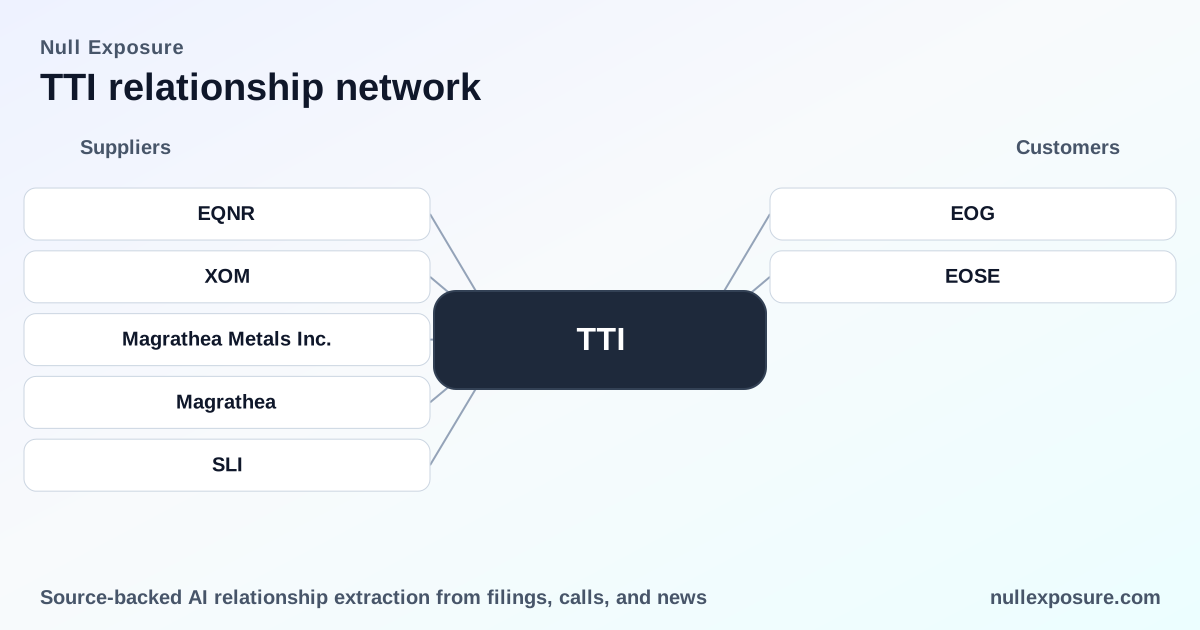
Tetra Technologies (TTI): Customer Relationships Drive Product Diversification and Industrial Adjacency
Tetra Technologies operates as a diversified oil-and-gas services company that monetizes through three core avenues: sale of chemical products (clear brine fluids and additives), water and flowback services to onshore operators, and specialty electrolyte and desalination services tied to energy transition customers. Revenue is derived from product sales, long-term supply agreements, and on-site service contracts, with operations spanning North America, Latin America, EMEA and parts of APAC. For a concise view of TTI’s commercial footprint, visit https://nullexposure.com/.
How TTI actually makes money — plain and focused
TTI sells commodities and engineered fluids to exploration & production companies and provides water management services that are billed either as time-and-materials services or under longer supply contracts. The company also manufactures TETRA PureFlow electrolyte and operates commercial desalination capacity that supports both traditional oilfield uses and emerging battery customers. Monetization blends spot product sales with contract-backed supply arrangements, giving TTI a hybrid revenue profile that captures both cyclical oilfield spend and growing energy-transition demand.
Who TTI is selling to right now — the relationships that matter
EOG Resources: commercial desalination customer in the Permian
Tetra highlighted a commercial desalination operation serving EOG in the Permian Basin and stated the plant is delivering positive results. This is a clear example of TTI selling higher-value water-treatment services to a major E&P operator rather than only commoditized fluids. According to TTI’s Q4 2025 earnings call transcript (March 7, 2026), management said: “We are very pleased with the results of our EOG commercial plant desalination operation in the Permian Basin.” A Globe and Mail posting of the earnings call (March 10, 2026) reiterated the same comment.
Eos / Eos Energy Enterprises (EOSE): strategic long-term electrolyte supply partner
TTI has an active, contract-backed supply relationship with Eos Energy Enterprises to provide TETRA PureFlow electrolyte and zinc bromide products. TTI disclosed that the West Memphis plant expanded production and distribution capacity to ship PureFlow electrolyte to Eos in tanker trucks to support Eos’ production ramp-up, and external reporting noted installation of a bulk electrolyte tanker loading system to feed Eos’ West Memphis output. The company’s Q4 2025 earnings call (March 7, 2026) described the West Memphis expansion; TradingView coverage of TTI’s FY2026 filings (March 10, 2026) reported the tanker loading system installation supporting Eos’ ramp. In addition, company disclosures describe a preferred supply agreement (entered January 2024 through December 31, 2027) under which Eos agreed to purchase a defined percentage of certain electrolyte products from TTI, including rights of first refusal that reinforce the multi-year nature of the relationship.
Constraints and what they signal about TTI’s operating model
TTI’s disclosed relationship signals intersect with company-level constraints to paint a coherent operating profile:
- Contracting posture: Company filings include an explicit preferred supply agreement with Eos that runs through 2027, reflecting a tendency to lock in multi-year supply commitments for strategic products. Where a constraint explicitly names Eos, that contractual signal is attributed to the Eos relationship; other contract posture indicators are company-level.
- Concentration and materiality: Management states that no single customer contributed 10% or more of consolidated revenues in 2022–2024, which signals low single-customer concentration across TTI’s revenue base. This makes TTI’s revenue base resilient to the loss of any one large buyer.
- Counterparty profile: Filings indicate a deliberate focus on larger capitalized oil & gas operators and national oil companies, suggesting TTI targets counterparties with stronger credit profiles and longer procurement cycles — a company-level signal supporting lower receivables risk.
- Geographic footprint: Revenue and segment disclosure show meaningful exposure across North America, Latin America and Europe, with operations referenced in Asia, the Middle East and Africa; this is a company-level indication of diversified regional exposure that tempers commodity-cycle correlation in any single basin.
- Business roles and criticality: TTI operates as a seller of fluids and as a service provider (water & flowback), while also acting as a required supplier for niche electrolyte supply to energy-storage manufacturers; these role descriptors are company-level and describe how customers engage commercially.
- Relationship stage: The Eos supply commitment is explicitly described as active and long-term based on the January 2024 preferred supply agreement; that active / long-term designation applies specifically to the Eos relationship where the constraint names the counterparty.
Collectively, these constraints show a company that balances spot product exposure with contract-protected flows, targets creditworthy counterparties, and leverages geographic diversification to manage demand volatility.
Investment implications and risk profile
- Diversification by end market is a strength. TTI’s mix of traditional oilfield products and emerging battery-electrolyte supply reduces pure oil-cycle sensitivity and creates cross-market optionality.
- Long-term supply to Eos is strategically meaningful and reduces near-term volatility in a niche product line. The preferred supply agreement through 2027 and capital investments at West Memphis create nearer-term revenue visibility for PureFlow products.
- Low customer concentration lowers counterparty concentration risk, but execution matters. While no individual customer breaches the 10% revenue threshold historically, revenue is still tied to oilfield activity levels; sustained weakness in drilling/completions would pressure product volumes.
- Counterparty credit posture is defensible because TTI targets large enterprises and NOCs, but macro energy stress could still affect payment cycles. Management’s stated focus on larger-cap customers is a deliberate mitigation of receivable risk.
- Geographic diversification makes TTI less exposed to a single-region shock, but it also requires operational discipline across different regulatory and logistics regimes.
If you want a systematic view of counterparty relationships and how they affect TTI’s revenue profile, see more context and relationship mapping at https://nullexposure.com/.
Bottom line for investors
Tetra operates a hybrid business model that mixes commodity chemistry with higher-margin, contract-backed services and strategic supply agreements. The EOG desalination engagement illustrates service-led revenue expansion within traditional oilfield customers, while the multi-year, active supply relationship with Eos demonstrates deliberate positioning into energy-transition supply chains. For investors, the key positives are geographic diversification, low single-customer concentration, and contractual insulation in select product lines; the primary risk remains demand sensitivity to oilfield activity and the operational execution required to scale electrolytes alongside battery customers.
For a deeper dive into how these customer relationships evolve and to monitor new contract disclosures, visit https://nullexposure.com/.