TTM Technologies (TTMI): Customer relationships driving a manufacturing-as-a-service growth story
TTM Technologies is a global printed circuit board (PCB) manufacturer that monetizes through a mix of long‑term program contracts and high‑velocity quick‑turn production services, selling to OEMs, EMS/ODMs, distributors and government agencies across diversified end markets. Revenue derives from engineered solutions for aerospace/defense and high‑volume production for data center, automotive and industrial customers, while incremental defense and AI-related orders are acting as near‑term catalysts. Learn more about the signal set and relationship-level evidence at https://nullexposure.com/.
Why customers matter: a short investor thesis
TTM converts engineering work and production scale into recurring program revenue and premium quick‑turn fees. The firm's value is driven by program stickiness in defense and mission systems, combined with leverage to large technology capex cycles (AI/data center) where PCBs are a critical, albeit commoditized, input. For investors, the key trade-offs are customer concentration and contract mix—long‑term defense engagements raise predictability and margins, while broad rapid‑turn commerce preserves growth optionality.
What the public signals show about key customers
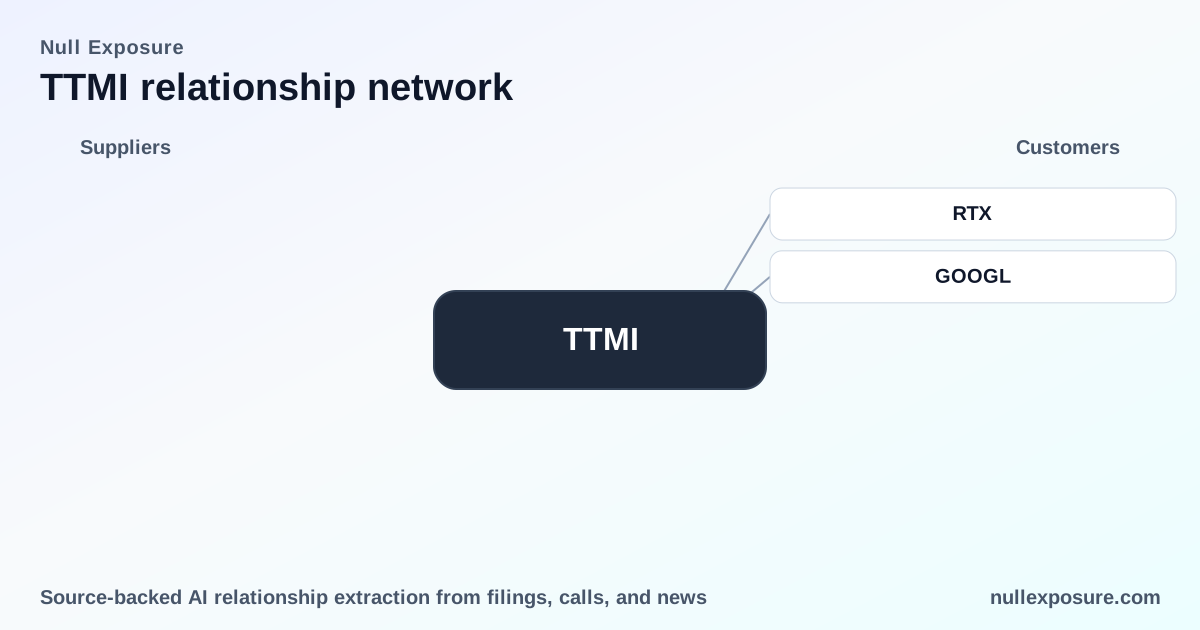
TTM’s publicly surfaced customer relationships in early 2026 concentrate around two named counterparties: Raytheon (RTX) in defense and Alphabet (GOOGL) in hyperscale data center capex. Below I cover each relationship from the available reporting and provide the specific source references.
Raytheon (RTX) — multimillion‑dollar defense programs
TTM disclosed a multi‑year agreement with Raytheon (an RTX business) tied to components for high‑end radar systems, with multiple reports valuing the deal at approximately $200 million and referencing supply for the Lower Tier Air and Missile Defense Sensor (LTAMDS) radar program. According to a BriefGlance article (May 2026) the LTAMDS award was announced in January 2026, and StockstoTrade (March 10, 2026) and SahmCapital commentary (Feb 2026) reiterated a $200M figure and framed the contract as a near‑term catalyst for margin improvement. (Sources: BriefGlance, May 2026; StockstoTrade, Mar 10, 2026; SahmCapital, Feb 2026.)
Alphabet (GOOGL) — exposure to AI infrastructure spending
Market reports flagged TTM as a potential direct beneficiary of Alphabet’s expanded AI infrastructure spending, saying TTMI shares jumped on the news. A FinViz note (March 10, 2026) captured market reaction that TTM could be a “major winner” from hyperscaler capex increases, reflecting investor expectations that PCB demand for data center hardware will lift volumes. This is a demand‑side signal rather than a named‑contract disclosure. (Source: FinViz, Mar 10, 2026.)
How these relationships translate to operating reality
The Raytheon engagement exemplifies TTM’s program‑level revenue model—multi‑year contracts that drive predictable backlog and higher margins—while the Alphabet link highlights the company’s cyclical exposure to hyperscaler capex where fast volume ramps translate into outsized revenue growth but also earnings cyclicality.
- Defense program engagements are structurally longer and more strategic, supporting incremental margin expansion when utilization rises.
- Hyperscaler/data center demand is episodic and volume‑driven; it grows revenue rapidly but subjects the company to capex cycles.
Company‑level constraints and what they imply for investors
The public disclosures and extracted constraint signals provide a clear picture of TTMI’s operating posture:
- Contracting posture: mixed — long‑term and short‑term coexist. Company filings emphasize both long‑term program contracts for sophisticated mission systems and a robust quick‑turn (“QTA”) service that delivers PCBs in as little as 24 hours. That mix produces predictability from programs and margin flexibility from premium quick‑turn orders.
- Contract maturity and recognition: The company recognizes the bulk of revenue over time (about 96% over time vs. 4% at a point in time), and short‑term obligations are expected to be recognized within a year for its rapid services—so revenue stickiness is meaningful but not absolute.
- Geography and market breadth: global diversification. TTM sells in roughly 60 countries to about 1,400 customers, which reduces single‑market exposure but maintains global regulatory and operational complexity.
- Counterparty composition includes governments. Filings list government agencies among customer types, which underscores policy and procurement risk but also supports long‑term program revenue.
- Customer concentration is material but manageable. One unnamed customer accounted for roughly 11% of net sales in FY2024, a signal of materiality that investors should monitor for signs of concentration change.
- Roles and capability set: TTM operates primarily as a manufacturer and service provider, executing customer designs and providing engineering/manufacturing for RF, microwave, mission systems and advanced PCBs.
- Relationship stage is active and manufacturing‑centric. The company’s commercial footprint and product mix reflect mature manufacturing relationships across multiple industries.
Those signals combine into three investment implications: (1) program revenue provides defense‑grade predictability and margin upside; (2) hyperscaler exposure offers high growth but higher cyclicality; and (3) customer concentration and global compliance risks require active monitoring.
Risk and upside — what investors should watch next
- Upside: further expansion of defense programs (e.g., additional awards with RTX or other primes) and continued hyperscaler AI capex could accelerate revenue and operating leverage. Analyst sentiment is constructive (consensus target around $170) and the company posted robust revenue and gross margin levels in recent history, supporting upside narratives.
- Risk: reliance on a handful of large customers (single‑customer ~11% of sales) and the global supply chain footprint increase operational and contractual risk, particularly under shifting defense procurement or hyperscaler buying patterns. A pronounced slowdown in data center capex would compress volumes quickly because of the volume‑sensitive manufacturing cost structure.
Final takeaways and next steps
TTM is a manufacturing platform monetizing through a blend of long program contracts and high‑speed production services — a profile that combines predictability with cyclical upside. The Raytheon $200M program is the clearest example of durable, higher‑margin work, while market commentary linking TTM to Alphabet’s AI spending underscores a second, growth‑oriented demand stream.
For a deeper look at the full relationship signal set and ongoing monitoring, visit https://nullexposure.com/ to review source‑level coverage and track incremental disclosures.
Bold, relationship‑level developments—new program awards, material amendments, or confirmed hyperscaler contracts—will be the primary catalysts that move the thesis from narrative to valuation.