Take-Two Interactive: how platform partners and distribution deals drive monetization
Take‑Two publishes and monetizes interactive entertainment through owned labels (Rockstar, 2K) and a broad set of commercial arrangements: direct digital sales, boxed retail, licensing to third‑party distributors, live services and in‑game purchases, and advertising and platform partnerships. The company recognizes revenue both at a point in time for delivered software and over the life of contracts for advertising and live‑service obligations; its top customers are highly concentrated and strategically critical to revenue. For investors, the partner set is less a list of small vendors and more a map of platform exposure and distribution risk.
Learn more about how partner exposure is tracked at Null Exposure: https://nullexposure.com/
What the partner map implies for investors
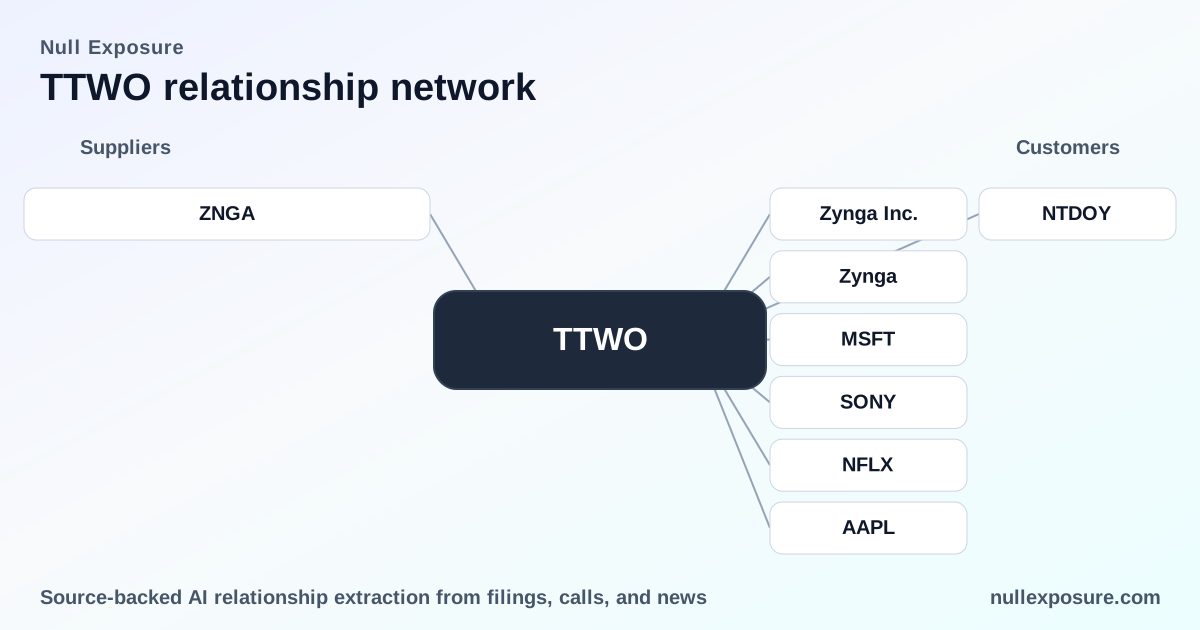
Take‑Two’s commercial relationships reflect a mix of long‑standing platform dependencies and expanding non‑traditional distribution channels. Platform owners (Sony, Microsoft, Nintendo) function as essential distribution conduits for console releases; digital platforms (Apple Arcade, Netflix) are growth channels for new formats; Zynga figures in financing / receivables and mobile publishing; and advertising/monetization contracts are recognized over time.
Key operating and business model signals:
- Contracting posture: Mix of licensing (fixed minimum guarantees + royalties) and usage‑based arrangements for advertising and live services, indicating hybrid cash flow profiles.
- Concentration and criticality: Sales to the top five customers accounted for 81% of net revenue in FY2025, signaling high counterparty concentration and critical dependency on a small set of major retail and platform partners.
- Counterparty profile and maturity: The company transacts primarily with large enterprise platform partners and retailers; these are active, mature relationships rather than one‑off customers.
- Geography: Take‑Two is global, but the United States remains the largest single market (United States net revenue reported at $3,406.8M for the year ended March 31, 2025).
- Revenue recognition mix: Software sales are largely point‑in‑time; advertising and live‑service obligations are recognized over contract life, producing differing margin dynamics.
These constraints shape risk-adjusted upside: high upside from blockbuster titles partnered with platform holders, offset by concentration risk and a portion of usage‑based revenue that grows with engagement rather than upfront sales.
Explore partnership analytics and counterparty signals at Null Exposure: https://nullexposure.com/
Relationship-by-relationship notes (plain-English, sourced)
Zynga — 10‑K entry on revenue recognition (FY2025)
Take‑Two’s FY2025 filing includes an excerpt tied to Zynga where net revenue recognized at a point in time is described as the portion of software revenue booked upon delivery and customer control. This underlines that certain partner transactions are treated as point‑in‑time sales for accounting purposes. Source: Take‑Two FY2025 10‑K (filed Mar 31, 2025).
Zynga Inc. — receivables purchase agreement with Wells Fargo (FY2025)
On May 19, 2025, Take‑Two and Zynga Inc. (as sellers) entered a Receivables Purchase Agreement with Wells Fargo Bank, N.A., indicating a financing/receivables arrangement that shifts cash collection mechanics for receivables tied to these sellers. Source: Take‑Two FY2025 10‑K (filed Mar 31, 2025).
Sony — platform distribution for console releases (FY2026)
Take‑Two’s pipeline and reporting note launches on Sony’s PlayStation 5 platforms, confirming Sony as a primary console distribution partner for current‑gen releases and future console refreshes. Source: The Globe and Mail coverage of FY2026 reporting (March 2026).
Microsoft — Xbox Series S/X platform launches (FY2026)
Take‑Two titles are launching on Microsoft’s Xbox Series S and Series X, with updates expected for new console generations; Microsoft functions as a major platform partner for console distribution. Source: The Globe and Mail coverage of FY2026 reporting (March 2026).
MSFT — same Microsoft platform reference (FY2026)
A parallel item references MSFT in coverage noting that titles will appear on Microsoft consoles and be updated for future console releases, reiterating the company’s platform dependence on Microsoft for Xbox distribution. Source: The Globe and Mail coverage of FY2026 reporting (March 2026).
NFLX — Red Dead Redemption launched on Netflix (FY2026)
Take‑Two has expanded distribution to include Netflix, with Red Dead Redemption cited as a recent launch on Netflix’s platform, illustrating a strategic move into cloud/streaming distribution channels. Source: InsiderMonkey coverage of Take‑Two’s FQ3 FY2026 results (March 2026).
NTDOY — potential Nintendo platform release (FY2026)
Analysts and press coverage note that Take‑Two titles could be released on Nintendo platforms, signaling potential cross‑platform support beyond current‑gen Sony and Microsoft launches. Source: The Globe and Mail coverage of FY2026 reporting (March 2026).
AAPL — Civilization VII listed for Apple Arcade (FY2026)
Take‑Two’s upcoming pipeline includes Sid Meier’s Civilization VII slated for Apple Arcade, indicating a relationship with Apple for subscription‑based distribution of at least one premium title. Source: InsiderMonkey coverage of Take‑Two’s FQ3 FY2026 results (March 2026).
Nintendo — commentary on potential platform release (FY2026)
Press commentary separately calls out Nintendo as a plausible platform for future releases, consistent with Take‑Two’s multi‑platform strategy and the company’s global distribution footprint. Source: The Globe and Mail coverage of FY2026 reporting (March 2026).
Apple (Apple Arcade) — pipeline inclusion (FY2026)
Coverage cites Apple Arcade specifically as a destination for new titles in Take‑Two’s pipeline, reflecting a strategic partnership channeling subscription and mobile/console cross‑distribution. Source: InsiderMonkey coverage of Take‑Two’s FQ3 FY2026 results (March 2026).
Netflix — repeated mention of Red Dead on Netflix (FY2026)
A second entry reiterates that Red Dead Redemption has reached Netflix's platform, reinforcing that Netflix is being used as a distribution and discovery channel for major IP. Source: InsiderMonkey coverage of Take‑Two’s FQ3 FY2026 results (March 2026).
Investment implications and concluding view
- Revenue profile is hybrid: Point‑in‑time software sales deliver upfront cash for major releases, while advertising, live services, and certain licensing deals produce usage‑based and recurring revenue streams. This mix supports higher gross margins on hits, but also creates variability tied to release cadence and engagement.
- High customer concentration is a structural risk: With the top five customers accounting for 81% of revenue in FY2025, platform negotiations, payment terms, or distribution changes at a handful of partners would have outsized effects on cash flow.
- Platform diversification is active: Expansion into Apple Arcade, Netflix distribution, and continued support for Sony, Microsoft, and Nintendo reduces single‑platform dependency over time but does not eliminate concentration risk given large retailer and platform share.
For investors and operators evaluating Take‑Two’s counterparty exposure, the takeaway is clear: the company manages a concentrated set of strategic, enterprise‑level relationships that deliver outsized revenue but also concentrate execution risk. Detailed partner tracking and scenario analysis are essential when modeling Take‑Two’s cash flow sensitivity to platform terms and content cadence.