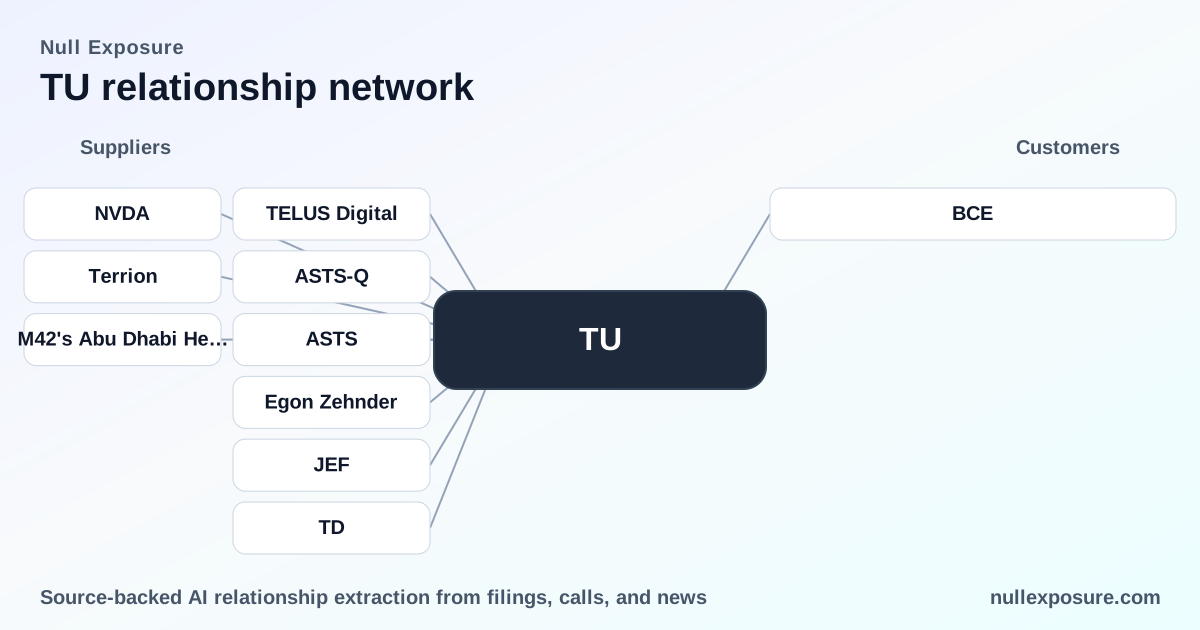
Telus customer map: Health partnerships and wholesale tension that shape revenue durability
Telus is a vertically integrated Canadian telecommunications and IT services company that monetizes through consumer wireless and wireline subscriptions, enterprise networking and IT contracts, and a fast-growing health-services arm branded TELUS Health that sells B2B programs to insurers and employers. Its cash flow profile blends stable subscription revenue with higher-growth services (healthcare, B2B IT) and discrete channel revenue from wholesale and reseller arrangements, creating a mix of recurring stability and operational concentration risk that investors must model explicitly. For a concise investor research package and ongoing relationship updates, see https://nullexposure.com/.
How to read these customer signals: contract posture, concentration and criticality
Telus’s customer relationships reveal a company that operates across three commercial vectors: consumer subscriptions (high-volume, commoditized contracting), enterprise and institutional contracts (longer-term, negotiated deals), and strategic services (TELUS Health—software, care programs, and employer services). From these vectors we infer the following operating-model characteristics as company-level signals:
- Contracting posture: Telus executes both standard supplier contracts for mass-market connectivity and bespoke commercial agreements for enterprise and health services; this dual posture requires both commodity-scale billing systems and specialized integration capabilities.
- Concentration: Revenue concentration is moderate—consumer subs dilute single-customer exposure, while large institutional partners and channel resellers create pockets of outsized counterparty importance.
- Criticality: For partners that integrate Telus’s services (e.g., resellers or insurers embedding TELUS Health), Telus is operationally critical, especially where systems and data integration are required.
- Maturity and ramp: Consumer telecom is mature and margin-stable; TELUS Health is growth-oriented and strategic to future margin expansion, while reseller/wholesale channels are operationally nascent in some regions, introducing implementation risk.
These signals guide valuation adjustments: assign steady-state multiples to core connectivity revenue and a premium growth multiple to health services, while applying conditional downside for channel-disruption events.
Relationship roll-call: what the records show
Below are all customer relationships captured in the review, each summarized with source context.
VOYA (Voya Financial) — expansion of TELUS Health EAP services
Telus has expanded Employee Assistance Program services with Voya Financial, indicating TELUS Health’s penetration into U.S. fiduciary and benefits channels for employer-sponsored wellbeing programs. The engagement positions Telus as a vendor to an asset/benefits manager distributing employee health services to institutional clients. (Source: Quantisnow, May 4, 2026.)
VOYA-P-B (Voya preferred class) — same commercial extension cited to investors
A separate notice referencing Voya’s corporate communications reiterates the expanded EAP services with TELUS Health, confirming that the Voya group is publicly communicating the partnership across investor- and corporate-facing channels. This duplication in public mentions underscores the partnership’s relevance to Voya stakeholders. (Source: Quantisnow, May 4, 2026.)
BCE / Bell (BCE Inc.) — reseller dispute over reseller systems in Alberta and B.C.
Bell (BCE Inc.) lodged a formal complaint alleging that Telus has not delivered “even minimally workable systems” for Bell to resell Telus’s internet in Alberta and British Columbia, and that the operational shortfall caused Bell to halt marketing that service. This is a material channel friction with a major Canadian competitor/partner that threatens near-term reseller revenue and raises regulatory risk. (Source: The Globe and Mail, March 10, 2026.)
Bell (duplicate entry) — identical complaint coverage
The duplicate record for Bell mirrors the BCE entry and documents the same operational and commercial contention between the two incumbents: unresolved system integration for reseller arrangements. The repeated coverage indicates media and regulator attention on the reseller rollout. (Source: The Globe and Mail, March 10, 2026.)
Why these relationships matter for valuation and risk
The Voya relationships are evidence of TELUS Health’s move from Canadian markets into institutional U.S. distribution, a positive signal for growth and margin expansion because health services command higher unit economics than commodity connectivity. Investors should treat TELUS Health partnerships as revenue diversification that supports higher long-term organic growth assumptions.
Conversely, the Bell/BCE dispute signals execution risk on wholesale/reseller initiatives. When a large potential channel partner pauses marketing because of integration failures, the impact is twofold: immediate lost reseller revenue and reputational/regulatory scrutiny that can slow other partner rollouts. Given Telus’s dual role as competitor and wholesale supplier in Canada, this is an operational constraint that amplifies counterparty concentration risk in specific regions (Alberta, British Columbia).
Collectively, these signals justify a blended modeling approach: anchor core telecom cash flows to stable multiples while attributing incremental upside to TELUS Health contracts and contemporaneous downside to channel execution risk.
Practical constraints and what they imply for operating model choices
No explicit contractual constraints were provided in the record set; treat the absence of formal constraint excerpts as a company-level signal: public disclosures emphasize commercial expansion and dispute visibility rather than formal covenants. From an operational perspective that implies Telus must prioritize:
- Systems integration rigour for reseller partners to prevent revenue slippage and regulatory complaints.
- Commercialization focus for TELUS Health to scale distribution through insurers and benefits providers.
- Balanced customer mix to prevent concentration where single-partner operational failures could dent growth.
These are strategic execution items—not single-source contractual prohibitions—and they influence capital allocation, M&A appetite in health tech, and near-term guidance.
Investor actions and monitoring checklist
- Track TELUS Health contract announcements and revenue recognition in upcoming quarters to quantify the Voya contribution.
- Monitor CRTC filings, regulatory correspondence, and Bell/BCE follow-ups for resolution timing and potential remedies or penalties.
- Watch quarterly commentary on channel integration and GTM timelines; management language will signal whether reseller issues are tactical delays or structural systems work.
For regular updates that consolidate customer relationship signals into investor-ready summaries, visit https://nullexposure.com/.
Bottom line
Telus’s strategic mix—stable telecom subscriptions plus a growth-oriented health services business—is intact, but revenue durability depends on execution across two different fronts: scaling TELUS Health through institutional partners and resolving operational shortfalls in reseller systems. The Voya partnership is a clear positive for growth; the Bell dispute is a concrete risk for channel revenue and regulatory attention. Investors should underwrite Telus with differentiated assumptions across these revenue streams and monitor partner communications and regulatory filings closely.