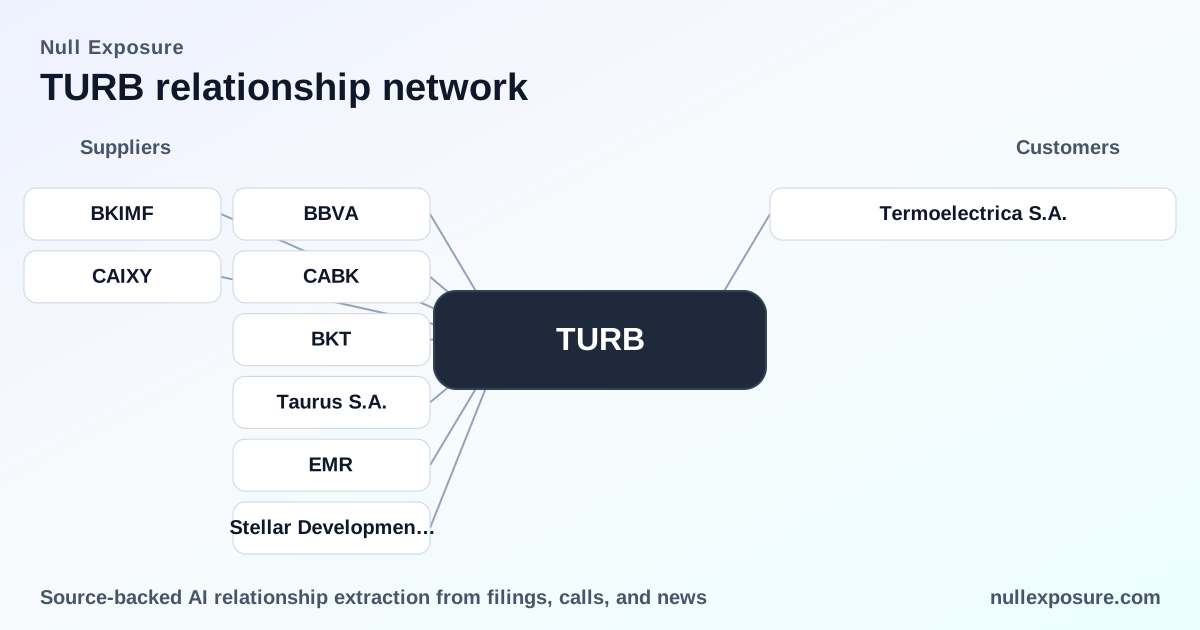
Turbo Energy (TURB): Customer Relationships That Drive Near-Term Commercialization
Turbo Energy designs, develops and distributes photovoltaic generation, management and storage systems and monetizes through project sales, systems integrations and recurring software-enabled optimization services for commercial and industrial clients. The company’s revenue mix is project-driven, anchored by named industrial contracts and strategic partnerships that convert product and software IP into multi-million dollar engagements. For investors, the catalytic items are contract scale, partner distribution, and the transition from one-off sales to embedded software long-duration revenue. Learn more at https://nullexposure.com/.
Thesis, in one paragraph
Turbo Energy sells hardware and embedded AI optimization for solar-plus-storage systems into industrial and defense buyers, monetizing via project contracts, OEM integrations and software licenses; FY2025 revenue disclosures show material projects and a step change in scale, but financials still reflect early commercial economics with negative margins and limited institutional ownership. Investors should value the stock as a high-growth, early-revenue play where named customers and partners are the primary de-risking signals.
Customers and partners that matter — line by line
Below are the firm relationships surfaced in public reporting and news, each summarized in plain English with the reporting source.
-
IM2 Energía Solar
Turbo Energy reported that fiscal year 2025 revenue includes approximately $10 million in contracted value tied to jointly developed projects with IM2 Energía Solar for electro‑intensive industrial clients, subject to normal revenue recognition standards. This contract materially underpins the company’s reported FY2025 top-line expansion. (QuiverQuant/ADVFN coverage of Turbo Energy company disclosure, May 4, 2026.) -
Pamesa Grupo Empresarial
Turbo Energy cited major industrial contracts with Pamesa Grupo Empresarial as part of a string of strategic validations and partnerships, emphasizing UL certification, patents and collaboration with global technology partners as commercial enablers. This is a named industrial customer validating product fit with large-scale manufacturing buyers. (Company announcement and subsequent QuiverQuant/ADVFN reports, May 4, 2026.) -
Hithium
Turbo Energy announced a strategic partnership with Hithium to embed Turbo’s AI-driven energy optimization platform into Hithium’s battery storage systems for commercial and industrial projects across Europe and Latin America, positioning Turbo as the software layer in a tier‑1 battery OEM’s ecosystem and opening OEM channels for scale. (TipRanks press coverage and multiple outlets including Investing.com and Yahoo Finance reporting on the April 20, 2026 partnership; republished May 2026.) -
Termoelectrica S.A.
Reporting from March 2026 raised questions about procurement irregularities in a tender where a related entity, TurboEnergy Power, was the winning bidder; Termoelectrica S.A. highlighted alleged inadequacies and price inflation in that tender memo. This introduces reputational and procurement risk in specific geographies or public‑sector tenders. (logos-pres.md article citing Termoelectrica S.A. memo, March 10, 2026.) -
Spanish Army
Turbo Energy reported a real‑world deployment with the Spanish Army, marking an entry into mission‑critical defense and energy security applications where availability and resilience are required. This demonstrates product ruggedization and sector diversification into government and defense buyers. (GlobeNewswire press release and Markets/BusinessInsider coverage, April 28–May 4, 2026.)
What these relationships imply about Turbo Energy’s operating model
- Contracting posture: Projects are contracted at the customer and OEM level—Turbo engages in both direct industrial contracts (Pamesa, IM2) and channel/OEM partnerships (Hithium). This indicates a hybrid go‑to‑market that mixes project sales with embedded OEM licensing for software.
- Concentration: Named deals such as the ~$10M IM2-related portfolio are material relative to reported revenue (Revenue TTM ~$9.98M). Customer concentration risk is high until the pipeline broadens beyond a handful of large contracts.
- Criticality: Deployments for electro‑intensive industrial clients and defense customers are high‑criticality use cases where uptime and software optimization carry premium value and can justify higher contract pricing or recurring fees.
- Maturity: Financial indicators show an early‑stage commercial profile: negative EBITDA (‑$2.33M), negative EPS (‑$0.23) and modest gross profit ($1.82M) against project revenue growth. The business is scaling commercial deployments but has not yet reached profitable operating leverage.
There are no extracted contractual constraint excerpts in the source feed to provide line‑item obligations, delivery schedules or termination clauses; this absence is a company‑level signal of limited public contract detail in the available disclosures.
Financial and strategic implications for investors
- Revenue growth is real but concentrated. The ~$10M IM2‑linked contracted value materially influenced FY2025 results and explains reported revenue growth of roughly 130–140% year over year in preliminary notices. (Company preliminary revenue disclosure reported May 2026.)
- Path to recurring margins runs through software and OEM embeds. The Hithium partnership positions Turbo to monetize its AI platform via OEM licensing and integrated solutions rather than pure hardware margins. This is strategically significant given negative operating margins today.
- Risk vectors are procurement and reputation in select public tenders. The Termoelectrica S.A. memo introduces a governance and execution risk that underwriters and procurement teams will scrutinize in future public‑sector bidding.
- Defense and energy‑security wins enhance strategic valuation multiple potential. The Spanish Army deployment signals product resilience and a premium market where long‑term service contracts and renewals are plausible.
Practical considerations for due diligence
- Validate recognition policy for the reported ~$10M IM2 contractual value and the timing of cash collections. The public notices state the value is included in FY2025 revenue “subject to customary revenue recognition criteria.” (QuiverQuant/ADVFN reporting, May 2026.)
- Request contract-level terms for Hithium OEM integration to quantify software licensing cadence, support obligations and upgrade/recurring revenue potential.
- Investigate the Termoelectrica S.A. procurement memo and any follow‑up audits to assess legal and reputational exposure in affected jurisdictions.
Bottom line: invest or monitor
Turbo Energy is a high‑growth, project‑centric solar and energy‑storage company whose near‑term valuation will track the conversion of large named contracts into repeatable, software‑enabled revenue streams. The IM2 and Pamesa industrial contracts and Hithium OEM partnership are the primary de‑risking events; however, concentration and early negative margins require active monitoring. For deeper signals and continuous tracking of Turbo’s commercial relationships, see our research hub at https://nullexposure.com/.
Key takeaway: named industrial contracts and OEM software embeds materially improve the company’s growth trajectory, but investor returns depend on converting project wins into recurring, higher‑margin software revenue while avoiding procurement and reputation pitfalls.