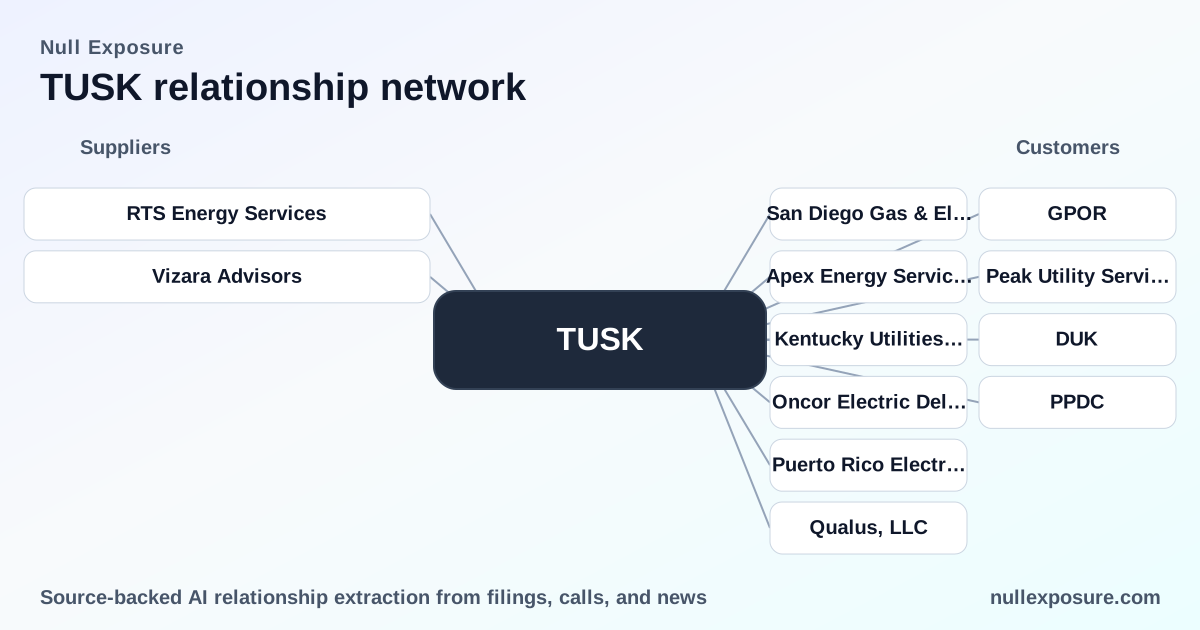
Mammoth Energy Services (TUSK): customer map, collection risk and what recent divestitures change
Thesis: Mammoth Energy Services (TUSK) operates as an oilfield and infrastructure services contractor that monetizes through project work, master services agreements (MSAs), proppant manufacturing and last‑mile logistics, and it supplements cash through targeted portfolio sales. Revenue is driven by a mix of short‑term MSAs with energy producers and municipal/utility infrastructure contracts; profitability and balance‑sheet recovery hinge on collections from large counterparties and on strategic divestitures that reduce operating scale. For a concise overview of our research tools, visit https://nullexposure.com/.
What Mammoth sells, who pays, and where the cash risk concentrates
Mammoth runs three commercial engines: well completion and sand proppant manufacturing, infrastructure services to utilities and cooperatives, and distribution/logistics for frac sand. The company bills customers under a mix of MSAs and project orders, which produces a revenue stream that is flexible but exposed to cancellations and short notice terminations. The 2024 Form 10‑K and related company disclosures show that the top five customers accounted for roughly one third of revenue, establishing a meaningful concentration that amplifies counterparty credit risk.
- Contracting posture: MSAs dominate well completion work while many infrastructure jobs are project‑by‑project; PREPA’s emergency one‑year MSAs are an explicit example of short‑term, high‑value agreements recorded in the 2024 Form 10‑K.
- Counterparty mix and credit: Utilities and government customers figure prominently; unpaid balances from public bodies have previously generated material bad‑debt expense.
- Geography: Operations and revenue are North America‑centric, with U.S. operations across major resource plays and proppant activity in Wisconsin and some Canadian oil‑sands exposure.
- Capital actions: Recent sales of non‑core subsidiaries indicate an active portfolio optimization strategy to shore up liquidity.
For more detail on counterparties and transaction history, see https://nullexposure.com/.
How each customer relationship in public records matters
The following are the customer and counterparty relationships mentioned in Mammoth’s public disclosures and news reports. Each line is a plain‑English note plus the source used to identify it.
-
Puerto Rico Electric Power Authority (PREPA) — Mammoth’s subsidiary Cobra executed emergency one‑year MSAs to repair PREPA’s grid after Hurricane Maria, producing large receivables and litigation over collections; the company’s 2024 Form 10‑K describes the MSAs and outstanding balances, while earnings commentary and news reports note related bad‑debt expense and settlement activity. (Company 2024 Form 10‑K; earnings transcript and OkEnergyToday coverage 2021–2026)
-
Apex Energy Services — Listed among customers in Mammoth’s 2024 Form 10‑K, Apex is cited as one of several named well‑completion customers that contribute to the company’s diversified client roster. (Company 2024 Form 10‑K)
-
San Diego Gas & Electric Company — SDG&E is explicitly named in Mammoth’s 2024 Form 10‑K as a customer for infrastructure services. (Company 2024 Form 10‑K)
-
Kentucky Utilities Company — Kentucky Utilities is included in the 2024 Form 10‑K list of infrastructure and utility customers that assign project work under MSAs. (Company 2024 Form 10‑K)
-
Oncor Electric Delivery Company, LLC — Oncor is named in the 2024 Form 10‑K among customers for infrastructure services across the U.S., reflecting exposure to investor‑owned utilities. (Company 2024 Form 10‑K)
-
Duke Energy (DUK) — Duke appears as one of the named customers in the 2024 Form 10‑K, underscoring Mammoth’s business with major public utilities. (Company 2024 Form 10‑K)
-
Qualus, LLC / Qualus — Mammoth sold its engineering subsidiary Aquawolf LLC to Qualus in late 2025; company announcements report an aggregate sale price of $30.0 million, while some outlets note $23.5 million in cash received at closing—part of Mammoth’s broader portfolio optimization. (Mammoth announcement reported on TipRanks and Investing.com, December 2025; additional press coverage March–May 2026)
-
Gulfport Energy (GPOR) / GPOR — Gulfport originally filed suit in 2019 seeking termination of a services agreement with Mammoth’s Stingray Pressure Pumping unit; that dispute is cited in media coverage of Mammoth’s historical litigation and settlement risk. (OkEnergyToday reporting on historical litigation, 2021)
-
Peak Utility Services Group / Peak Utility Services Group, Inc. — Mammoth’s subsidiary Lion Power Services completed the sale of certain electrical business units (5 Star Electric, Higher Power Electrical, Python Equipment) to Peak for an aggregate transaction cited at approximately $108.7–$109 million, a material divestiture disclosed in company announcements. (Company announcements and OkEnergyToday/Intellectia coverage, 2025–2026)
-
PREPA / PPDC references in earnings coverage — Earnings transcripts and investor commentary repeatedly call out PREPA‑related bad debt as a non‑recurring but material item; post‑settlement payments and the timing of PREPA plan confirmation remain central to Mammoth’s receivables outlook. (Earnings call transcripts and media coverage, Q4 2025–Q1 2026)
Why these relationships change the investment case
-
PREPA is the single largest credit event in public filings. The emergency MSAs and subsequent litigation created large receivables and bad‑debt volatility; the 2024 Form 10‑K and later earnings calls confirm that PREPA collections directly affect leverage covenant metrics and reported SG&A. Collections timing is critical for the company’s near‑term liquidity profile.
-
Large utility customers provide recurring revenue but limited volume guarantees. MSAs are framework agreements where customers often have no obligation to assign work; this structure produces revenue volatility when commodity cycles or capital plans shift.
-
Divestitures materially reconfigure cash flow. The sale of Aquawolf to Qualus and the sale of multiple Lion Power subsidiaries to Peak Utility Services generated cash inflows and reduced operating scope; the disclosed sale proceeds are important for deleveraging and funding working capital, although coverage reports show variation in the exact amounts received at closing.
Constraints and company‑level operating signals
The public record establishes several company‑level constraints that shape Mammoth’s operating model:
-
Short‑term contracting is foundational. The Form 10‑K documents one‑year emergency MSAs (explicitly with PREPA) and acknowledges that many contracts are cancellable on 30–90 days’ notice, producing a working capital and backlog profile that is inherently transient.
-
Framework agreements dominate well‑completion work. The firm’s MSAs for well completion function as frameworks without firm volume guarantees, limiting revenue visibility beyond awarded project orders.
-
Government and utility exposure is a credit vector. Multiple disclosures point to customers funded by federal, state or local bodies; delayed appropriations or bankruptcy proceedings (as with PREPA) introduce collection risk that has previously driven material bad‑debt expense.
-
Geography is concentrated in North America. Revenue disclosure and facility locations anchor the business to U.S. resource plays and Canadian oil sands, implying market‑cycle sensitivity concentrated in those regions.
-
Revenue concentration is meaningful. Top‑five customers contributed approximately 34% of revenue in 2024, a concentration that increases the financial impact of losing a single large counterparty.
-
Segments span services, infrastructure and manufacturing. The company acts as a seller, service provider and manufacturer (notably proppant sand mining and processing), creating operational complexity but multiple monetization levers.
-
Material receivable exposure exists. Public excerpts describe multi‑hundred‑million dollar claims and large installment payments associated with the PREPA settlement; this underpins the classification of PREPA as a material counterparty.
Bottom line for investors and operators
Mammoth’s revenue mix and customer list show a business reshaped by large, short‑term MSAs, concentrated customer exposure, and an active divestiture program that is restoring liquidity. The PREPA relationship is both a cautionary tale and a resolved cash event in process—its ultimate impact depends on final plan timing and payment completion. For investors prioritizing counterparty credit and cash recovery, Mammoth’s public disclosures and recent sales provide clear signals on where risk has been reduced and where revenue volatility remains.
Explore the full company tracking and transaction timelines at https://nullexposure.com/ for deeper counterparty analytics and source documents.