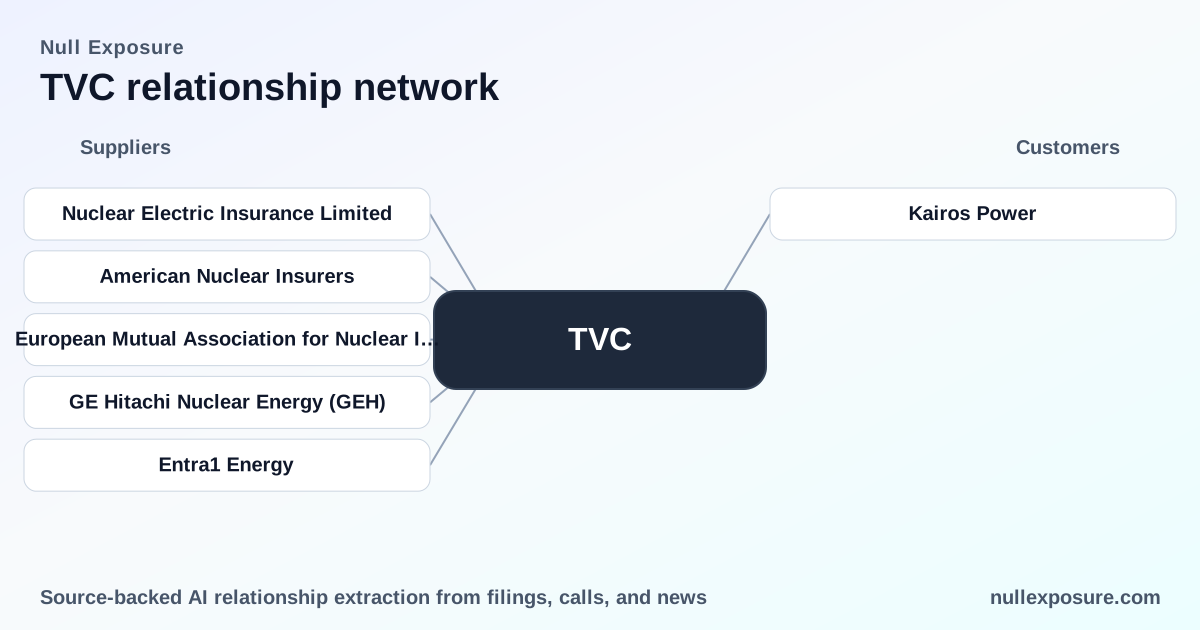
TVA (TVC) customer map: what investors need to know
Tennessee Valley Authority (traded here as the preferred TVC) is a wholesale power producer that monetizes by generating and selling electricity at scale to local public power companies (LPCs), directly served large loads, and federal agencies; its cashflow is driven by long-standing wholesale contracts and a geographically concentrated customer base across the Tennessee Valley. For income-focused investors, the preferred shares sit on top of a utility that produces recurring, contract-backed revenue dominated by its core wholesale business. Learn more about how we source and track customer relationships at https://nullexposure.com/.
Quick operational snapshot that matters to holders
TVA is a single-reportable-segment public power wholesaler whose financials reflect the generator-to-wholesaler model: $13.5 billion in electricity sales in 2025 and EBITDA around $5.16 billion, with roughly 90% of operating revenues coming from LPCs. TVA serves approximately 10 million end users through 153 LPCs and 62 directly served customers, concentrated across Tennessee and parts of six neighboring states. These factors create a business that is highly concentrated, regionally critical, and contractually anchored, which supports predictable cash flow but concentrates political and credit risk geographically.
Constraints that define TVA's customer economics
The company disclosures and reporting history show the structural constraints that underwrite TVA’s revenue profile and should guide investor diligence:
- Contracting posture: TVA’s primary relationships are long-term wholesale contracts; LPC agreements commonly include multi-year terms with automatic renewals and long (up to 20-year) termination notice periods, while the company also uses shorter-term arrangements when appropriate. These contract features produce durable revenue streams and reduce churn risk, but also create lock-in that can complicate rate reset dynamics.
- Counterparty mix: TVA’s customers are predominantly municipal/government and customer-owned cooperatives; it also sells directly to large commercial and industrial loads and federal agencies. This mix lowers commercial-credit volatility relative to pure merchant exposure, while increasing regulatory and political sensitivity.
- Geographic concentration: Operations and counterparties are concentrated in the Tennessee Valley (Tennessee, northern Alabama, northeastern Mississippi, parts of Georgia, North Carolina, Kentucky, and Virginia), exposing TVA to region-specific economic cycles, weather risk, and state-level policy shifts.
- Materiality and criticality: Revenues from LPCs accounted for approximately 90% of TVA’s total operating revenues for 2025, making these relationships critical to enterprise value and preferred-equity coverage.
- Commercial role and maturity: TVA functions primarily as a wholesaler/seller of electricity to LPCs and as a distributor/reseller via LPC networks; the company operates as a mature, single-segment utility where the generation, transmission, and sale of electricity are integrated.
These are company-level signals drawn from TVA’s FY2024–FY2025 reporting and governance disclosures.
Every named relationship in recent reporting and press — what each means for investors
Memphis Light, Gas & Water — local utility that enforces interconnection requirements
Memphis Light, Gas & Water is the local distributor that purchases TVA power for the Memphis area, and TVA’s recent transaction notes that xAI met requirements set by Memphis Light, Gas & Water before taking increased supply from TVA’s grid. This underscores that local utility approvals remain a gating factor for large incremental loads. (Knox News, Feb 12, 2026)
OKLO — advanced reactor developer exploring used fuel transfers
Oklo is evaluating opportunities to obtain used nuclear fuel from TVA’s seven reactors across its three nuclear plants, indicating nuclear-material and back-end fuel handling interactions between TVA and advanced reactor firms as TVA’s assets become inputs to emerging nuclear supply chains. (Oak Ridger, Feb 19, 2026)
Elon Musk’s xAI — rapidly growing large industrial load
TVA’s board voted to double the amount of power provided to Elon Musk’s xAI facility in Memphis, reflecting a direct large-load relationship with a high-growth computational customer that increases short- and medium-term revenue concentration in the Memphis footprint. (Knox News, Feb 12, 2026)
xAI (board approval detail) — formalized contract expansion and board-level sign-off
In a related board action, TVA’s directors unanimously approved a contract-level increase in xAI’s power entitlement, formalizing the utility’s commitment to a significant incremental industrial load and confirming management and board alignment on servicing large, non-traditional electricity consumers. (Knox News, Feb 12, 2026)
Kairos Power — R&D, licensing and engineering collaboration on advanced reactors
TVA is part of a consortium supporting Kairos Power’s advanced reactor development and, since May 2021, has provided engineering, operations, and licensing support to deploy a low-power demonstration reactor near the Clinch River site; this represents a strategic industrial partnership that positions TVA as an enabler for next-generation nuclear projects rather than simply a buyer or seller. (World Nuclear News, reporting on FY2024 activities)
How these relationships alter the risk/reward profile for TVC holders
- Revenue stability vs concentration risk: Long-term LPC contracts and that ~90% revenue concentration in LPCs produce stability of cash flow — the central credit driver for preferred claims — yet the concentration creates single-region political and economic exposure.
- Large-load optionality: Deals with xAI and similar large industrial customers increase upside to utilization and revenues, but they also elevate counterparty concentration and transmission planning risk; these customers can materially alter load shape and capital planning needs over short time horizons.
- Strategic nuclear engagements: Partnerships with firms like Kairos and Oklo reflect TVA’s operational role beyond pure generation, giving it potential upside from licensing/engineering fees and strategic positioning in advanced nuclear, but they also introduce R&D and regulatory complexities that are not core rate-base activities.
- Counterparty credit profile: The predominance of municipal/cooperative and federal counterparts reduces traditional commercial default risk but increases political and regulatory exposures that can affect rates and cash collection dynamics.
If you want a consolidated customer-risk scorecard and ongoing monitoring for these counterparties, we maintain an investor-facing hub of relationship intelligence and filings aggregation at https://nullexposure.com/.
Bottom line
For investors in TVC, the key strengths are contract durability, large-scale generation economics, and concentrated regional scale; the key risks are revenue concentration into LPCs, the political/regulatory sensitivity of government-owned counterparties, and increasing exposure to a small number of large industrial loads. These dynamics make TVA a classic regulated-wholesale utility investment where preferred equity benefits from predictable cash flow, while investors must monitor counterparty concentration and regional policy shifts closely.