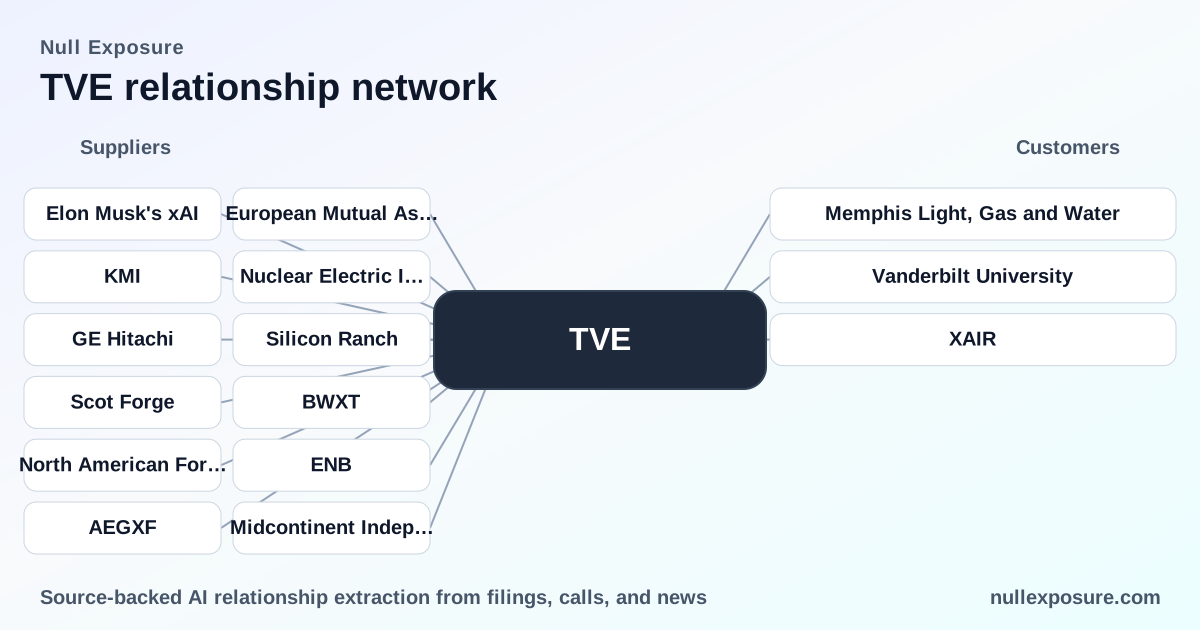
TVA’s customer book: wholesale scale, long-dated commitments, and a few headline clients to watch
Thesis: Tennessee Valley Authority (TVA) is a wholesale electricity wholesaler that monetizes by generating and selling power to local public utilities, federal agencies, and large direct customers across the Tennessee Valley; its economics are driven by long-term contract footprints, deep revenue concentration in local power companies (LPCs), and regulatory/political exposure that can instantly become credit-relevant. Investors should value TVA as a large, contract-driven utility with significant counterparty concentration and embedded policy risk.
If you want a structured view of TVA customer relationships and what they imply for credit and commercial risk, see the authoritative coverage on Null Exposure: https://nullexposure.com/.
How TVA actually gets paid — the basic business model that matters to investors
TVA operates as a wholesaler: it generates, transmits, and sells electricity to 153 local power company customers and a smaller set of directly served federal and industrial customers. Revenue is overwhelmingly derived from wholesale electricity sales, with LPCs responsible for roughly 90% of operating revenues in 2025 according to TVA disclosures. TVA locks much of this revenue profile with long-term partnership arrangements that create predictable cash flows but also concentrate counterparty and regional risk. These commercial dynamics are the primary lens for valuation and credit analysis.
The customer roster you need to read: headline relationships and what they imply
Below I list every customer relationship surfaced in the recent reporting and press coverage, with a plain-English takeaway and source note for each.
Nashville Electric Service (NES)
NES has an arrangement allowing it to source about 5% of its power from non-TVA solar under a contract with TVA, reflecting selective flexibility in renewable procurement while remaining a TVA wholesale customer. This was reported by WPLN in May 2026 addressing retail bill impacts and contract terms. (WPLN, May 2026)
Memphis Light, Gas and Water (MLGW)
TVA instructed local power companies, including MLGW, to shed load during the Memphis blackouts — an operational decision that the TVA CEO later defended as necessary to preserve system integrity. This episode underscores operational interdependence and the system-level control TVA exercises over local utilities. (Commercial Appeal, Dec 2022 / coverage cited in 2026)
Glasgow Electric Plant Board
Glasgow EPB is a direct TVA customer; local reporting on executive transitions notes TVA is the primary power supplier for the Board, linking governance attention at the municipal supplier level to TVA’s service delivery. This connection highlights TVA’s role as the wholesale backbone for small municipal utilities. (WCLU Radio, April 2026)
Vanderbilt University (project relationship via NES)
A utility-scale solar project in Tullahoma was developed in partnership with Nashville Electric Service and TVA to deliver a combined 125 MW of solar capacity for Metro Nashville and Vanderbilt University, demonstrating TVA’s participation in regional renewable builds alongside municipal partners. This was reported by The Tennessean in 2020 and remains relevant to TVA’s customer-facing renewable initiatives. (The Tennessean, Nov 2020)
xAI / XAIR (Elon Musk’s company drawing increased grid power)
TVA’s board voted to double the amount of power provided to Elon Musk’s AI company in Memphis, an action that drew public scrutiny and was covered extensively in national outlets; reporting links the board decision to political fallout and executive-level churn. These developments place large industrial customers that demand rapid power growth squarely in TVA’s governance and political risk profile. (Mother Jones, Feb 2026; USA Today, Mar 2026)
What the constraints tell investors about TVA’s operating posture
TVA’s documented contract and counterparty constraints are company-level signals that explain how revenue is earned and where risks concentrate.
-
Long-term, framework-heavy contracting is core to the model. TVA offers Partnership Agreements and LPC power contracts that effectively create 20-year termination notice structures and automatic renewals in many cases, which embed durable revenue streams and reduce short-term churn risk. TVA disclosures show that 97% of LPCs have signed 20-year Partnership Agreements and that 148 LPCs had signed the partnership by September 30, 2025.
-
Revenue concentration is material and critical. TVA reported that two LPCs accounted for 17% of operating revenues in both 2024 and 2025, and that LPC revenues comprised approximately 90% of total operating revenues in 2025. That concentration elevates counterparty credit and service continuity considerations for investors.
-
Counterparties are primarily government or not-for-profit municipal/cooperative entities. LPCs are municipalities or customer-owned cooperatives whose objective is public service rather than profit, which creates low-commercial-risk but high political/regulatory coupling.
-
Geography is tightly regional. TVA’s service territory covers most of Tennessee, parts of six neighboring states, and serves roughly 10 million people — a compact footprint that concentrates weather, economic, and regulatory risk.
-
Primary role is seller/wholesaler of a core product. TVA’s segmenting shows generation, transmission, and wholesale electricity sales as the operating core; the business is not diversified away from power supply.
-
Relationship stage is active and predominantly long-tenured. With wholesale power contracts in place for 153 LPCs and a high rate of long-term partnership signings, TVA’s customer book is active, deeply committed, and largely mature.
Together, these constraints paint a picture of a utility with predictable cash flows and a high dependency on local public entities and a narrow geography — a profile that supports high structural predictability but concentrates political, regulatory, and event-driven operational risk.
If you want a deeper analytical brief on TVA’s customer concentration and contract language, visit Null Exposure for the full suite of relationship analytics: https://nullexposure.com/.
Investment implications and the watchlist
-
Credit profile: Long-term, renewable contracts plus 90% revenue from LPCs support stable cash generation, but material revenue concentration in a few LPCs warrants active monitoring of local fiscal stress or retail rate politics.
-
Operational risk: System-level load-shedding decisions — as occurred during Memphis blackouts — show TVA’s ability to control local load and the resulting political fallout. Large industrial customers (for example xAI) that rapidly scale demand create governance risk and headline-driven volatility.
-
Regulatory and political risk: Partnership Agreements include protections and termination triggers (such as rate-increase limits over rolling fiscal periods), which inserts political/regulatory variables directly into commercial stability.
-
Growth and renewables: TVA participates in municipal-scale solar projects with LPCs and institutional customers, providing upside to contracted green-power revenue but also tying TVA to municipal procurement timelines and community politics.
Bottom line
TVA is a wholesale power utility whose value derives from long-dated contractual relationships with municipal and federal counterparties, regional scale, and dominant revenue share from LPCs. Those attributes create a stable earnings base but concentrate political, event-driven, and counterparty concentration risk. For investors, the trade-off is classic: reliable cash flows with concentrated exposures that require active monitoring of major LPC customers, large industrial users, and regulatory developments.
For granular relationship profiles and contract-level signals that inform credit and M&A decisions, consult the detailed dashboards at Null Exposure: https://nullexposure.com/.