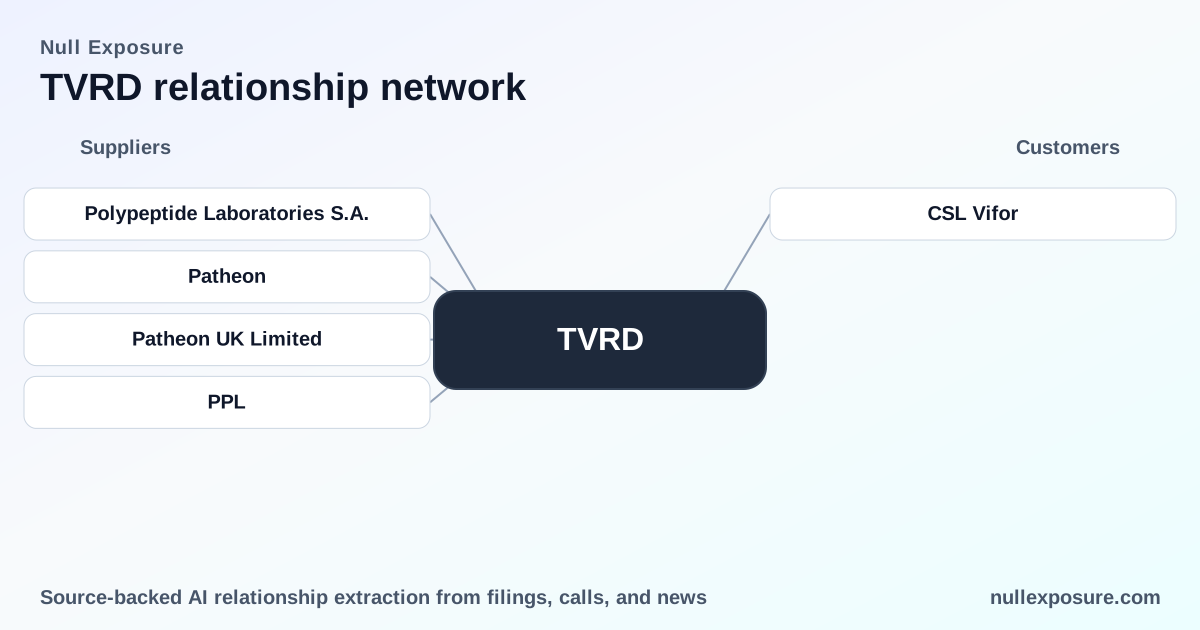
Tvardi Therapeutics (TVRD): Customer relationships driving a small but mission-critical commercial franchise
Tvardi monetizes its KORSUVA (difelikefalin) franchise primarily through regional licensing and commercial-supply arrangements: the company out-licenses development and territorial commercialization rights to partners, records commercial supply revenue when product is sold to those partners, and participates in profit-share and milestone economics tied to third‑party commercialization. For investors, the core investment thesis is straightforward: Tvardi’s near-term cash flows and valuation are driven by partner economics around KORSUVA, not by direct sales, which concentrates commercial risk in a small set of counterparties while preserving upside via royalties and profit splits.
For a mapped view of counterparties and commercial contours, see the company customer detail at https://nullexposure.com/ — the platform aggregates the same filings and transaction notices that inform this note.
What the record shows: each customer relationship documented in the source set
-
CSL Vifor — 10‑K commercial supply sales. Tvardi’s FY2024 10‑K records sales of KORSUVA injection to CSL Vifor of $640, $5,843 and $10,223 included within commercial supply revenue for the years ended December 31, 2024, 2023 and 2022, reflecting the partner-driven revenue recognition path the company uses for U.S. flows. According to Tvardi’s FY2024 10‑K filing, these line items are captured as commercial supply revenue.
-
CSL Vifor — asset purchase agreement referenced in market coverage. A market report covering FY2026 activity states that, under an asset purchase agreement, Cara agreed to sell to CSL Vifor certain assets and rights to the development, manufacture and commercialization of Korsuva/Kapruvia for a purchase price of $900,000, signaling consolidation of product rights under CSL Vifor in a corporate transaction context. This detail was reported in an Intellectia news summary (FY2026).
-
Vifor Fresenius Medical Care Renal Pharma — concurrent asset purchase notice. A contemporaneous news item covering the same FY2026 transaction notes that Cara entered into an asset purchase agreement with Vifor Fresenius Medical Care Renal Pharma (a joint company of Fresenius Medical Care and CSL Vifor) concurrent with a merger agreement with Tvardi, indicating linked transactions that reallocate commercialization and development rights among the Vifor/Fresenius group. The reporting source is Intellectia’s FY2026 news feed.
How these relationships define Tvardi’s operating model
Tvardi’s commercial posture is partner-first and license-centric. The company consistently grants exclusive, regionally carved licenses rather than building a broad internal commercial organization. The filing evidence documents a U.S. license to Vifor (Vifor Pharma) and a complementary global license to VFMCRP (Fresenius-related) for territories outside the U.S./Japan/South Korea, which creates a revenue model that is dependent on a small set of large strategic partners.
-
Contracting posture: The company’s contracts are predominantly licensing agreements and long‑term commercial supply relationships that assign commercialization responsibilities to partners while reserving royalty/profit-share economics for Tvardi. The October 2020 and May 2018 license agreements in company filings demonstrate this structure.
-
Geographic segmentation: Tvardi’s go‑to‑market is geographically segmented — the U.S. rights are licensed to Vifor, while other territories (with exclusions) fall to the Fresenius‑linked licensee — creating distinct commercial corridors rather than a single global operating model.
-
Role dynamics: Tvardi operates both as licensor (granting commercialization rights to partners) and as a seller of supply to those licensees under commercial‑supply and profit‑sharing arrangements; counterparties in the Vifor/Fresenius group act as both licensee and principal seller into end markets in practice, per the company filing language.
-
Maturity and criticality: KORSUVA is the revenue-bearing asset in play; commercial launches since April 2022 have moved the program from development‑only risk to commercial execution risk, with partner payments and asset transfers reflecting an active, post‑launch commercial phase.
For a detailed mapping of counterparties and licensing contours, visit https://nullexposure.com/ to view the consolidated relationship view and filings.
Investor implications and risk profile
-
Concentration risk is material. A small number of strategic partners — principally CSL Vifor and the Fresenius‑linked entity — account for the commercialization and immediate revenue streams tied to KORSUVA, concentrating counterparty and execution risk.
-
Revenue quality is partner-dependent. Tvardi recognizes commercial supply revenue when product moves to partners and participates in profit splits; hence cash flow durability depends on partner sales execution, regulatory maintenance of approvals and any asset transfers or restructurings among partners.
-
Transactions can reallocate economics quickly. The cited asset purchase activity involving Cara, CSL Vifor and Vifor Fresenius Medical Care Renal Pharma demonstrates that third‑party M&A and asset purchases can shift rights and revenue streams, creating event risk that is outside Tvardi’s direct control.
-
Balance sheet and ownership signals matter. Tvardi’s small market capitalization and negative operating metrics indicate a development‑to‑early‑commercial biotech profile; partner payments recorded in filings provide episodic inflows but do not eliminate the need for external funding or successful partner commercialization.
Relationship takeaways for operators and research teams
-
For commercial teams: CSL Vifor functions as the principal U.S. commercialization partner, and any change in that arrangement materially alters U.S. distribution and royalties; contract language in the 10‑K ties Tvardi’s commercial revenue recognition to sales into CSL Vifor. (Tvardi FY2024 10‑K)
-
For strategic diligence: the FY2026 asset purchase notices reported by market sources show the Vifor/Fresenius group consolidating rights, an outcome that demands monitoring for how purchase price and liability allocations change Tvardi’s royalty or profit‑share receipts. (Intellectia FY2026)
-
For risk management: expect earnings and cash receipts to be lumpy and tied to partner milestones, transfers, and product flow, not to broad-based direct sales; scenarios that alter partner portfolios (M&A, insolvency, product repossession) are first‑order valuation risks.
Bottom line
Tvardi’s commercial value is concentrated in a small number of licensing and supply relationships that place execution responsibility with large strategic partners while preserving upside through royalties, profit splits and occasional asset‑level transactions. Investors should treat partner stability and transaction activity in the Vifor/Fresenius ecosystem as the principal driver of near‑term cash flows and valuation outcomes.
For a full map of Tvardi’s counterparties and sourced filing excerpts, visit Null Exposure for the consolidated relationship view: https://nullexposure.com/.