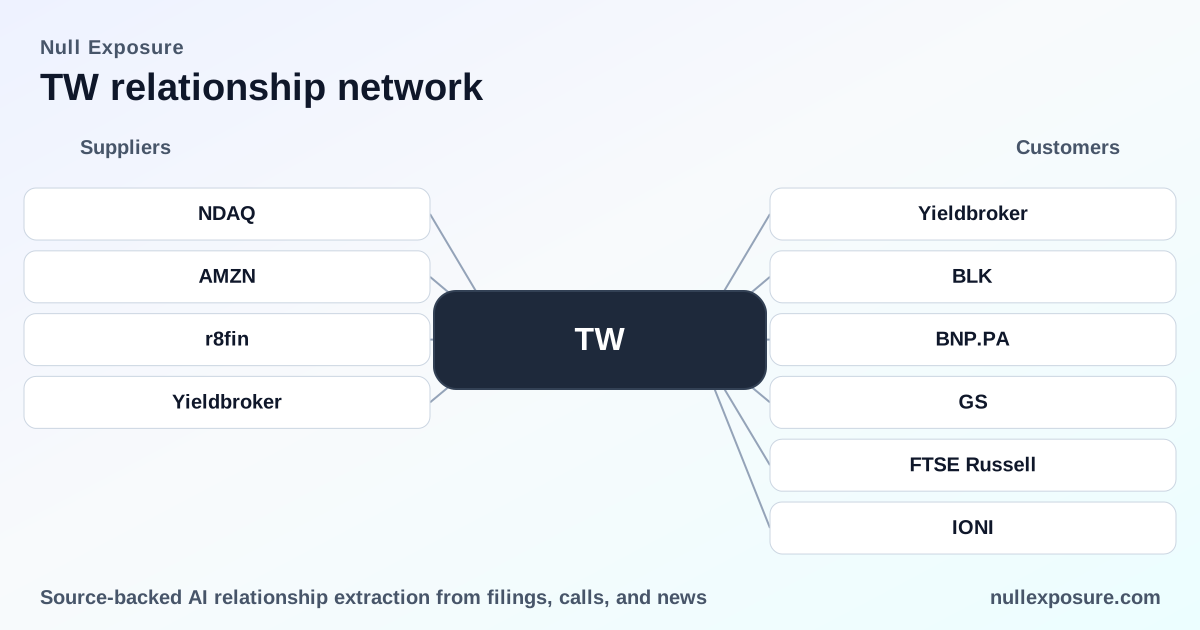
Tradeweb (TW): Client Footprint and Commercial Levers investors should price in
Tradeweb operates electronic marketplaces for fixed income, derivatives and ETFs, monetizing through a mix of subscription and license fees, plus variable transaction-based commissions. The business combines durable, large-dealer relationships that supply liquidity with a broad base of liquidity takers who use the platform on a spot basis, producing a revenue mix that is simultaneously recurring and volume-sensitive. For relationship-level diligence and modeling guidance, see https://nullexposure.com/.
How Tradeweb gets paid — clear, diversified monetization
Tradeweb’s revenue model is straightforward and investor-friendly:
- Subscription and fixed licensing fees for platform access and market data (recognized monthly).
- Usage-based transaction fees and commissions that scale with traded volume, product mix and trade size.
- Professional services and post-trade analytics that supplement platform revenue.
Key takeaway: the combination of fixed access fees and variable transaction economics gives Tradeweb predictable baseline revenue while preserving upside exposure to market volumes and product expansion.
Corporate operating posture and what it means for counterparties
Tradeweb’s disclosures and public reporting establish several company-level signals that shape counterparty risk and commercial durability. Long-term licensing relationships exist alongside spot, transaction-based users: dealers and large asset managers often maintain stable, strategic integrations, while many liquidity-taking clients transact on a transaction-by-transaction basis. The firm also operates globally—North America, EMEA and APAC—and pursues both infrastructure investments and services expansion to deepen its market share.
- Contracting mix: a portfolio approach — long-term licenses and subscriptions for institutional counterparties, plus spot/usage relationships for high-frequency and ad-hoc market participants. This structure reduces churn risk while leaving the business exposed to cyclical volume swings.
- Concentration and criticality: Tradeweb discloses that certain dealer clients generate a significant share of trading volume, making these relationships commercially material and operationally critical to platform liquidity.
- Geographic reach and maturity: global footprint across 85+ countries supports product expansion (ETF RFQ, fixed income benchmarks, regional bond platforms) and helps diversify against localized market shocks.
For further relationship-level tracking and analytics, explore practical tools at https://nullexposure.com/.
Customer relationships to price into a thesis
Below I summarize every customer relationship captured in the public results and provide a compact source for each item.
Yieldbroker — Australian network integration and user onboarding
Tradeweb completed the strategic acquisition of Yieldbroker, enabling expanded local client access in Australia and onboarding significant local users to Tradeweb’s global interest rate swaps platform, according to Tradeweb’s FY2025 Form 10‑K. The combination accelerates Tradeweb’s APAC footprint and gives direct distribution of global products into an Australian client base. Source: Tradeweb 2025 Form 10‑K (FY2025).
Yieldbroker (press coverage) — transaction close and strategic access
News coverage from Finance Magnates reported that Tradeweb completed the A$125 million acquisition of Yieldbroker in 2023, closing the deal before year-end and enabling mutual access to each company’s offerings. This press confirmation aligns with the 10‑K description of expanded regional capabilities. Source: Finance Magnates coverage of the Yieldbroker transaction (reported 2023, referenced 2026).
BlackRock — anchor counterpart on new regional market venues
Finance Magnates reported that BlackRock was a counterparty in the first trades executed on Tradeweb’s Saudi electronic bond platform, positioning BlackRock as an anchor buy-side participant in new regional venues. Having a global asset manager such as BlackRock execute inaugural trades provides commercial validation for Tradeweb’s local market expansion strategy. Source: Finance Magnates article on Tradeweb’s Saudi electronic bond platform (March 2026).
BLK (duplicate entry: BlackRock) — same market role, same source
The duplicate listing for BLK references the same Tradeweb-facilitated Saudi bond trades involving BlackRock, confirming the buy-side firm's active participation in platform launches. Source: Finance Magnates (March 2026).
Goldman Sachs — dealer participation in inaugural platform liquidity
Finance Magnates noted a trade on Tradeweb’s Saudi bond platform between BlackRock and Goldman Sachs, highlighting Goldman Sachs’ role as a key dealer counterparty providing market liquidity for new sovereign bond trading venues. Dealer participation from global banks underscores Tradeweb’s strategy of onboarding major liquidity providers to seed new markets. Source: Finance Magnates article on Saudi electronic bond platform (March 2026).
BNP Paribas — buy-side / dealer match in first trades
BNP Paribas is identified in the same Finance Magnates coverage as a counterparty in early Saudi bond platform transactions, reflecting a cross-border dealer/buy-side mix critical for initial market depth. The presence of BNP Paribas alongside other global institutions supports Tradeweb’s ability to attract international liquidity into regional benchmarks. Source: Finance Magnates (March 2026).
FTSE Russell — benchmark and pricing partnerships
Finance Magnates reported that Tradeweb and FTSE Russell expanded collaboration to include US Treasury closing prices, adding to existing UK Gilts and European government bond benchmarks that incorporate Tradeweb platform data. This arrangement deepens Tradeweb’s role as a pricing and market-data contributor to index providers and underscores its licensing and market-data revenue pathways. Source: Finance Magnates article on FTSE Russell partnership (March 2026).
ION / IONI — distribution and workflow integration for ETF RFQ
Futunn News reported that ION integrated Tradeweb’s ETF RFQ functionality into its own systems, giving ION clients access to enhanced RFQ workflow, data insights and best-execution capability. This is a distribution and channel partnership that increases Tradeweb’s addressable flow for ETF trading and embeds its workflow within third-party trading ecosystems. Source: Futunn News coverage of ION integration (March 2026).
Investment implications and risk framing
Tradeweb’s dual revenue engine—fixed subscriptions/licensing and variable transaction fees—creates both stability and volume sensitivity. The firm’s customer relationships reveal a clear playbook: acquire local platforms (Yieldbroker) to expand distribution, partner with benchmarks providers (FTSE Russell) to monetize data, and rely on major dealers and asset managers (Goldman, BNP, BlackRock) to seed liquidity in new venues.
Risks investors must price:
- Volume cyclicality: spot liquidity takers generate a significant share of activity; subdued markets compress variable revenue.
- Counterparty concentration: a handful of dealers account for disproportionate trading volumes, elevating counterparty and revenue concentration risk.
- Licensing renewals and data distribution: multi-year licensing contracts (for market data) are durable but require renewal and competitive defense.
Bottom line for allocators
Tradeweb’s commercial architecture is scalable and resilient, driven by platform effects and high-quality counterparties, but returns are coupled to trading volumes and a small set of material dealer relationships. For deeper, relationship-specific analytics and to monitor changes in counterparty concentration over time, visit https://nullexposure.com/.
Actionable takeaway: model Tradeweb with a core recurring revenue base and a cyclical volume overlay, and monitor top-dealer share and regional platform rollouts (APAC, Saudi bond market) as primary drivers of upside or downside.