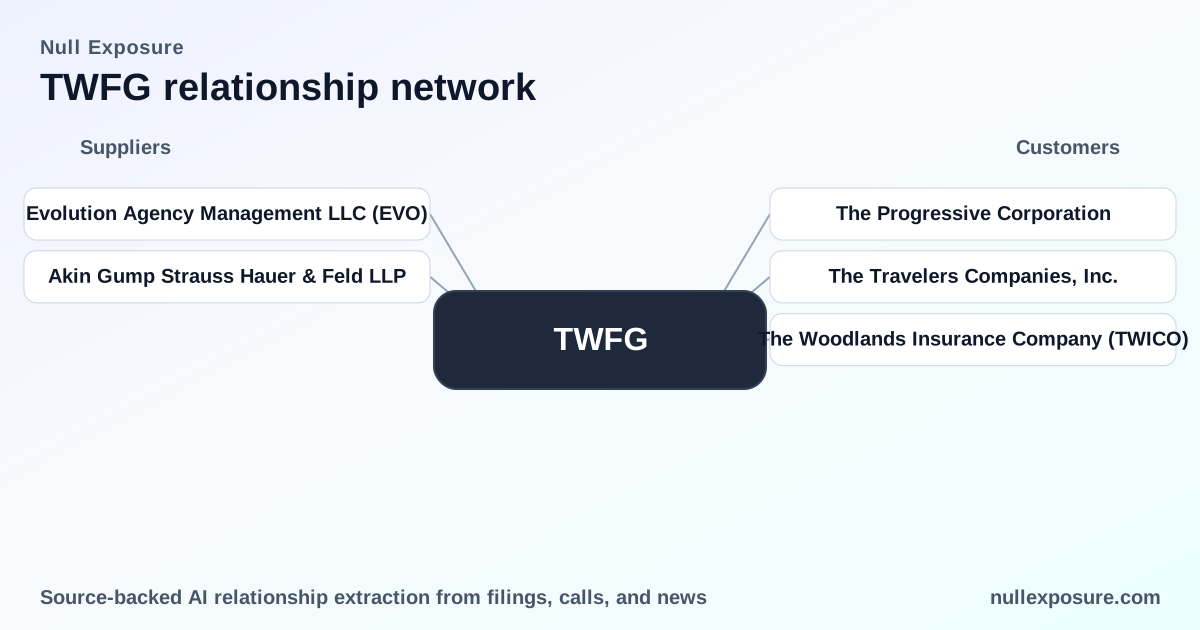
TWFG customer map: concentrated carrier relationships, commission-driven economics
TWFG is an independent insurance distribution platform that monetizes primarily through commission income on policies placed with carriers, supplemented by licensing fees for its proprietary applications and occasional fee income from affiliated carriers. The firm earns the bulk of its revenue from short-duration agency relationships with more than 300 carriers across the United States, which creates a highly commission-dependent, geographically diversified distribution business with both concentration and counterparty termination risk. For a concise investor briefing on counterparties and contract posture, see more at https://nullexposure.com/.
Why carriers — not policyholders — define TWFG's economics
TWFG's operating model is straightforward: the company places business with insurance carriers and is paid commissions and fees for policy placement and servicing. According to TWFG’s 2024 Form 10‑K, commission income comprised roughly 90% of total revenues in 2024 and 92% in 2023, underlining that carrier relationships, not direct premium retention, drive cash flows and margins. The company supplements commissions with license fees for proprietary applications, which are structured as a mix of fixed monthly charges and usage-based fees; an amendment noted in filings converted at least one customer from usage fees to a capped fixed monthly fee.
This composition produces a business that scales through distribution reach and carrier access, but is exposed to contract churn and commission rate pressure if carriers alter agency economics.
Relationship-by-relationship: the three carriers called out in filings
The Progressive Corporation
TWFG reported that The Progressive Corporation accounted for 13% of TWFG’s total revenues for the year ended December 31, 2024, up from 11% in 2023, making Progressive a material revenue source. According to TWFG’s 2024 Form 10‑K, Progressive was a top carrier customer in FY2024 and therefore a significant counterparty for distribution economics.
The Travelers Companies, Inc.
TWFG disclosed that The Travelers Companies accounted for 10% of total revenues for the year ended December 31, 2023, positioning Travelers among TWFG’s top carrier relationships. The 2024 Form 10‑K lists Travelers alongside Progressive as a meaningful contributor to historical revenue.
The Woodlands Insurance Company (TWICO)
TWFG provides more granular transactional detail with a captive/affiliate-like carrier: TWICO generated commissions of $9.6 million in 2024 (up from $4.2 million in 2023) and fee income of $2.7 million in 2024 (up from $1.6 million in 2023), as reported in the company’s FY2024 10‑K. This shows TWFG’s ability to earn both commission and fee streams from insurance entities that are operationally close to the platform.
What the filings and constraints reveal about operating posture
The excerpts and constraint signals in TWFG’s filings deliver a clear profile of the business model beyond headline relationships:
- Contracting posture — short-term and non-exclusive for carrier agreements. TWFG contracts with carriers on agency agreements that typically govern compensation and authority but are often terminable unilaterally and tied to the initial policy term. This creates persistent renewal and retention risk for commission streams.
- Hybrid monetization on software: License fees for proprietary applications exist and are structured both as fixed monthly subscription arrangements and usage-based charges, with at least one amendment converting usage fees into a capped fixed monthly fee. This indicates a maturation of recurring revenue practices but also implies mixed pricing sensitivity from customers.
- High revenue concentration and criticality: Carrier commissions are material to TWFG’s top-line, with commission income comprising about 90% of revenue in 2024. That makes top carrier partners strategically critical to earnings.
- Distributor role at scale: TWFG operates as a national retail distribution platform—an active distributor—licensed in all 50 states with physical presence in 42 states plus D.C., representing a broad but carrier-dependent footprint.
- Segment mix: The firm is primarily a distribution business with a growing software/license element; the latter is meaningful for operating leverage but not currently the dominant revenue driver.
These are company-level signals drawn from TWFG’s FY2024 disclosures and constraint excerpts in the public filing.
Investment implications: concentrated, recurring commissions with renewal risk
Investors should weigh a set of clear trade-offs:
- Positive — stable distribution economics and scale: TWFG benefits from an extensive carrier panel (300+ carriers) and national licensing, which supports top-line growth and cross-selling for commercial and personal lines. The company reported Revenue TTM of roughly $248.5 million and positive operating margin (operating margin TTM of 21.1%), reflecting scalable distribution economics.
- Risk — concentration and counterparty termination risk: A single carrier (Progressive) accounted for 13% of revenue in 2024, and a small set of carriers historically contribute double‑digit percentages of revenue; combined with the short-term, non-exclusive nature of agency agreements, there is clear counterparty concentration and churn exposure.
- Software adds diversification but limited scale: Licensing revenues are structured via subscription and usage models, which diversify revenue streams but have not displaced commission dominance; pricing shifts (e.g., converting usage to capped fixed fees) can constrain margin upside from software.
- Affiliates can skew economics: The TWICO relationship demonstrates TWFG’s ability to extract higher fee and commission dollars from affiliated carriers, a useful lever but one investors should treat as potentially non-repeatable at the same cadence across the carrier base.
- Governance and liquidity signals: Institutional ownership is high (~86%), insiders ~13.7%, and the company trades on NASDAQ with a trailing P/E around 35.9 and forward P/E near 20.9, implying the market prices growth expectations alongside the distribution risk profile.
Tactical takeaways for analysts and operators
- Underwrite renewal risk explicitly when modeling revenue: commissions are paid largely at policy inception and renewals are the key driver of sustainable revenue.
- Stress-test concentration: model scenarios where top carriers reduce placements by 10–30% to observe EBITDA and free cash flow sensitivity.
- Monitor license-fee trajectory as an indicator of product maturity: upward traction in fixed monthly licensing would improve recurring revenue visibility and reduce reliance on commission seasonality.
For a focused, interactive view of TWFG’s counterparties and relationship metrics, visit https://nullexposure.com/.
Bottom line
TWFG’s value proposition is distribution scale and carrier access, and its earnings profile is materially driven by commissions from a concentrated set of carriers. That combination produces attractive operating leverage when carrier placement trends are favorable, but also elevated counterparty and renewal risk that should be a first-order input to any investment or operational diligence.