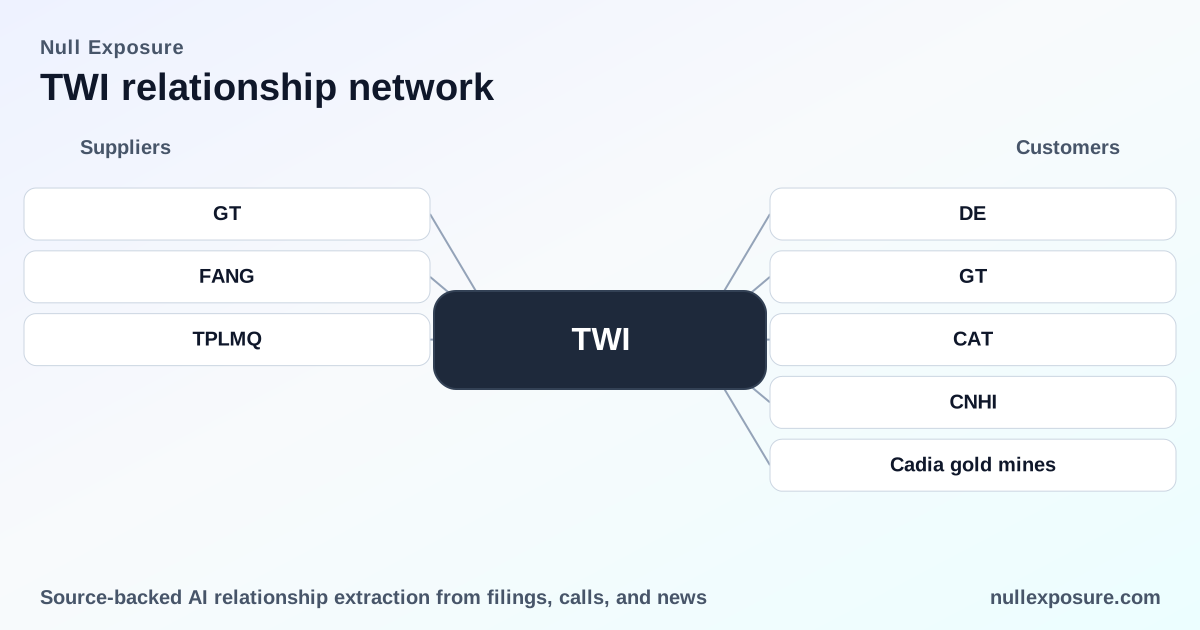
Titan International (TWI): Customer Map and Commercial Levers for Investors
Titan International manufactures wheels, tires, and undercarriage systems for off-road equipment and monetizes primarily through OEM contracts, aftermarket distribution, and branded tire sales (including licenses and manufacturing arrangements under Goodyear Farm Tire, Titan Tire, Carlstar and Voltyre‑Prom). Revenue is driven by large equipment OEMs and branded channel sales, with meaningful customer concentration and broad geographic coverage across North America, EMEA, LATAM and APAC. For deeper relationship signals and source tracing visit https://nullexposure.com/.
Why customers define Titan's economics
Titan’s go‑to‑market blends direct OEM supply with aftermarket distribution and branded manufacturing agreements. That mix produces a few operational characteristics investors should treat as structural rather than transitory:
- Customer concentration is real — Titan discloses multi‑percent exposures to individual OEMs that materially influence consolidated sales.
- Global footprint cushions cyclicality but increases geopolitical and tariff exposure — Titan reports significant net sales across NA, EMEA, LATAM and APAC.
- Contracting posture is a mix of supplier and co‑developer — Titan supplies finished wheels and undercarriage, manufactures branded tires under partner arrangements, and sells through independent distributors and dealers.
- Relationships are mature — the company notes long‑standing customer ties and repeated purchases over many years, which reduces customer acquisition risk but raises bargaining power and renewal sensitivity.
These characteristics drive the company’s margin and cash‑flow profile: sales volume is linked to OEM production schedules and agricultural/construction cycle dynamics, while branded and aftermarket channels offer margin diversification.
Direct OEMs that move the needle
Deere & Company — material OEM exposure (FY2024)
Deere & Company accounted for 11% of Titan’s consolidated net sales in FY2024, down slightly from prior years where combined segment exposures reached as high as 15%, making Deere a clearly material customer for equipment components and wheels. This concentration is disclosed in Titan’s FY2024 Form 10‑K. (FY2024 10‑K)
Caterpillar — tariff and supply‑chain implications (FY2026 reporting)
Caterpillar is cited alongside Deere in recent investor calls and earnings transcripts as a major OEM customer whose public tariff estimates and production guidance influence Titan’s planning and margin outlook. The point was raised in a Q4 2025 earnings call transcript reported in early 2026. (Q4‑2025 earnings transcript, reported FY2026)
Brand partners and distribution relationships
Goodyear / Goodyear Farm Tire — contract manufacturing and co‑branding (FY2022–FY2026)
Titan has been reported to manufacture ag tires under the Goodyear Farm Tire brand for Europe and to have other manufacturing relationships with Goodyear, including earthmover wheels production; those arrangements extend Titan’s branded tire footprint and provide a mix of OEM and branded revenue. (RubberNews, FY2022; Birmingham Mail, FY2023; industry coverage FY2026)
Carlstar — branded product channel presence (FY2026)
Titan’s public investor materials note it manufactures and sells products under the Carlstar brand among others, indicating a multi‑brand strategy that broadens go‑to‑market channels beyond pure OEM supply. (Investor coverage and company commentary, FY2026)
Voltyre‑Prom Tire — branded manufacturing / channel exposure (FY2026)
Voltyre‑Prom appears in Titan’s brand portfolio reporting, signaling an international tire brand relationship that supports sales in select markets and contributes to Titan’s product diversity. (Investor coverage FY2026)
New Holland (CNHI) — product catalog inclusion (FY2026)
New Holland has begun offering Titan’s Low Sidewall Technology tractor configurations, demonstrating how Titan’s product innovations get adopted by major agricultural OEMs and flow into OEM product offerings. (Company news reporting via ADVFN, FY2026)
Industrial end‑users and specialty projects
Cadia gold mines — end‑user deployment (FY2023)
Titan’s wheels are specified for heavy applications such as large mining operations, with local reporting noting use at Australia’s Cadia gold mines and at major ports, highlighting the company’s exposure to non‑OEM heavy industrial buyers as part of its end‑market mix. (Birmingham Mail, FY2023)
Constraints and what they imply for operations and risk
The relationship signals and Titan’s filings produce consistent company‑level constraints investors should internalize when modeling revenue and downside:
- Large‑enterprise counterparties dominate sales: Titan explicitly references longstanding relationships with global OEM leaders, so channel risk is concentrated—loss or order reduction from a single large OEM would be material. (Company filing evidence)
- Geographic dispersion is broad: disclosures show substantial net sales across North America, EMEA, LATAM and APAC, which reduces single‑market cyclicality but increases exposure to trade policy, tariffs, and FX volatility. (Regional net sales reporting)
- Role diversity (seller + distributor): Titan sells directly to OEMs and to aftermarket distributors and dealers, so contracting dynamics vary by buyer segment—OEM deals are negotiated supplier contracts, aftermarket flows depend on dealer inventory cycles. (Company commercial description)
- Mature relationships dominate: long‑standing purchases indicate low churn but high renewal and pricing sensitivity, creating operational stability together with leverage risk on pricing.
Together, these signals support a valuation view that prizes order visibility from OEMs while discounting for concentration and trade‑policy volatility. For a structured view of how these relationships map to credit and revenue scenarios, visit https://nullexposure.com/ for additional signal layers.
Investment implications: what matters to risk and upside
- Top‑customer exposure is the primary downside vector — Deere’s multi‑percent share and public OEM guidance (including tariffs raised in recent public commentary) create a path to abrupt revenue variation.
- Branded manufacturing provides margin optionality — agreements to manufacture under Goodyear and other brands diversify revenue and can improve mix in stable cycles.
- Global distribution offsets but complicates — presence in NA, EMEA, LATAM and APAC smooths regional recessions but raises tariff and logistics sensitivity that can compress margins episodically.
- Mature OEM relationships reduce churn risk but increase bargaining power pressure — durable demand is balanced by the OEMs’ negotiating leverage at contract renewal.
Bottom line for investors
Titan’s business is fundamentally an OEM‑and‑brands industrial supplier: revenue is sensitive to a handful of large equipment manufacturers but cushioned by branded and aftermarket channels and an international footprint. Monitor OEM order books (Deere and Caterpillar), tariff and trade developments, and branded manufacturing rollouts under Goodyear/Carlstar/Voltyre‑Prom for the clearest signals to near‑term revenue and margin inflection. For deeper relationship analytics and periodic updates on these counterparties, visit https://nullexposure.com/.
Key takeaway: Titan’s upside is tied to cyclical recovery in ag/construction equipment and successful expansion of branded manufacturing; its principal risk is top‑customer concentration and trade‑policy volatility.