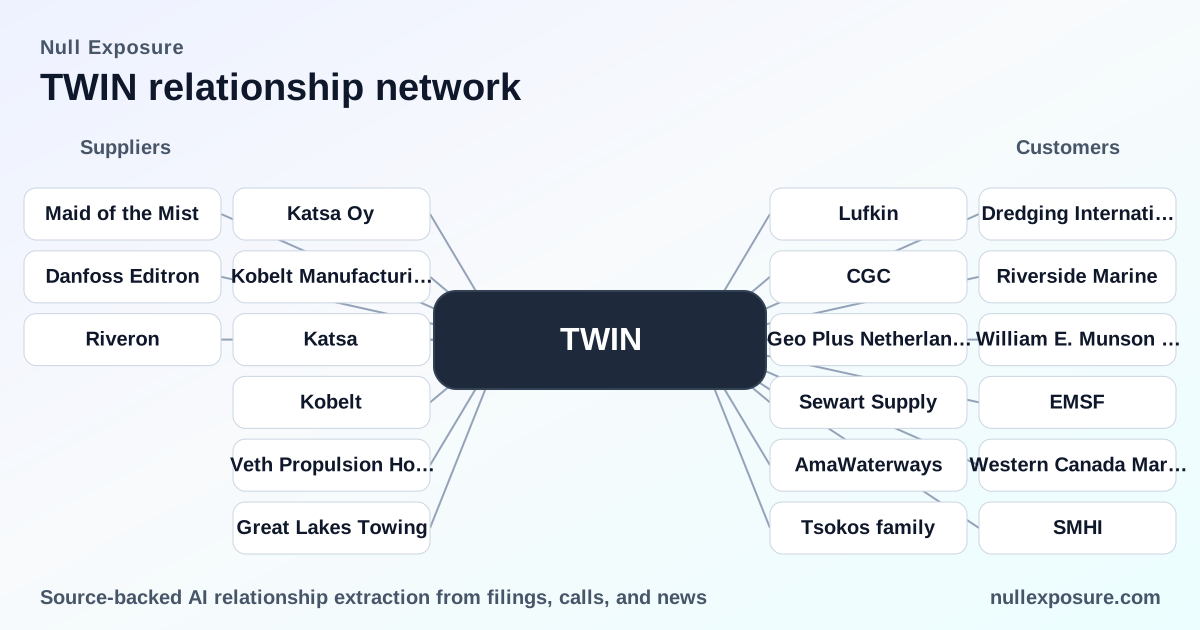
Twin Disc (TWIN): Customer relationships that underwrite a durable marine and off‑highway franchise
Twin Disc designs and manufactures power‑transmission equipment — marine gearboxes, propeller systems, azimuth drives and off‑highway transmissions — and monetizes through new equipment sales, a global distributor network and aftermarket spare parts and service. The company's revenue mix is geographically diversified and skewed toward recurring aftermarket demand, with a distributor channel that amplifies reach into commercial, military and energy end markets. For investors, the critical questions are concentration risk, the role of distributors in revenue realization, and how geopolitical and regional trends steer demand. Learn more about the coverage that informed this note at https://nullexposure.com/.
How Twin Disc’s customer footprint shapes its cash flows
Twin Disc operates as a component supplier with moderate customer concentration and high geographic diversity. Company filings show sales outside the U.S. represented roughly 73% of consolidated net sales in FY2025, with Europe accounting for about 41%, Asia Pacific about 22%, and North America roughly 27%. The top ten customers together represented ~35% of sales in FY2025, and no single customer exceeded 10% of consolidated revenue — a profile that delivers both scale benefits and multi‑customer exposure without single‑counterparty dominance.
The business model is balanced between OEM and aftermarket economics. Sales flow through a mixed go‑to‑market: a direct force for major accounts and a distributor network that drives breadth and local service. Procurement dynamics therefore vary: government and military contracts are part of the end‑market mix, increasing contract complexity and delivery lead times, while commercial marine and energy customers generate steadier aftermarket demand.
Key operating constraints to watch
- Contracting posture: Mixed direct and distributor sales translate to lower single‑customer negotiation leverage but add dependency on channel partners for market penetration.
- Concentration: Top‑10 customer concentration is material enough to influence revenue cycles, but the absence of any >10% customer reduces acute counterparty risk.
- Criticality: Twin Disc products are mission‑critical on vessels and heavy equipment, supporting durable aftermarket spend and service margins.
- Maturity: End markets include mature commercial marine segments and cyclical energy/off‑highway markets, creating a revenue profile that is partly defensive (aftermarket) and partly cyclical (new equipment).
For deeper company relationship intelligence, see our research hub at https://nullexposure.com/.
The relationship ledger — line‑by‑line customer references and sources
Below are every customer mention surfaced in the review set, each summarized in plain English with the cited source.
-
Lufkin: Twin Disc reported shipments to Lufkin of approximately $4.1 million in Q4 FY2025, up from a $3.1 million run rate, indicating a near‑term lift in marine/off‑highway equipment demand tied to this account. Source: Twin Disc Q4 FY2025 earnings call (March 2026).
-
CGC: CGC is cited among target operators in a Veth Propulsion market review, implying Twin Disc components are relevant to dredging and cruise vessel operators in shared supply chains. Source: BairdMaritime coverage of Veth Propulsion, fiscal context FY2021 (https://www.bairdmaritime.com/gear/equipment/engines-propulsion-systems/gear-veth-propulsion-identifies-opportunities-in-pacific-maritime-market).
-
Sewart Supply: Sewart Supply acted as a Twin Disc distributor supplying QuickShift marine transmissions to Seacor Marine, illustrating Twin Disc’s reliance on local distributors to access offshore service craft OEMs. Source: MarineLink article on Seacor crewboats, FY2018 (https://www.marinelink.com/news/crewboats-seacors-equips436323).
-
Geo Plus Netherlands: The Geo Ranger survey vessel is referenced for fitted Veth thrusters in the same industry article, marking opportunities where Twin Disc‑class drivetrain components sit within integrated propulsion packages. Source: BairdMaritime, FY2021 (https://www.bairdmaritime.com/gear/equipment/engines-propulsion-systems/gear-veth-propulsion-identifies-opportunities-in-pacific-maritime-market).
-
AmaWaterways: Vessel outfitting examples cite Veth propulsion on the AmaMagna, underscoring the cruise and river cruise channels where Twin Disc products compete inside larger propulsion systems. Source: BairdMaritime, FY2021 (https://www.bairdmaritime.com/gear/equipment/engines-propulsion-systems/gear-veth-propulsion-identifies-opportunities-in-pacific-maritime-market).
-
Tsokos family: A ceremonial delivery of a thruster to the Tsokos family in Greece is recorded in industry press, showing the bespoke, relationship‑driven nature of certain marine deliveries where Twin Disc components can play a role in final outfitting. Source: Waterways Journal coverage of Veth’s 4,000th thruster, FY2019 (https://www.waterwaysjournal.net/2019/07/22/veth-propulsion-delivers-4000th-thruster/).
-
Dredging International Australia: Mentioned alongside other dredging operators, this account signals Twin Disc exposure into the dredging segment through propulsion and transmission suppliers. Source: BairdMaritime, FY2021 (https://www.bairdmaritime.com/gear/equipment/engines-propulsion-systems/gear-veth-propulsion-identifies-opportunities-in-pacific-maritime-market).
-
Riverside Marine: Listed among cruise and dredging operators in industry reporting, Riverside Marine represents commercial shipowners where Twin Disc components could be specified via integrators. Source: BairdMaritime, FY2021 (https://www.bairdmaritime.com/gear/equipment/engines-propulsion-systems/gear-veth-propulsion-identifies-opportunities-in-pacific-maritime-market).
-
William E. Munson Company: The builder specified Scania engines paired with Twin Disc 5095 marine gearboxes for oil‑spill response landing crafts, highlighting OEM relationships where Twin Disc gearboxes are OEM‑specified through distributors. Source: MarineLink article on Canada’s oil spill response boats, FY2021 (https://www.marinelink.com/news/canadas-new-oil-spill-response-boats-490424).
-
Ems: Industry reporting notes Veth refits on the ferry Münsterland with electric contra‑rotating rudder propellers; this context is relevant to Twin Disc’s addressable market in retrofit and propulsion modernization projects. Source: BairdMaritime, FY2021 (https://www.bairdmaritime.com/gear/equipment/engines-propulsion-systems/gear-veth-propulsion-identifies-opportunities-in-pacific-maritime-market).
-
EMSF: The same refit on the Münsterland is also indexed under the EMSF identifier in coverage, reiterating the connection to retrofit opportunities in European ferry fleets. Source: BairdMaritime, FY2021 (https://www.bairdmaritime.com/gear/equipment/engines-propulsion-systems/gear-veth-propulsion-identifies-opportunities-in-pacific-maritime-market).
-
Western Canada Marine Response Corporation (WCMRC): WCMRC selected Scania engines with Twin Disc 5095 gearboxes supplied through a distributor, a direct example of Twin Disc participation in government/response vessel projects. Source: MarineLink article on oil‑spill response vessels, FY2021 (https://www.marinelink.com/news/canadas-new-oil-spill-response-boats-490424).
-
Seacor Marine: Seacor specified QuickShift transmissions provided by Twin Disc distributor Sewart Supply, a clear example of a major commercial operator relying on Twin Disc parts via channel partners. Source: MarineLink, FY2018 (https://www.marinelink.com/news/crewboats-seacors-equips436323).
-
SMHI: Indexed alongside Seacor in reporting, SMHI (Seacor Marine Holdings Inc.) references reinforce the same distributor‑driven equipment spec and delivery pattern for commercial crewboats. Source: MarineLink, FY2018 (https://www.marinelink.com/news/crewboats-seacors-equips436323).
Investment implications and risk checklist
- Diversified geography reduces single‑market cyclicality, but APAC weakness (sales down 20% year‑over‑year in FY2025) and heavy EMEA weighting (41% of sales) create regional demand sensitivity. This is a company‑level signal drawn from FY2025 reporting.
- Channel dependence is structural: distributor network enables scale while adding execution risk around fulfillment and aftermarket capture. Company filings confirm an established global distributor footprint.
- No single customer concentration >10% reduces catastrophic counterparty risk, but top‑ten customer concentration (~35% in FY2025) is material enough to influence longer‑term revenue trajectories.
- Government and military end markets introduce procurement timeline and compliance complexity but also offer higher contract durability when secured.
For modelers and operators evaluating Twin Disc, prioritize scenario analysis that layers regional demand shifts, distributor fill‑rates and aftermarket retention into revenue and margin forecasts. For ongoing sourcing of relationship intelligence, visit our research hub at https://nullexposure.com/.
Bold conclusions: Twin Disc’s customer base is broad, global and channel‑mediated; revenue durability rests on aftermarket economics and distributor execution, not single‑account concentration.