TWLV: Customer footprint and what a sparse record means for investors
Twelve Seas Investment Company II is a NASDAQ-listed SPAC that monetizes by completing a business combination and realizing value from sponsor shares, PIPE commitments, and a post-merger operating company rather than by generating operating revenues today. As a shell company headquartered in Los Angeles, Twelve Seas reports negligible operating revenue and no EBITDA, and its market value reflects speculation about a future deal rather than an incumbent customer base. For a focused view on counterparties and customer signals, this note aggregates the public relationship signals tied to TWLV and explains the implications for investors and operators. For further tracing of counterparty signals, visit https://nullexposure.com/.
Business model and financial posture in one paragraph Twelve Seas functions as a blank-check acquisition vehicle: it raises capital in public markets to pursue a merger, stock exchange, acquisition, or similar business combination. The company’s economics today are driven by deal execution and financing events, not recurring sales—the latest reported financials show zero reported revenues and no operating profit through the most recent quarter. Market capitalization and share structure therefore reflect merger expectations, sponsor economics, and market positioning rather than customer contracts (MarketCap: $232,969,000; Shares Outstanding: 17,745,000; Latest Quarter: 2025-12-31, per company disclosures).
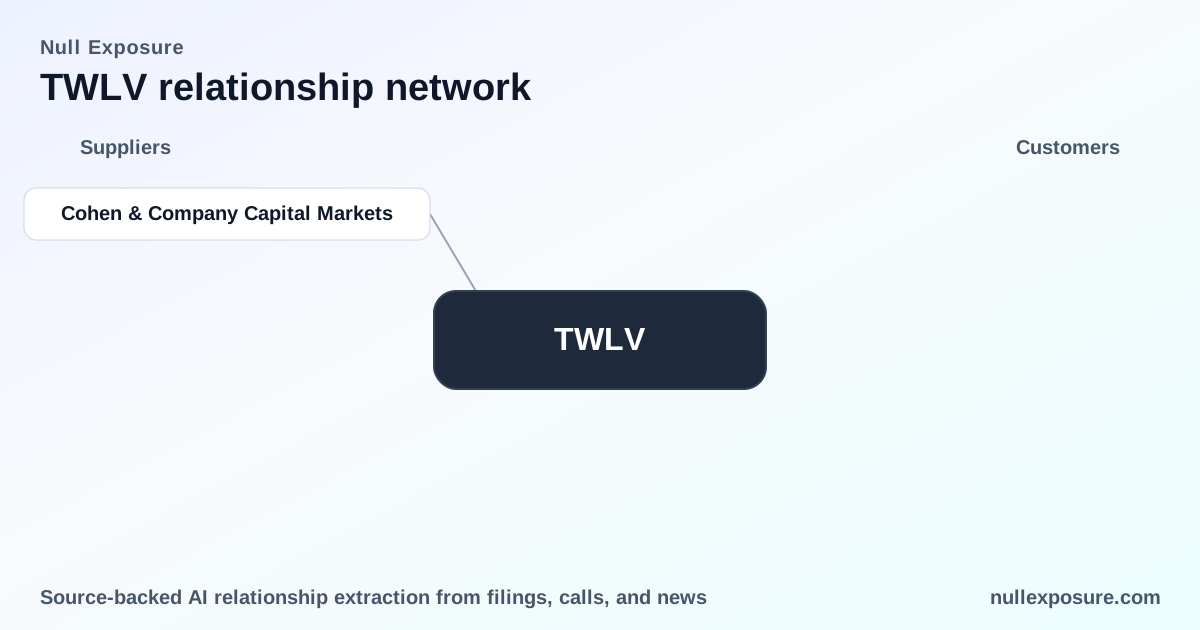
What public signals tell us about TWLV’s customer relationships The public relationship footprint for TWLV is extremely limited. There is a single flagged customer-related signal in the public corpus: a news release referencing an alleged revenue claim involving an entity named BIA. That signal is not a conventional supplier or revenue ledger entry for Twelve Seas; it is instead a third-party allegation surfaced in wider market commentary. The scarcity of customer relationships is consistent with the SPAC operating model: counterparties and revenue are generally nonexistent until a business combination consummates.
Key corporate metrics to keep in mind
- No reported revenues or EBITDA through the latest quarter (2025-12-31).
- Market cap around $233M and PE ratio 994, reflecting limited earnings and price driven by deal expectations.
- Book value negative (-0.265) and institutional ownership under 14% (13.447%), indicating modest institutional position size at current pricing (company disclosures).
A single relationship flagged: BIA (BIAD)
- The public signal references an external press release that alleges Brooge Energy exaggerated revenue by claiming receipts from BIA and another fictitious customer; the mention ties BIA into disputed revenue statements. This is a reporting of an allegation in a market notice rather than confirmed counterparty billing or a cleared customer contract. Source: GlobeNewswire press release dated April 8, 2024 (reported in the public news stream).
- The relationship record lists BIA with an inferred symbol BIAD and links to the news item that raises questions about whether BIA was ever a genuine revenue source for the firm alleged to have reported it. Source context: GlobeNewswire news release, April 8, 2024.
Constraints, contracting posture, and structural signals There are no recorded contractual constraints in the available relationship constraint set for TWLV. That absence is itself a signal: as a SPAC, Twelve Seas does not display the typical vendor/customer contract footprint that an operating company would. From an operational and risk perspective this implies:
- Contracting posture: Pre-combination TWLV’s contracting posture is passive; it does not maintain material customer contracts or supplier dependencies that drive revenue today.
- Concentration: There is no customer concentration to analyze because TWLV reports no operating sales—investor risk instead centers on deal concentration (reliance on one or a few potential target transactions).
- Criticality and maturity: Without stand-alone customers, counterparty criticality is low at the corporate level; maturity of commercial relationships will be determined only after a business combination completes.
- Visibility: The public record shows limited visibility into counterparties and contract-level risk; investors should treat customer signals as secondary to transaction risk and sponsor alignment for current valuation.
How the single flagged relationship affects investor due diligence The GlobeNewswire item that mentions BIA is a reputational data point rather than proof of a contractual customer for Twelve Seas. For deal-focused investors, the principal questions remain sponsor track record, PIPE and anchor investor commitments, and the target’s commercial validation post-merger. That said, any third-party allegation linking counterparties to disputed revenue practices is relevant for reputational and regulatory due diligence once a prospective target is identified.
Practical takeaways for research teams and operators
- Treat TWLV as a deal vehicle, not an operating counterparty—customer lists and revenue-based due diligence are not applicable pre-combination.
- Monitor third-party allegations (like the GlobeNewswire notice involving BIA) as part of a reputational screen for any target or named counterparty once a business combination candidate emerges.
- Focus primary diligence on sponsor alignment, PIPE strength, and post-merger customer validation rather than on current TWLV customer contracts, which do not exist in any material sense in public filings.
Near-term monitoring checklist
- Track deal announcements and S-4 / proxy disclosures for named targets and associated customer lists.
- Screen for third-party allegations or regulatory notices tied to any prospective target’s counterparties (the BIA mention is an example of such a noise signal).
- Evaluate sponsor and PIPE investor composition as leading indicators of transaction probability and post-merger support.
If you want regular counterparty and reputational signal updates tied to SPACs and acquisition vehicles, explore more at https://nullexposure.com/.
Bottom line: Twelve Seas is a SPAC whose value is driven by deal execution, not existing customer revenue; the public relationship record is effectively empty except for a single news allegation referencing BIA, which should be treated as a reputational lead rather than confirmation of a TWLV customer contract. Investors should prioritize transaction and sponsor diligence over customer-level analysis until a business combination closes.