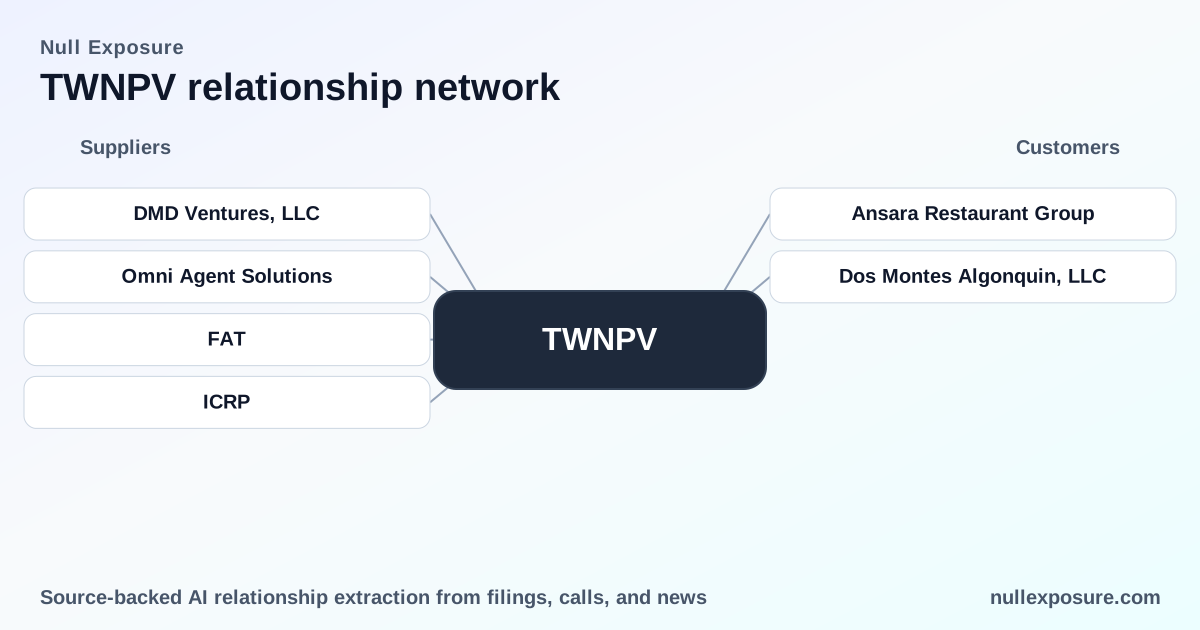
TWNPV Customer Footprint: Franchise relationships that drive lodge-level economics
Twin Peaks operates as a franchised casual-dining and lodge-style brand, monetizing primarily through franchise agreements that generate upfront fees, ongoing royalties and brand-related services; its growth and cash flow depend on scaling lodge openings and preserving unit-level performance through third-party operators. For investors and operators evaluating TWNPV customer relationships, the observable record shows diversified franchise partners executing expansion at the local level — a business model that delivers recurring revenue but concentrates operational execution risk in the hands of independent franchisees. For ongoing monitoring and deeper relationship analytics, visit https://nullexposure.com/.
How the franchised operating model translates into predictable cash flow — and specific risks
Twin Peaks leverages a classic franchisor posture: brand control, standardized operating requirements, and revenue captured through contractual royalty streams rather than direct unit ownership. That contracting posture produces two investor-relevant signatures:
- Revenue predictability: Royalties and service fees create recurring, margin-rich streams once a critical mass of franchise locations is established.
- Execution leverage and operational variance: Franchise economics amplify upside if experienced operators scale quickly, while underperforming operators directly affect same-store economics and brand health.
From the customer-side sample analyzed here, the company exhibits moderate concentration of operator types — a mix of multi-unit restaurant groups and single-operator LLCs — which implies both geographic diversification and dependency on local operator capability. There are no explicit third-party constraints flagged in the customer-scope data returned for TWNPV, so contract-level friction or concentration risks beyond operator quality are not documented in this set.
Customer relationships on record (what the public filings and press report)
Below are the franchise relationships identified in the available customer-scope results; each entry includes a concise, plain-English description and the originating source.
New London Hospitality
New London Hospitality — led by Deepak Verma and Kam Singh — is developing new Twin Peaks lodges as a local hospitality developer and multi-unit operator, positioning itself as experienced management for regional expansion. According to a Patch profile reporting on May 4, 2026, the group is described as “seasoned entrepreneurs with extensive experience in the hospitality space and multi-unit operations” (Patch, May 4, 2026: https://patch.com/connecticut/across-ct/twin-peaks-restaurant-chain-venturing-connecticut).
Ansara Restaurant Group
Ansara Restaurant Group operates several Twin Peaks restaurants in Michigan and Toledo, alongside an established portfolio of 22 Red Robin locations and other concepts, signaling a multi-concept operator with scale in the Midwest. The Lansing State Journal covered this footprint and operator mix in a September 16, 2025 article documenting Ansara’s Twin Peaks and related operations (Lansing State Journal, Sept 16, 2025: https://www.lansingstatejournal.com/story/news/local/michigan/2025/09/16/michigan-smokey-bones-lansing-twin-peaks-utica-grand-rapids/86183217007/).
Music City, LLC
Music City, LLC is a franchise group expanding Twin Peaks within its local footprint; the Fayetteville lodge is identified as that group’s second location following a successful Fort Mill opening, indicating deliberate, staged expansion by a small franchisee. BizFayetteville reported on the Fayetteville opening and Music City’s multi-location move on May 4, 2026, highlighting this incremental roll-out approach (BizFayetteville, May 2026: https://bizfayetteville.com/printstory/4632).
Dos Montes Algonquin, LLC
Dos Montes Algonquin, LLC is the named franchisee behind the Algonquin, Illinois Twin Peaks lodge opened March 17, 2025, representing another single-entity operator executing local market entry. A Twin Peaks press release circulated via GlobeNewswire documents the Algonquin opening and cites Michael Paulhus as the franchisee (GlobeNewswire, March 17, 2025: https://www.globenewswire.com/news-release/2025/03/17/3043638/0/en/Twin-Peaks-Opens-New-Lodge-in-Algonquin-Illinois-on-March-17.html).
What these relationships reveal about business characteristics and risk posture
The composition of these customers gives clear signals about Twin Peaks’ operating profile:
- Contracting posture: The company operates through standard franchise contracts that emphasize brand standards, local capital investment by franchisees, and ongoing royalty streams. That structure aligns corporate revenue with third-party unit performance rather than corporate-operated same-store sales.
- Concentration: The sample includes both multi-unit operators (Ansara) and single-entity franchisees (Dos Montes, Music City, New London Hospitality), suggesting geographic diversification with operational concentration at the local-operator level rather than reliance on a single large partner.
- Criticality: Franchisee execution is critical to topline growth and brand health; openings documented in these sources directly expand royalty-bearing units and thus influence short- to mid-term revenue momentum.
- Maturity and operator capability: Press descriptions of some partners as “seasoned entrepreneurs” and multi-concept operators indicate pockets of mature operator capability, which supports faster, lower-risk expansion where present.
No explicit contractual constraints or external bottlenecks were identified in the customer-focused search results provided; as a result, investor diligence should emphasize operator quality, unit economics and local market performance rather than third-party supplier constraints in this dataset.
Investment implications and recommended monitoring approach
For investors assessing TWNPV from a customer-relationship lens, the following takeaways are decisive:
- Growth engine: New lodge openings by independent franchisees scale recurring royalty revenue without twin-peaks capital deployment — a capital-light growth model.
- Operator risk: Because earnings depend on third-party operators, track operator portfolios, multi-unit rollouts and any public reports on underperformance or unit closures.
- Geographic diversification is a strength: Mixed single-operator and multi-unit partners suggest the brand is layering expansion across markets and operator types rather than over-indexing on one counterparty.
- Signal monitoring: Prioritize monitoring press releases and local business coverage for early signs of openings, operator exits, or reputational issues that will surface at the franchisee level.
For ongoing relationship intelligence and to maintain a live view of franchise partner activity, access the platform at https://nullexposure.com/.
Bottom line
Twin Peaks’ customer footprint in the reviewed records is a textbook franchisor profile: growth through independent operators, recurring royalty economics, and direct dependence on franchisee execution. Investors should focus diligence on operator capability, staging of rollouts, and local market performance metrics that drive the franchisor’s top-line conversion into royalties and service revenues.