Two Harbors (TWO): customer relationships, operational posture, and what investors need to know
Two Harbors is a mortgage REIT that earns returns by originating residential mortgage assets, selling those loans into the secondary market, and monetizing mortgage-servicing rights (MSRs) and financing spreads. The company typically originates loans for sale to GSEs or other investors on a servicing-retained basis and captures gain-on-sale economics plus recurring servicing fee income from MSR ownership; Two Harbors’ public disclosures through Q1 2026 show this business model alongside a high dividend yield and a balance sheet exposed to U.S. mortgage markets. For a quick deep-dive into how Two Harbors’ customer and counterparty relationships influence value, see more at https://nullexposure.com/.
How Two Harbors monetizes customers and counterparties
Two Harbors’ economics are built on two interlocking customer dynamics: (1) selling originated loans to government-sponsored entities and other investors, which generates immediate gain-on-sale and funds asset growth, and (2) retaining and servicing MSRs, which produce ongoing fee income and optionality as an asset class. Company disclosures state the firm normally sells loans within 60 days of origination on a servicing‑retained basis; this is the operating rhythm that defines contracting posture and cash‑flow timing. According to the company overview through Q1 2026, Two Harbors reported about $494 million in trailing revenue and a dividend yield of approximately 11.2%, reflective of its REIT payout focus and reliance on recurring servicing and financing returns.
Key commercial drivers: originations → loan sales to GSEs/third‑party investors → retained MSR fees and servicing economics. This structure concentrates counterparty risk around GSEs and guarantors while creating recurring fee streams embedded in MSR assets.
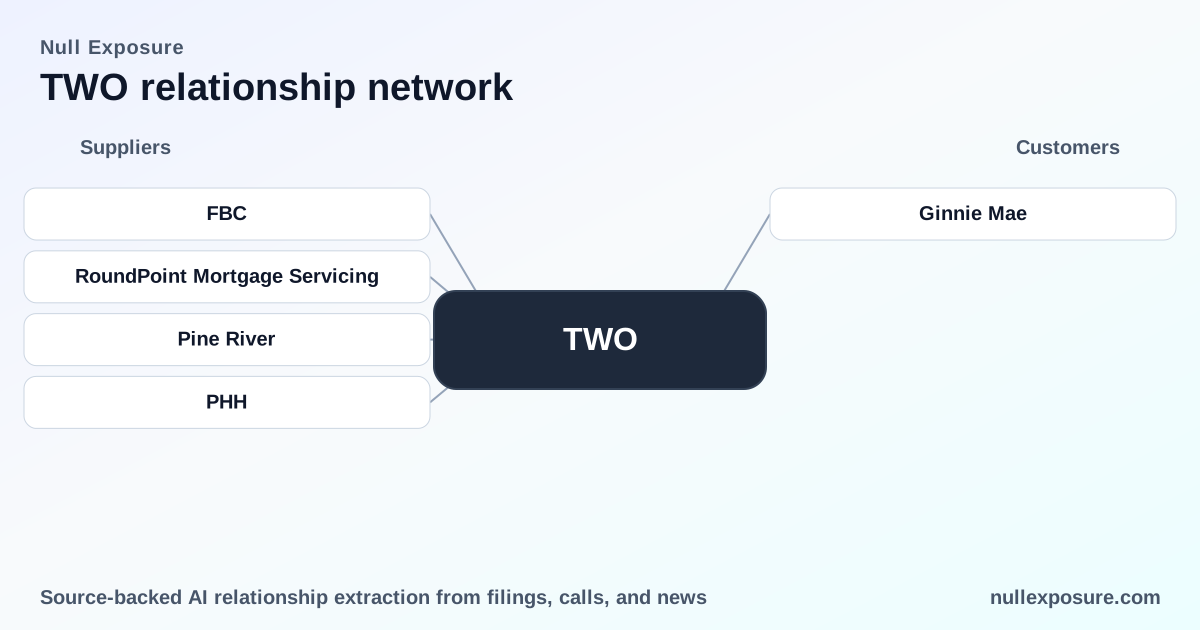
The explicit customer relationship: Ginnie Mae — a gating partner
Ginnie Mae is recorded in Two Harbors’ customer relationship set and functions as an operational counterparty whose approvals affect where and how loans are placed and guaranteed. According to an SEC filing (FY2016) hosted on the SEC website, continued status as an approved servicer by the GSEs or Ginnie Mae is contingent on compliance with their selling and servicing guidelines, minimum capital requirements, and other discretionary conditions (SEC filing, FY2016: https://www.sec.gov/Archives/edgar/data/1465740/000146574016000202/twoharborsmortgageservic.htm). This filing indicates that approval status with Ginnie Mae is a gating condition for servicing-related activity and, by extension, for access to certain guarantee programs.
Takeaway: Ginnie Mae’s approval regime is a direct operational constraint on how Two Harbors places and services loans; maintaining that approval is central to accessing Ginnie Mae‑guaranteed markets and related liquidity channels.
Other contract and operational signals shaping the customer footprint
Company-level disclosures and management commentary provide additional color on Two Harbors’ contracting posture, counterparty concentration, and the maturity of its service relationships:
- U.S.-centric footprint. Filings and disclosures explicitly identify the United States as the geographic market for Two Harbors’ mortgage activities, signaling concentrated regulatory and market exposure to U.S. housing finance conditions.
- Servicer outsourcing and operational dependency. Two Harbors’ MSR vehicle does not directly perform loan servicing; instead, the firm engages a third-party servicer, RoundPoint, to handle substantially all servicing functions, and RoundPoint holds approvals with Fannie Mae and Freddie Mac. This outsourcing is documented in company filings and creates an operational dependency on a specialized servicer with its own approval regime.
- Seller posture with retained servicing. The company’s stated practice is to originate loans for sale to GSEs or other investors, typically within 60 days, and to retain servicing rights — a business model that locks in both near-term sale proceeds and longer-term servicing cash flows.
- Services segment emphasis. Two Harbors emphasizes servicing activities as a revenue segment, both for MSRs it owns and for MSRs owned by third parties, indicating recurring fee revenue is a material and strategic line of business.
These constraints translate to concrete investor considerations: contracting posture is transactional and short-cycle, with capital recycled through rapid sell-downs; counterparty concentration is high and U.S.-centric, increasing sensitivity to domestic policy and GSE/Ginnie Mae actions; operational criticality sits with the servicer (RoundPoint) rather than with in‑house servicing; and the business is structurally mature in product but sensitive to regulatory and approval risk.
Relationship-by-relationship view (complete list from the disclosed set)
Ginnie Mae — Two Harbors’ operations and servicing access are conditioned on approved servicer status with Ginnie Mae, and the company explicitly recognizes that continued approval depends on compliance with Ginnie Mae selling and servicing requirements and capital standards. Source: SEC filing (FY2016) on the company’s servicing disclosures (https://www.sec.gov/Archives/edgar/data/1465740/000146574016000202/twoharborsmortgageservic.htm).
(There is one relationship disclosed in the customer results. Company filings cited elsewhere in the same disclosure set also name RoundPoint as the outsourced servicer and describe the company’s seller and servicing-retained posture.)
What this means for investors: risks and actionable signals
- Regulatory and approval risk is first-order. Ginnie Mae or GSE approvals are contractual prerequisites that can directly restrict where loans can be placed and how MSR economics are realized. Investors should treat counterparty approvals as a credit and operational risk factor.
- Operational concentration through servicer outsourcing. Outsourcing servicing to RoundPoint concentrates the operational criticality in a third party; servicer performance or termination could materially affect MSR cash flows and operational continuity. Company filings name RoundPoint and note it services loans for Two Harbors’ MSR vehicle, including approvals with Fannie Mae and Freddie Mac.
- Predictable cash-flow levers but macro sensitivity. The originate‑and‑sell model generates gain-on-sale and recurring servicing income, but those levers are sensitive to mortgage spread dynamics, prepayment speeds, and funding/hedging costs. Two Harbors’ public metrics through Q1 2026 show a price‑to‑book around 1.17 and an analyst target price near $11.28, offering a market cross-check for intrinsic value and payout sustainability.
- Concentration on U.S. housing finance policy. The company’s footprint is U.S.-only; policy shifts, programmatic changes at Ginnie Mae or the GSEs, or shifts in guarantee fee regimes materially affect expected economics.
Final read: positioning for investors
Two Harbors delivers a high-yield, servicing-enhanced mortgage REIT profile where operational access to Ginnie Mae and the integrity of a third‑party servicer are among the most consequential variables for realized returns. Monitor servicing approvals, servicer counterparty health, and the GSE/Ginnie Mae policy environment as primary drivers of downside risk. For a more granular look at how these customer dynamics map to valuative scenarios, visit https://nullexposure.com/ for additional analysis and model-ready intelligence.