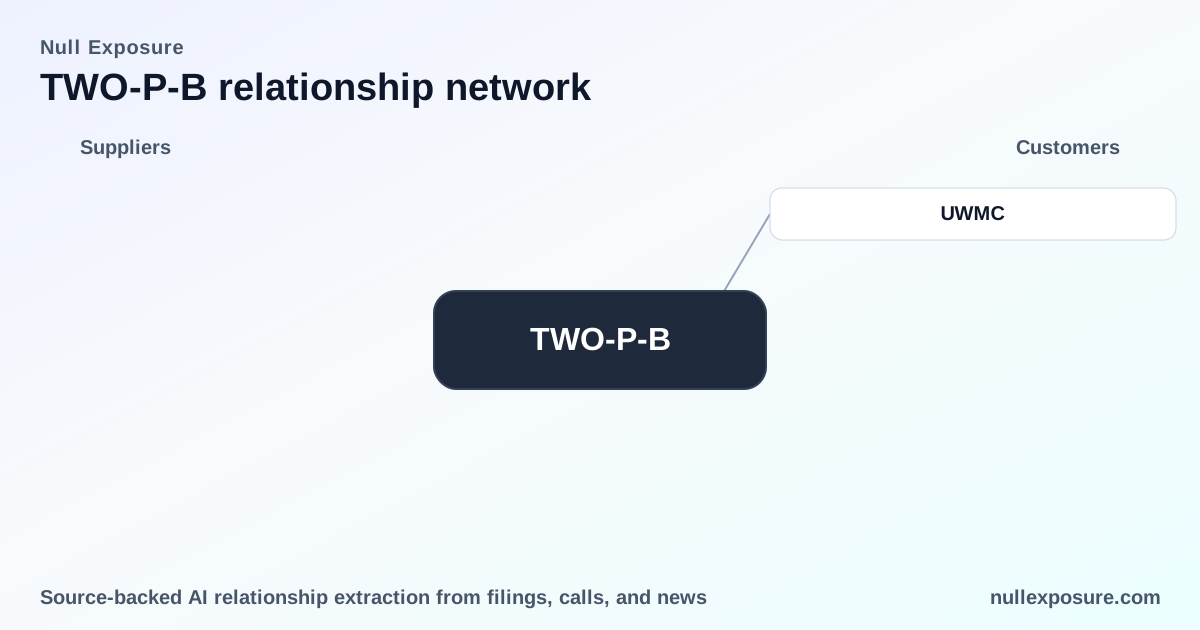
Two Harbors (TWO‑P‑B): How takeover dynamics rewrite the economics for preferred holders
Two Harbors is a mortgage‑focused REIT that monetizes by owning and managing residential mortgage‑backed securities and related assets while funding operations and shareholder distributions through a mix of equity and preferred securities such as the 7.625% Series B fixed‑to‑floating preferred (TWO‑P‑B). The company’s immediate valuation drivers are no longer purely portfolio performance but competing acquisition proposals that determine the cash or stock consideration available to preferred and common holders—and therefore the path for redemption or conversion value. For an investor evaluating TWO‑P‑B, the critical questions are: who pays, in what form, and how transaction terms affect preferred‑class protections and yield capture.
Explore deeper coverage at https://nullexposure.com/
Key takeaways
- M&A is the dominant driver of near‑term value for TWO‑P‑B holders: competing bids from CrossCountry and UWM (UWMC) set the exit mechanics.
- Counterparty financing is visible and meaningful: UWM’s revised offer is supported by a $1.3 billion Mizuho bridge facility, signaling deal execution capability.
- Board posture and shareholder litigation/representation (Halper Sadeh involvement) increase negotiation leverage and the potential for improved consideration.
Why the relationship map matters to preferred‑stock investors
Preferred securities like TWO‑P‑B are sensitive to corporate actions because redemption or restructuring outcomes change yield realization and capital recovery profiles. Two Harbors’ underlying mortgage portfolio performance is important, but in the current window transaction structure (cash vs. stock) and timing (special meetings, regulatory clearances) are the decisive variables. The active interest from strategic buyers creates concentration risk around a small set of counterparties and elevates governance and informational transparency as immediate credit‑relevant factors. Investors should assume high counterparty criticality while this contest is unresolved.
All reported counterparties — concise relationship briefs
UWM Holding — revised proposal with mixed cash/stock election (TipRanks, April 30, 2026)
UWM issued an open letter proposing that Two Harbors shareholders receive either $12 in cash or 2.3328 shares of UWM Class A stock per Two Harbors share, with the offer backed by a committed $1.3 billion unsecured bridge facility from Mizuho Bank, indicating near‑term financing support for the transaction. (According to TipRanks reporting on April 30, 2026.)
UWM Holdings Corporation — 2.3328 shares per share exchange proposal (Intellectia, March 10, 2026)
UWM proposed a stock‑for‑stock transaction at an exchange ratio of 2.3328 UWM Class A shares for each Two Harbors common share, a structure that converts common‑holder exposure into UWM equity and changes the risk profile for holders subordinate to preferred stock. (Reported by Intellectia on March 10, 2026.)
CrossCountry Mortgage — all‑cash acquisition terms (Investing.com, May 4, 2026)
CrossCountry moved to acquire all outstanding Two Harbors common shares in an all‑cash transaction, shifting the calculus for preferred holders toward a cash‑exit scenario that could simplify redemption mechanics if and when the preferred class is addressed. (Investing.com company news, May 4, 2026.)
CrossCountry Mortgage — target of UWM’s comparative criticism (TipRanks, April 30, 2026)
UWM publicly asserted that its bid is superior to Two Harbors’ amended agreement with CrossCountry, accusing the Two Harbors board of entrenchment and incomplete disclosure—issues that impact shareholder support dynamics and the likelihood of the CrossCountry deal proceeding unchanged. (TipRanks coverage, April 30, 2026.)
UWMC (Intellectia duplicate) — shareholder representation and relief efforts (Intellectia, March 10, 2026)
Intellectia noted that Halper Sadeh LLC is representing shareholders seeking higher consideration and other relief, a development that increases pressure on the board to maximize value or renegotiate terms in the face of UWM’s share‑based proposal. (Intellectia, March 10, 2026.)
CrossCountry context around earnings and investor focus (Investing.com earnings coverage, May 4, 2026)
Market attention around Two Harbors’ reported quarter was concentrated on whether operational results would influence shareholder support for CrossCountry’s stated $10.80‑per‑share cash bid, signaling that financial disclosures can be used tactically during takeover contests. (Investing.com earnings piece, May 4, 2026.)
UWM Holdings — termination of prior agreement and timing of CrossCountry deal (Investing.com, May 4, 2026)
Investing.com reports the all‑cash CrossCountry deal was announced March 27 after Two Harbors terminated an earlier agreement with UWM; the CrossCountry transaction is expected to close in the second half of 2026 pending regulatory and shareholder approvals, establishing a clear timetable for preferred‑holder outcomes. (Investing.com, May 4, 2026.)
UWM Holdings Corporation — unsolicited competing proposal triggered an amendment (Investing.com, May 4, 2026)
Investing.com also notes that the CrossCountry amendment follows an unsolicited proposal from UWM dated April 20, 2026, evidence of a fast‑moving auction process that creates negotiation leverage for both bidders and for shareholder representatives. (Investing.com company news, May 4, 2026.)
What the lack of explicit constraints signals about Two Harbors’ operating posture
The relationship dataset contains no formal contracting constraints or explicit service‑level obligations tied to specific counterparties. That absence should be read as a company‑level signal: current public information emphasizes M&A negotiations and governance disputes over long‑term, contractually‑bound operational dependencies. In practical terms:
- Contracting posture: transactional and event‑driven rather than long‑term vendor reliance.
- Concentration: ownership and control outcomes hinge on a small set of strategic buyers (CrossCountry, UWM).
- Criticality: counterparties are critical for exit liquidity; financing commitments (Mizuho bridge for UWM) materially affect deal credibility.
- Maturity: counterparties are established mortgage‑market players, so counterparty execution risk centers on regulatory and shareholder approval rather than operational inexperience.
Investment implications and risk framing for TWO‑P‑B holders
- If CrossCountry’s all‑cash deal closes as announced, preferred holders get clarity on settlement mechanics and cash liquidity, subject to any contractual subordination or redemption provisions embedded in the preferred instrument.
- If UWM’s stock alternative prevails, preferred holders face indirect exposure to UWM equity performance and to underwriting terms supporting the stock issuance—an outcome that changes risk/reward and potentially total return.
- Governance and litigation activity (shareholder representatives) materially influence deal economics and can force higher consideration, which is favorable for holders of preferred stock if it leads to enhanced redemption or treatment.
- Timing is determinative: approvals and regulatory reviews set the window for when preferred‑class decisions are implemented; expect a concentrated period of disclosure and voting activity through H2 2026.
For focused, transaction‑level monitoring and to track how these negotiations evolve into specific treatments for preferred claims, see broader coverage at https://nullexposure.com/.
Bold, precise attention to counterparty commitments and the legal treatment of preferred claims will determine whether TWO‑P‑B delivers its stated coupon through to par redemption or whether holders are forced into a different instrument or payout profile as a result of the takeover outcome.