Two Harbors (TWO‑P‑C): Customer Linkages and the Income Proposition for Investors
Two Harbors Investments’ 7.25% Series C preferred (TWO‑P‑C) is an income-first instrument: it monetizes stable cash flow through claim priority on REIT distributions and a fixed‑to‑floating dividend structure that protects yield as rates change. For investors and operators evaluating customer relationships, the relevant signal set is not about operating sales but about counterparties and servicing partnerships that affect cash generation, liquidity and dividend coverage. Read on for a focused review of the customer mentions that matter, what they imply for Two Harbors’ operating model, and the implications for preferred‑share holders.
If you want a concise view of Two Harbors’ counterparty footprint and what it means for preferred income stability, visit https://nullexposure.com/ for the firm-level summary and relationship tracking.
How this preferred share fits into Two Harbors’ business model
Two Harbors is a mortgage‑focused REIT that structures capital as both equity and preferred securities to fund mortgage assets and related servicing businesses. TWO‑P‑C offers investors a contractual priority on dividend payments with a fixed 7.25% coupon that converts to a floating rate at a specified reset — a design that balances current yield with rate sensitivity. The firm leverages capital markets expertise and an affiliated servicing platform to reduce funding costs and extract spread from mortgage assets; those operational linkages are the primary drivers of preferred‑share credit quality rather than top‑line sales figures.
Customer mentions: concise, source‑linked takeaways
The dataset yields a limited but direct set of customer references, concentrated on a single counterparty. Each listed mention below is covered exactly as found in the published material.
United Wholesale Mortgage — capital markets and servicing benefit
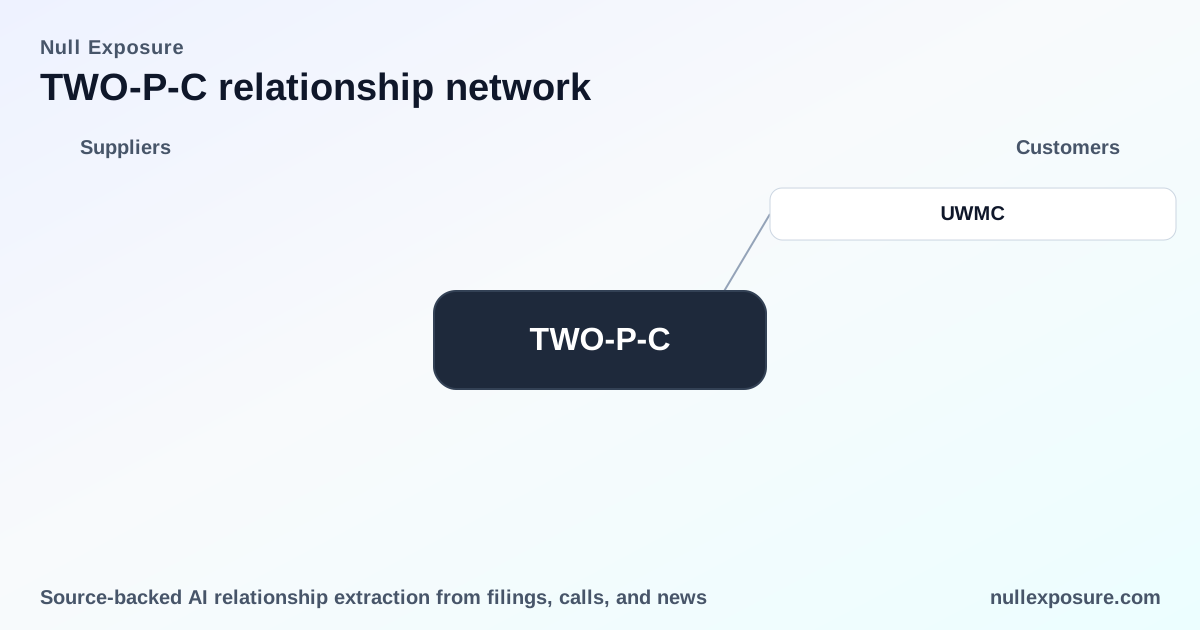
Two Harbors notes that United Wholesale Mortgage (UWMC) benefits from Two Harbors’ capital‑markets and asset‑management capabilities, and can use Two Harbors’ Roundpoint servicing platform for low‑cost servicing needs. According to Two Harbors’ Q4 2025 earnings‑call transcript (published March 10, 2026 on The Globe and Mail), the company explicitly described this cooperative dynamic between UWMC and its servicing business. Source: Q4 2025 earnings‑call transcript, The Globe and Mail, March 10, 2026 — https://www.theglobeandmail.com/investing/markets/stocks/TWO-N/pressreleases/37385503/two-harbors-two-q4-2025-earnings-call-transcript/
United Wholesale Mortgage — repeated disclosure of the same servicing relationship
The same transcript contains a repeated mention of UWMC’s ability to leverage Roundpoint’s “best‑in‑class and low‑cost servicing capabilities,” reinforcing the operational linkage between mortgage originators and Two Harbors’ servicing platform. This duplicate mention underlines the company’s emphasis on servicing synergies as a structural source of spread capture. Source: Q4 2025 earnings‑call transcript, The Globe and Mail, March 10, 2026 — https://www.theglobeandmail.com/investing/markets/stocks/TWO-N/pressreleases/37385503/two-harbors-two-q4-2025-earnings-call-transcript/
What the customer picture implies for investors and operators
- Concentration of public relationship signals is low. The only counterparty explicitly referenced in the available customer results is UWMC, cited twice within the same earnings‑call transcript; that limited public footprint does not imply broader counterparty absence, but it does mean Two Harbors highlights strategic servicing and capital markets relationships selectively.
- Servicing is a strategic asset. The repeated callout of Roundpoint as a low‑cost servicing partner signals that Two Harbors treats operational servicing capacity as a primary profit lever — an internal margin driver that supports dividend coverage for preferred shareholders.
- Capital‑markets expertise is an active commercial lever. Two Harbors positions its capital markets and asset management skills as commercial value to counterparties like UWMC, which implies transactional revenue potential beyond passive mortgage holdings.
Operating‑model constraints and business‑model characteristics
There are no explicit contractual constraints listed in the provided relationship data; this absence itself is a signal to treat the public relationship map as selective rather than exhaustive. Translating the customer evidence into operating and business‑model characteristics:
- Contracting posture: Relationship disclosures emphasize strategic, bilateral servicing and capital‑markets cooperation rather than arm’s‑length sales; this indicates a contracting posture that favors integrated servicing arrangements and bespoke financing solutions.
- Concentration: Publicly visible counterparty mentions are concentrated (UWMC only), which raises information concentration risk for external analysts — not necessarily a counterparty concentration on the balance sheet but a disclosure concentration in investor communications.
- Criticality: Servicing capabilities (Roundpoint) are presented as operationally critical to Two Harbors’ ability to reduce funding costs and offer low‑cost servicing to partners; that vertical capability is a critical internal competency that underpins spread generation.
- Maturity: The nature of the relationship (earnings‑call commentary) suggests mature commercial ties rather than early‑stage partnerships; the language frames UWMC as a counterparty that already leverages Two Harbors’ services.
Investment implications and risk points for preferred holders
- Credit hinge on operating cash flow, not revenue growth. Preferred holders should focus on mortgage‑asset cash generation and servicing economics that feed dividend coverage rather than top‑line expansion metrics.
- Servicing integration reduces cost but concentrates operational risk. Roundpoint’s role as a low‑cost servicer is a source of strength; any servicing disruption would have outsized effects on margins and preferred dividend security.
- Disclosure sparsity necessitates active monitoring. Because public relationship mentions are limited, preferred investors must monitor earnings calls and servicing performance metrics for changes in counterparty risk or servicing throughput.
For a consolidated, ongoing view of Two Harbors’ counterparty landscape and how it maps to preferred‑share income risk, see the firm summary at https://nullexposure.com/.
Bottom line
Two Harbors’ Series C preferred is positioned as an income vehicle supported by mortgage REIT economics and a servicing franchise. The primary public customer signal in the reviewed material links the company to United Wholesale Mortgage, with Roundpoint servicing and capital‑markets support called out as operational strengths (Q4 2025 earnings call, Mar 10, 2026). For income investors, the core exposures to watch are servicing performance, dividend coverage from mortgage asset cash flow, and any shifts in disclosed counterparty relationships that could alter credit dynamics.