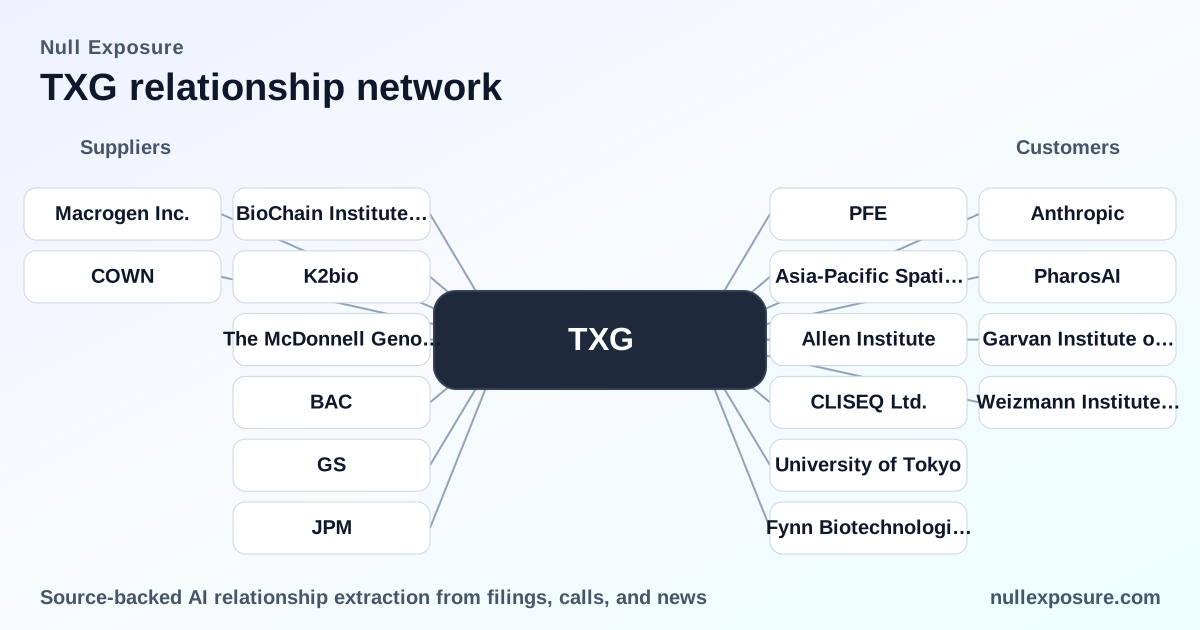
10x Genomics (TXG): Customer Map and Commercial Implications for Investors
10x Genomics sells integrated life‑science tools—instruments, consumables, bundled software and post‑warranty services—and monetizes through hardware sales, recurring consumables, software bundles and licensing/royalty arrangements. Recent product momentum (Xenium spatial, Chromium Flex, and Cloud Analysis) is driving large academic, consortium and pharmaceutical engagements that scale consumable usage and create cross‑sell opportunities for services and licenses. For a concise commercial signal set and relationship tracking, see NullExposure’s coverage: https://nullexposure.com/.
What the customer mosaic implies about TXG’s operating model
10x operates a hybrid hardware‑plus‑consumables model typical of life‑science tools vendors, with recurring revenue tied to consumables and short‑term service contracts. Contracting posture is transactional on services—instrument service agreements are typically one‑year extensions after warranty—while IP monetization surfaces through licensing and royalty structures. Geographic revenue is diversified across North America, EMEA and APAC, supporting a global commercial footprint since 2015. Sales channels include direct field teams in major markets and third‑party distributors in select regions, which moderates distribution risk but creates channel complexity.
- Concentration and criticality: Customers span academia, government research institutes and large pharma consortia, which positions TXG as critical infrastructure for translational and large‑scale spatial and single‑cell programs—high switching costs for established workflows.
- Maturity and stage: Product lineup and commercial adoption show enterprise maturation: instrument placements (Xenium shipments) and large consortium projects indicate durable institutional adoption, while licensing income (e.g., settlement receipts) demonstrates IP monetization pathways.
- Segments: TXG sells across hardware, consumables, software and services, with software bundled to drive instrument utilization and analytics lock‑in.
If you are evaluating channel exposure or revenue mix drivers, NullExposure’s relationship summaries provide a rapid way to vet counterparties and cited sources: https://nullexposure.com/.
Detailed relationship log — each reported counterparty and source
Below are the relationships reported in the source set. Each entry is one or two sentences and cites the public item that disclosed the relationship.
Allen Institute
The Allen Institute is an early access customer for the Chromium Flex 384‑plex assay, using the technology to scale single‑cell immunology programs and batch processing with liquid‑handling automation. Source: BioSpace press release (March 10, 2026).
Bruker
10x settled worldwide patent litigation with Bruker and recognized a $68 million upfront payment that was allocated between operating expenses and license/royalty revenue, reflecting a material one‑time IP monetization event. Source: Investing.com earnings transcript (Q2 2025, reported May 4, 2026).
CareDx (listed as CDNA — first mention)
CareDx entered a collaboration with 10x Genomics to launch ImmuneScape, a multi‑omics research initiative aimed at mapping transplant rejection biology using Xenium and Chromium Flex platforms. Source: TradingView summary of collaboration (reported May 2, 2026).
Asia‑Pacific Spatial Translational Research Alliance (ASTRA)
ASTRA, a regional consortium, will use the Xenium spatial platform to map immune–tumor interactions across 2,000 tumor samples—an institutional deployment that scales sample throughput and consumable demand. Source: PR Newswire (March 10, 2026).
PFE (Pfizer reference #1)
Pfizer staff described the next‑generation Flex assay as a streamlined, robust tool that enables high‑multiplex studies and faster processing—evidence of pharma validation for Flex in drug discovery workflows. Source: BioSpace press release (March 10, 2026).
Pfizer (duplicate reference #2)
Pfizer reiterated that Flex’s multiplexing and batching capabilities will accelerate drug discovery and development, signalling strategic adoption by a major pharma R&D organization. Source: BioSpace press release (March 10, 2026).
CLISEQ Ltd.
CLISEQ (spun out of the Weizmann Institute) announced a translational research collaboration with 10x to apply Chromium GEM‑X Single Cell technology to hematology clinical diagnostics studies. Source: PR Newswire (March 10, 2026).
PharosAI
PharosAI, a UK research consortium, will use the Xenium spatial platform to build a comprehensive multimodal cancer dataset paired with advanced AI models—linking 10x’s instrumentation to downstream analytics pipelines. Source: Yahoo Finance coverage (March 10, 2026).
Fynn Biotechnologies
Fynn Biotechnologies’ CTO praised Xenium’s speed and reliability after running multiple slides with 10x’s human breast gene panel, reflecting operational satisfaction from a commercial user. Source: BioSpace article on Xenium shipments (reported March 2026).
Anthropic
Anthropic and 10x partnered to integrate 10x Cloud Analysis with Anthropic’s Claude, lowering technical barriers for large‑scale single‑cell and spatial analyses and expanding cloud‑based analytics adoption. Source: BioSpace press release (March 10, 2026).
Xyrem Therapeutics
Xyrem used the Chromium Universal pipeline in an industrialized perturbedSeq workload to generate a large public perturbedSeq dataset, demonstrating the platform’s suitability for high‑throughput pharmaceutical screens. Source: Investing.com earnings transcript (Q2 2025, reported May 4, 2026).
Garvan Institute of Medical Research
The Garvan Institute is a lead participant in ASTRA and will leverage custom Xenium panels to study multiple cancer types, reinforcing academic and clinical adoption in the Asia‑Pacific region. Source: PR Newswire (March 10, 2026).
University of Tokyo
The University of Tokyo is a co‑lead of ASTRA and will participate in the regionwide pan‑cancer spatial atlas using Xenium, indicating institutional collaboration across national research centers. Source: PR Newswire (March 10, 2026).
CareDx (CDNA — second mention via TradingView)
CareDx’s ImmuneScape initiative with 10x was also reported in a second outlet, highlighting the collaboration’s objective to generate immune maps to inform diagnostic development. Source: TradingView (March 9–May 2, 2026 reporting).
Bioptimus
Bioptimus launched the STELA initiative anchored by a 10x partnership to profile up to 100,000 patient tissue specimens on the Xenium platform, increasing projected consumables and slide‑throughput demand. Source: SahmCapital coverage (May 4, 2026).
Genome Institute of Singapore
10x announced a tissue map collaboration with the Genome Institute of Singapore to accelerate drug target discovery and biomarker signatures, indicating government/academic engagement in strategic translational programs. Source: Investing.com earnings transcript (Q2 2025, reported May 4, 2026).
Weizmann Institute of Science
The Weizmann Institute (via its Yeda spinout CLISEQ) partnered on translational hematology research using Chromium GEM‑X, reinforcing 10x’s role in diagnostics‑focused projects. Source: PR Newswire (March 10, 2026).
ARC Institute
The ARC Institute extended a partnership using Chromium FLEX as the standard for the Virtual Cell Challenge, demonstrating 10x’s role in benchmarking community computational efforts and standardizing assays. Source: Investing.com earnings transcript (Q2 2025, reported May 4, 2026).
CareDx (CDNA — third mention via Bitget)
CareDx’s ImmuneScape collaboration was also documented in additional outlets noting use of both Xenium and Chromium Flex to generate high‑resolution immune maps to guide diagnostic development. Source: Bitget news repost (March 9, 2026).
Investor implications and risk factors
- Revenue durability stems from consumables and services: instrument placements seed long‑term consumable revenue and analytics consumption via Cloud Analysis.
- Geographic diversification reduces single‑market concentration: meaningful revenue in the Americas, EMEA and APAC supports resilience but requires execution across channels.
- Contracting posture drives near‑term visibility limits: one‑year service contracts and transactional sales create lumpy revenue recognition; licensing and royalties add episodic upside (as evidenced by the Bruker settlement).
- Counterparty mix is quality‑weighted: heavy engagement with top pharma, government and major academic consortia implies high scientific validation and stickiness, but exposes TXG to funding cycles in academia and procurement timelines in pharma.
Bottom line
10x Genomics’ customer ecosystem is broad and institutionally deep, combining high‑profile pharma partnerships, global research consortia and academic anchors that together drive consumable recurring revenue and create routes to software and licensing monetization. Investors should weight the recurring consumables runway and licensing cadence against short‑term service contract visibility and the timing of large consortium deployments.
For a consolidated feed of customer‑level signals and relationship sourcing, visit NullExposure: https://nullexposure.com/.