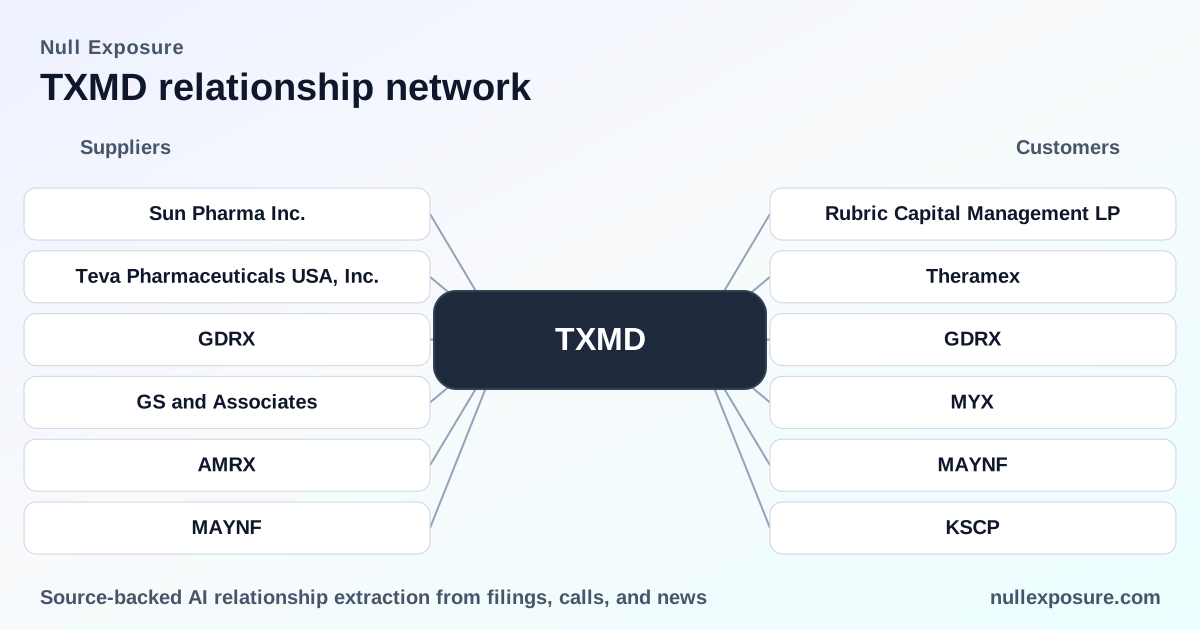
TherapeuticsMD (TXMD): A royalty-first commercial engine with concentrated license income
TherapeuticsMD has repositioned from an operating drug developer to a pharmaceutical royalty company that monetizes proprietary women’s health products through long-term licenses and royalty streams to specialist partners. Its economic model delivers recurring, contractually backed cash flows (minimum annual royalties and percentage-based royalties) while offloading commercialization and manufacturing execution to licensees. For investors and operators, the thesis is simple: value depends on the durability of license agreements, the revenue contribution of a small set of commercial partners, and the upside from royalty escalation or new licensing deals. For a concise view of our research tools and signals, visit https://nullexposure.com/.
What drives TXMD’s economics and operating posture
- TherapeuticsMD receives royalties and license revenue rather than running broad-scale commercialization. The company publicly states it changed its business model on December 30, 2022, to become a royalty company that collects payments from third-party commercial partners.
- Contracts are long-term and structured: the Mayne License Agreement (described in SEC filings) carries royalty rates and minimum payments, and includes a 20‑year royalty tail for U.S. sales with minimum annual payments for a 12‑year period.
- Revenue concentration is high. Recent disclosures and market commentary show Mayne Pharma is the principal contributor to license revenue; other partners provide geographic or product-specific revenue but at smaller reported amounts.
- Cash flow characteristics are predictable but finite. Minimum annual royalties and percentage royalties create near-term visibility, yet ultimate upside depends on partner sales performance and any territory sublicensing.
Customer and partner map — the relationships that define TXMD today
Rubric Capital Management LP
Rubric entered a Subscription Agreement with TherapeuticsMD on May 1, 2023, under which TherapeuticsMD agreed to sell up to 5,000,000 shares of common stock to Rubric or its affiliates, reflecting a financing relationship rather than a commercial customer. This is disclosed in TXMD’s 2024 Form 10‑K (FY2024).
Theramex (multiple references)
Theramex holds exclusive license and supply rights for Bijuva outside the U.S., Canada and Israel under a license deal executed in 2019, making it a non‑U.S. commercialization partner for at least one of TXMD’s products (Bijuva). This relationship is referenced in industry coverage of Theramex and in summaries of TXMD disclosures (DrugDeliveryBusiness, FY2021; TradingView, FY2025). Independent financial summaries also list Theramex as a named revenue source in later periods (Intellectia, FY2026).
Mayne Pharma / MYX / MAYNF (composite of multiple public items)
Mayne Pharma is the primary U.S. licensee under the Mayne License Agreement dated December 4, 2022. The contract grants Mayne exclusive, sublicensable rights to commercialize IMVEXXY, BIJUVA and prescription prenatal vitamins in the U.S., and establishes royalty economics (8.0% on the first $80M; 7.5% thereafter) plus minimum annual royalties of $3.0M for 12 years (reported in the License Agreement text summarized in TXMD filings and public reporting). License revenue reported in company releases was $1.0M for Q2 2025 and $3.0M for the full year 2025, confirming Mayne as the material driver of TXMD’s license revenue in 2024–2025 (Biospace Q2 2025 and full-year 2025; TradingView 10‑Q summary FY2025; Markets.FinancialContent BizWire Q3 2025). Industry press at the time of the deal noted the transfer of commercialization rights and the large licensing consideration that accompanied the shift (MMM‑Online, FY2022).
GoodRx / GDRX
TherapeuticsMD completed a definitive agreement selling certain assets to GoodRx for $150 million cash plus earnout potential (reported in the company’s prior investor communications and earnings calls). That transaction materially changed the company's asset base and capital position, and it is cited in TXMD earnings commentary from FY2022 (Fool.com transcript, FY2022).
Knight
Knight is listed as a partner with licensing arrangements for markets outside the U.S., similar to Theramex, under the portfolio of territorial licensing deals disclosed in TXMD’s SEC filings and summarized in media coverage (TradingView, FY2025). Knight’s role is territorial commercialization outside of the U.S. for specified products.
How the contracts actually read — constraints that matter to investors
- Long-term, royalty-based contracting: TXMD’s Mayne License Agreement includes a 20‑year royalty term for U.S. sales and specified royalty percentages tied to sales bands, a structural feature that converts product sales into long-dated cash flow for TXMD (evidence in the Mayne License Agreement text summarized in company filings).
- Minimum annual royalties and spend-band signalling: Mayne will pay minimum annual royalties of $3.0M per year for 12 years, indexed to inflation, which establishes a baseline cash inflow in the mid‑single‑millions band and reduces downside volatility relative to pure percent‑of‑sales exposure.
- Geographic concentration in North America: The company’s licensing architecture delegates U.S. commercialization to Mayne while rights outside the U.S. are granted to parties including Knight and Theramex, signaling a U.S. revenue focus for on‑book royalties.
- Relationship maturity and active receipts: TXMD reported license revenue from these agreements in 2023–2025, indicating the licensing model is in active cash collection mode and not merely prospective.
Investment implications — what operators and investors should watch next
- Concentration risk is the dominant variable. Mayne’s contractual economics and sales execution determine most near‑term royalty growth and downside protection via minimums.
- Contractual protections are meaningful. Minimum annual royalties and a 20‑year royalty term give TXMD visibility and make cash flows more investible than short‑term licensing arrangements.
- Geographic and portfolio diversification is limited. Outside‑U.S. partners (Theramex, Knight) provide optionality, but U.S. receipts are the primary driver of reported revenue to date.
- Transaction history shapes capital posture. The Rubric financing and the prior GoodRx sale materially influenced balance‑sheet flexibility; future licensing or capital actions will be evaluated in the context of these moves.
For a deeper signal-driven view of TXMD’s partner map and contract constraints, explore our platform at https://nullexposure.com/.
Bottom line: TherapeuticsMD now sells access to its IP and cash flow rather than running broad commercialization. The company’s valuation and credit profile depend on Mayne Pharma’s execution, the durability of minimum royalties, and the pace at which TXMD can either grow existing royalties or add similarly contracted license deals. Investors should monitor partner sales disclosures, royalty receipts, and any changes to the minimum payment ladder as the primary inputs for future upside or downside.