TXO customer relationships: concentration, contract tenor, and what it means for investors
MorningStar Partners (NYSE: TXO) monetizes upstream production by selling oil, NGLs and natural gas into domestic U.S. markets, primarily under short‑term, arm’s‑length purchase agreements; the economics are driven by production optimization and opportunistic asset sales, while cash flow is exposed to customer concentration and short contract tenors. For investors, the customer picture is straightforward: a small set of large buyers accounts for a meaningful share of revenue, and recent asset dispositions introduced a related‑party buyer into the mix — factors that materially influence counterparty risk and near‑term cash flow visibility. For further context and tracking, visit https://nullexposure.com/ for continuous coverage and alerts.
The headline: concentrated, short‑term sales into U.S. offtake
TXO sells the majority of its production under contracts with terms of 12 months or less, including month‑to‑month arrangements, which establishes a commercial posture of high flexibility but low long‑term revenue visibility. According to TXO’s 2024 Form 10‑K, “we sell the majority of our production under arm’s length contracts with terms of 12 months or less, including on a month‑to‑month basis.” The company also reports that all assets and revenues are U.S.‑based, concentrating counterparty and regulatory exposure domestically. Both facts are company‑level signals that shape operational risk: short contract tenors reduce lock‑in but raise the sensitivity of cash flow to buyer behavior and commodity logistics.
Who the buyers are — the relationships investors should know
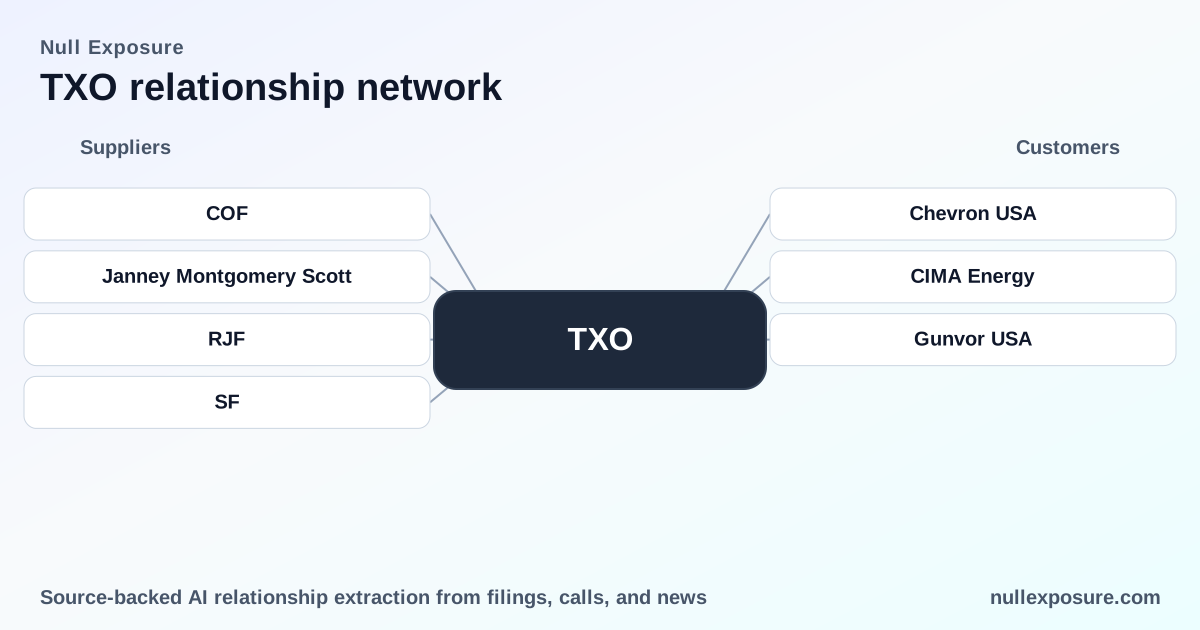
TXO’s disclosures and recent news identify four counterparties or buyer relationships referenced in public filings and press: Chevron USA, Gunvor USA, CIMA Energy, and CTOC Energy. Each relationship is summarized below with the primary public source.
Chevron USA
Chevron USA is one of TXO’s largest buyers; in FY2024 Chevron and Gunvor together accounted for almost 46% of TXO’s total revenues (excluding commodity derivatives), making Chevron a material purchaser in the company’s revenue mix. According to TXO’s 2024 Form 10‑K, Chevron is explicitly called out in that concentration disclosure (FY2024 10‑K).
Gunvor USA
Gunvor USA is a counterpart that, alongside Chevron, represents a large share of TXO’s revenue; the company’s 10‑K states Chevron USA and Gunvor USA together generated almost 46% of revenue in 2024, highlighting high top‑counterparty concentration and associated counterparty risk (FY2024 10‑K).
CIMA Energy
CIMA Energy was cited in TXO’s filing for the prior year: for the year ended December 31, 2023, Chevron USA and CIMA Energy together accounted for more than 42% of total revenues (excluding commodity derivatives), indicating that the identity of top purchasers has shifted across reporting periods but concentration persisted (FY2023 disclosure quoted in TXO’s 2024 10‑K).
CTOC Energy
CTOC Energy entered the picture via a March 2026 asset sale: TXO’s 50%-owned joint venture, Cross Timbers, executed agreements to sell substantially all of its oil and gas properties for about $200 million, including a $123.5 million purchase by CTOC Energy, an entity owned by the company chairman’s family members, according to contemporary press coverage. TradingView and related reporting summarized the March 10, 2026 transaction and noted the related‑party nature of CTOC’s purchase (news coverage, March 2026).
What the constraints tell us about operating risk and business model
- Contracting posture — short‑term and arm’s‑length. TXO’s business model relies on flexible, short‑tenor offtake: contracts typically run 12 months or less and can be month‑to‑month, which supports price responsiveness and operational agility but reduces revenue stickiness and extends working capital volatility (TXO 2024 10‑K).
- Counterparty profile — large, capable buyers. Receivables are from a mix that includes major energy companies and midstream counterparties, which is consistent with institutional counterparties and limits credit risk per counterparty size, even as concentration remains a concern (company disclosures).
- Geographic concentration — U.S. only. All assets and revenues are attributable to U.S. customers, which simplifies geopolitical risk assessment but concentrates exposure to U.S. commodity markets and regulatory environments.
- Materiality and conflicting company signals. The company’s own disclosures contain both a materiality warning — “the loss of any such purchaser could materially adversely affect our financial condition, results of operations and ability to make distributions” — and a countervailing assertion that oil, NGLs and natural gas are fungible with numerous purchasers and the loss of a single purchaser would not necessarily be materially impactful. Presenting both statements as company‑level signals is essential: TXO acknowledges concentration risk while also emphasizing market fungibility as a mitigant (TXO 2024 10‑K).
- Relationship role — buyer. These counterparties function as the primary buyers of TXO’s production; the company depends on several significant purchasers for most sales, making buyer behavior central to cash flow realization.
Risk/mitigant checklist for investors
- Monitor top‑customer concentration (quarterly revenue by counterparty): sustained >40% concentration to two buyers is a liquidity and negotiation risk.
- Track contract tenor and renewal behavior: short contract durations increase re‑price and re‑allocation risk during price dislocations.
- Watch for related‑party transactions and governance disclosures around the CTOC sale; asset sales to entities connected to management warrant scrutiny on valuation and process.
- Observe receivables aging and counterparties’ credit health even if counterparties are large, because concentrated exposure amplifies any single counterparty downgrade.
- Evaluate JV dispositions and portfolio optimization as a source of cash and a driver of buyer mix changes.
Bottom line for investors
TXO’s customer footprint is concentrated, domestic, and transacted primarily on short‑term terms — a structure that delivers operational flexibility and the potential for rapid re‑pricing, but also elevates counterparty concentration risk and reduces long‑term revenue certainty. The 2024 Form 10‑K explicitly quantifies concentration (Chevron and Gunvor ~46% of revenues) and balances that disclosure with statements about market fungibility; investors should treat both as part of the risk calculus. The March 2026 Cross Timbers sale to CTOC Energy introduces a related‑party buyer that requires governance and valuation scrutiny in ongoing monitoring (news reports, March 2026).
For continuous tracking of TXO’s customer relationships, concentration metrics, and post‑deal governance signals, see full coverage at https://nullexposure.com/.