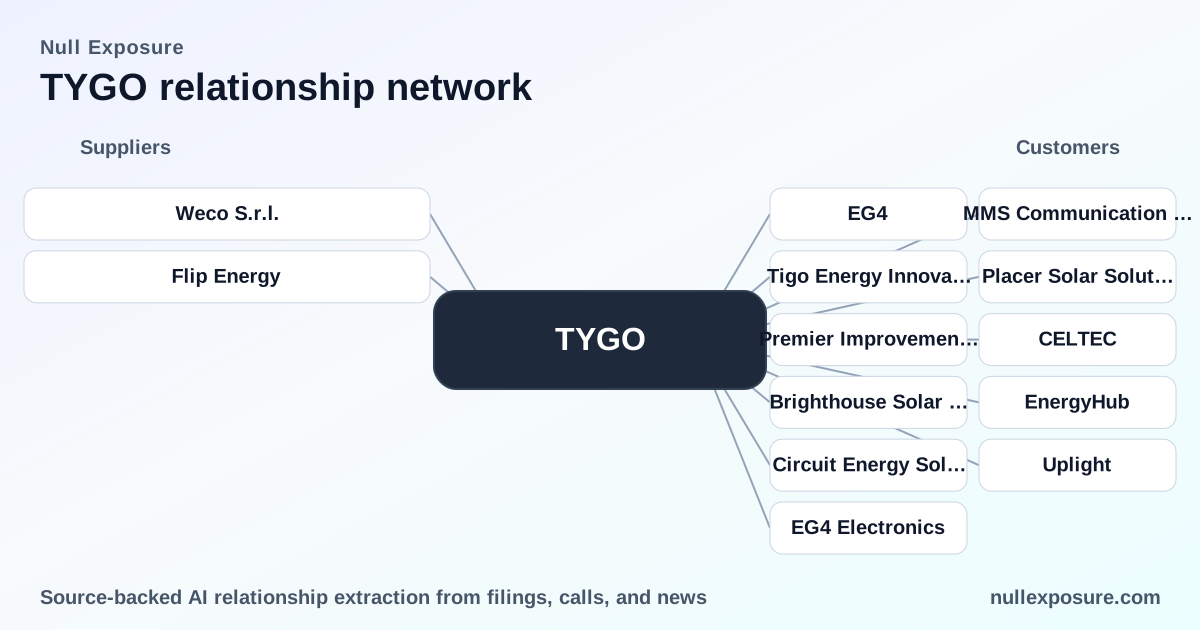
Tigo Energy (TYGO): Customer Relationships, Distribution Footprint, and Contracting Signals for Investors
Tigo Energy sells MLPE hardware and complementary software and services to distributors, installers and channel partners, monetizing primarily through point-of-sale hardware sales and a smaller, recurring subscription SaaS and monitoring business tied to its Predict+ and premium monitoring offerings. The company’s commercial model leans on distributor/reseller relationships and installer programs to scale global deployment while selectively monetizing intellectual property and ancillary software features to boost margin and cash flow. For a concise investor briefing and deeper relationship mapping, visit the NullExposure homepage: https://nullexposure.com/
Why the customer map matters for valuation
Tigo’s revenue mix and partner list drive both growth optionality and concentration risk. Hardware (MLPE) remains the core profit engine, while software and monitoring are strategic upsells that increase lifetime customer value and stickiness. Recent patent monetization and US contract-manufacturing moves shift the balance toward cash generation and supply-chain control — both positive for margin normalization if executed cleanly.
Constraints that define how Tigo operates (company-level signals)
- Contracting posture: Tigo runs a dual model — spot product sales recognized at shipment for the bulk of MLPE hardware, and long-dated subscription revenue for premium monitoring and Predict+ SaaS (contracts up to 11–20 years). This drives lumpy hardware revenue with steadier, smaller recurring streams.
- Geography and concentration: The business is EMEA-first, with roughly 60.3% of 2024 revenue from EMEA and about 24.3% from the Americas; the U.S. contributed 20.7% of net revenue in 2024. Tigo is global, with installations in over 100 countries.
- Materiality and customer concentration: Monitoring revenue is immaterial (<1% of total) and there were no customers >10% of revenue in 2023–24, indicating low single-customer concentration but dependence on channel breadth.
- Channel strategy: The company sells primarily through distributors and installers, positioning Tigo as a supplier rather than a direct-to-end-user vendor; this reduces sales cost but increases distribution dependency.
- Business segments: Hardware dominates revenue, while software (Predict+) is a growing but still modest contributor (Predict+ ~2.2% of 2024 revenue). These are strategic complements rather than equal revenue engines.
These constraints imply Tigo’s revenue profile is cyclical with hardware-driven volatility, improved predictability from long-term monitoring contracts, and operational risk tied to distributor execution and regional market swings.
Relationship roll-call: what each named partner does for Tigo
Below are the relationships cited in public sources, with a concise plain-English description and a short source note for each.
EG4
Tigo has established a U.S.-based contract manufacturing operation to produce CoC-compliant MLPE to support U.S. customers and an EG4 partnership, signaling tighter supply-chain control and a buy-side relationship with EG4 for bundled solutions. This was stated on the 2025 Q4 earnings call (transcript posted March 2026).
EG4 Electronics
Under a related arrangement, Tigo will set up U.S. production of optimizers and EG4 inverters, which EG4 Electronics will bundle and sell, creating an integrated hardware offering for U.S. customers. This arrangement was described in coverage of the partnership (LatitudeMedia, March 2026).
Tigo Energy Innovations LLC
Tigo sold certain patents to Tigo Energy Innovations LLC in a patent purchase agreement dated December 16, 2025, for a total consideration of approximately $17.75–$17.95 million (with $15.0 million upfront), representing deliberate IP monetization to improve near-term cash flow. The company disclosed this transaction in a December 2025 press release reported in March 2026 (The Globe and Mail).
CELTEC
Tigo entered a distribution partnership with CELTEC on March 9, 2026 to expand distribution of Rapid Shutdown solutions, optimizers and other products across Central America and the Caribbean, broadening Tigo’s channel reach in growth markets. The partnership was announced in March 2026 press coverage (InsiderMonkey; MarketScreener).
Premier Improvements Solar
A regional installer, Premier Improvements Solar publicly endorsed Tigo improvements and continued deployment, highlighting installer-level product satisfaction that supports channel retention and repeat business. This endorsement appeared in Solar Power World coverage of GO Battery and VPP compatibility (January 2026).
Brighthouse Solar of Central California
As a participant in Tigo’s Green Glove installer program, Brighthouse Solar of Central California demonstrates Tigo’s installer-engagement strategy designed to improve design accuracy, code compliance, and commissioning consistency across projects. This was reported in a Tigo Global Quality Program press release (STT Info, March 2026).
Circuit Energy Solutions
Circuit Energy Solutions used the Green Glove program in a case study to ensure precise design and smooth commissioning on commercial rooftop projects, illustrating how Tigo leverages installer training to reduce deployment defects and speed time-to-revenue. This case study was included in the Tigo Global Quality Program announcement (STT Info, March 2026).
Uplight
Tigo’s GO Battery was added to the Uplight distributed energy resource management platform, enabling two-way integration with DERM systems and expanding Tigo’s interoperability with utility and aggregator software. This was reported in Solar Power World’s January 2026 coverage of GO Battery VPP participation.
EnergyHub
The GO Battery was also added to the EnergyHub platform, furthering Tigo’s connectivity to virtual power plant ecosystems and opening potential aggregated revenue channels for distributed storage deployments. Solar Power World reported this integration in January 2026.
MMS Communication GmbH & Co. KG
MMS participated in early testing of Tigo’s Dynamic Rate feature within the EI residential solar-plus-storage product, providing on-the-ground validation of new software functionality for European customers. Michael Schmittinger of MMS commented on the benefits in press coverage (Cleantechnica; STT Info, late 2025 / early 2026).
Placer Solar Solutions, Inc.
Placer Solar Solutions praised Tigo’s real-time active commissioning software, highlighting field efficiency gains and the ability to commission systems locally without continuous internet connectivity — a differentiator for field deployment. This endorsement was quoted in an AltEnergyMag notice about Tigo demos (February 2026).
What this partner map signals to investors
- Distribution-first go-to-market: Multiple distributor and installer endorsements show Tigo’s channel-led scale is intact; distributor execution is therefore a key operational lever.
- Product stickiness via software and programs: Green Glove, active commissioning, and Predict+ create installer loyalty and modest recurring revenue; software is a hockey-stick enabler, not the primary revenue base yet.
- Supply-chain and IP actions improve optionality: U.S. contract manufacturing with EG4 and the patent sale to Tigo Energy Innovations LLC are explicit liquidity and margin-management moves that reduce dependency on offshore suppliers and monetize non-core IP.
- Regional exposure drives growth dynamics: Heavy EMEA weighting (60.3% in 2024) plus expansion in Central America/Caribbean and U.S. manufacturing indicate geography diversification with an EMEA-era base.
Final takeaways for investors
- Core thesis: Tigo is a hardware-led MLPE supplier with growing software and programmatic levers that improve lifetime value and installer retention; its near-term capital strategy includes IP monetization and domestic production to stabilize margins.
- Key risks: Hardware cyclicality, distributor execution, and regional concentration in EMEA; monitor distributor rollouts and recurring-revenue growth rates as early indicators of durability.
- Actionable signal: Watch EG4 manufacturing ramp and the deployment metrics from CELTEC and installer programs (Green Glove) to judge whether supply-side and channel initiatives convert into more predictable revenue and margin expansion.
For a systematic map of Tigo’s partner signals and event-driven disclosures, see our broader coverage at https://nullexposure.com/ where we track relationship-level developments and their valuation implications.