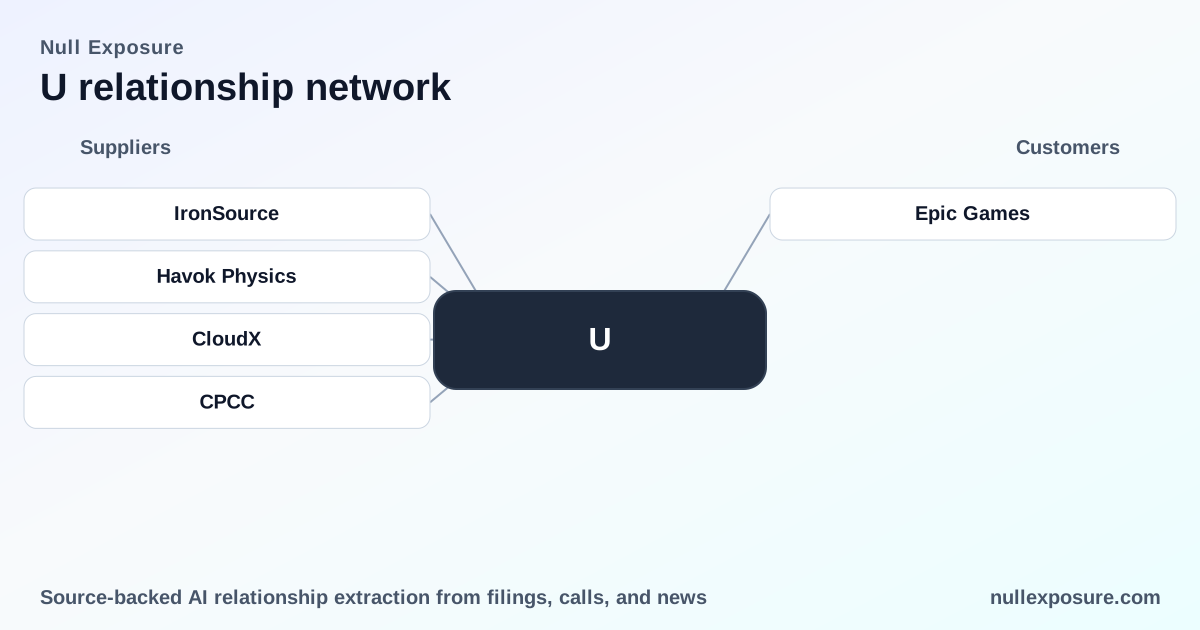
Unity’s customer map: commercial anchors, platform partners, and where revenue stability comes from
Unity Software operates a real-time 3D development platform and monetizes through a mix of Create Solutions subscriptions (one-to-five year terms with enterprise support options), Grow Solutions that include revenue- or profit-share arrangements, and platform services such as advertising mediation and in‑app commerce. The company’s revenue profile couples subscription stability with variable, transaction‑based income—creating a revenue mix that benefits from both recurring enterprise contracts and scale-dependent monetization. For a concise companion view of counterparties and commercial signals, visit https://nullexposure.com/.
Why customers matter for Unity’s valuation
Unity’s commercial relationships are both product- and scale-driven: enterprise Create subscriptions provide predictable, ratable revenue, while broader developer adoption and third‑party integrations expand addressable monetization through ads, in‑app purchasing (IAP), and platform services. That dual model makes customer concentration and strategic partnerships meaningful valuation levers—large platform partners create revenue floors and distribution, while integrations with commerce and services firms increase per‑user monetization.
Notable customer signals — record-by-record roll call
-
Meta Platforms — Shares jumped after an extension of a multi‑year partnership to support next‑generation VR experiences on Quest headsets; the move was reported premarket on 4 May 2026 and cited as a primary driver of the stock move. Source: StockTwits news article, 2026-05-04.
-
Coda (entry 1) — Simply Wall St reported on 4 May 2026 that Coda is integrating Unity’s In‑App Purchasing SDK with its global web store platforms, centralizing catalog management across mobile, web and PC through Unity’s existing IAP workflow. Source: Simply Wall St, 2026-05-04.
-
Coda (entry 2) — A parallel Simply Wall St summary reiterated that Coda’s integration uses Unity’s IAP flow to consolidate digital catalog and commerce controls for developers on multi‑platform storefronts. Source: Simply Wall St, 2026-05-04.
-
Meta (entry 1) — Simply Wall St noted on 4 May 2026 that Unity extended a multi‑year platform support and enterprise agreement with Meta, preserving Unity as a key content‑creation partner for Meta’s VR hardware and OS and supporting developers on Meta’s devices. Source: Simply Wall St, 2026-05-04.
-
Meta (entry 2) — A Simply Wall St community narrative on 4 May 2026 characterized the Meta extension as providing a stable revenue floor for Unity’s Create segment. Source: Simply Wall St community narrative, 2026-05-04.
-
Globant (entry 1) — Simply Wall St reported on 4 May 2026 that Globant and Unity formed a global partnership to deliver interactive solutions across manufacturing, healthcare and automotive using Unity’s real‑time 3D technology. Source: Simply Wall St, 2026-05-04.
-
Globant (entry 2) — Another Simply Wall St item on 4 May 2026 described Globant joining Unity’s Service Partner Program and investing in Unity certification for its engineering teams, signaling commercial enablement and go‑to‑market alignment. Source: Simply Wall St, 2026-05-04.
-
AIOT — A March 2026 press release noted Powerfleet launched an automated AI risk‑intervention module for driver safety that was integrated on Unity’s Data Highway, showing Unity’s platform being used as the central video and telemetry command center. Source: PR Newswire, 2026-03-09.
-
Facebook — A StockTwits report on 4 May 2026 recalled that the initial collaboration was centered on integrating Unity’s game engines with Facebook’s platform, reinforcing a long‑standing technical and commercial linkage between the companies. Source: StockTwits news, 2026-05-04.
-
GXAI — Simply Wall St coverage on 3 May 2026 described Gaxos.ai as building AI tools for game developers via Unity integrations and separately operating AI‑driven health services, indicating Unity’s platform is being used as an integration point for specialized AI tooling. Source: Simply Wall St, 2026-05-03.
-
Epic Games — A January 2026 market piece referenced an Epic–Unity partnership extending Unity’s monetization tools to Unreal Engine developers, a commercially material move if it broadens Unity’s monetization reach beyond its own engine ecosystem. Source: 247WallStreet, 2026-01-22.
-
Oculus — StockTwits commentary on 4 May 2026 reiterated that Unity became the primary development platform for Oculus (now Meta Quest) headsets as Meta pivoted toward VR, underlining the platform’s entrenched role in headset content creation. Source: StockTwits news, 2026-05-04.
What the corporate constraints tell investors about Unity’s operating model
Unity’s disclosed relationship constraints paint a clear picture of commercial posture and customer mix:
-
Subscription‑first contracting: Create Solutions revenue is predominantly subscription based with one‑to‑five year terms and ratable recognition, which gives Unity predictable recurring revenue components while retaining renewal exposure since subscriptions are not perpetual. Evidence in company disclosures emphasizes the subscription billing cadence and term lengths.
-
Diverse counterparty universe: Customers explicitly span individual developers, small businesses, mid‑market firms, large enterprises, non‑profits and governments, signaling low single‑counterparty concentration at the top level but a wide spectrum of contract sophistication and support needs.
-
Global footprint with regional variance: The company reports revenue associated with a non‑strategic portfolio concentrated primarily in North America and Europe, while also referencing a globally diverse customer base—this indicates global distribution but with revenue skew that matters for regional growth and FX exposure.
-
Seller and service provider roles: Unity functions as both a software vendor (Create subscriptions, enterprise support) and a platform service provider (ad mediation, transaction facilitation); revenue is therefore a mix of retained subscription fees and margin on platform transactions.
-
Segment maturity and criticality: Create Solutions are positioned as the core software offering used to build and run RT3D content, while Grow and services segments capture monetization and operational services—the business blends mature subscription economics with variable, scale‑sensitive monetization.
Investment implications and risk framing
-
Positive: strategic platform partnerships create a revenue floor. The multi‑year Meta extension and deep device integration with Quest headsets provide a meaningful enterprise anchor for Create segment revenues. Unity’s partnerships with systems integrators like Globant and commerce integrators like Coda extend distribution and monetization vectors.
-
Positive: platform extensibility increases addressable monetization. Integration of IAP, ad mediation, and Data Highway usage for AI/telemetry show Unity’s platform captures downstream commerce and services revenue beyond pure engine licensing.
-
Risk: renewal and concentration dynamics remain material. While subscription terms deliver predictability, renewals and the variable Grow segment expose Unity to performance and developer‑ecosystem risk. The broad counterparty base reduces single‑customer concentration but increases operational complexity.
-
Risk: competition and cross‑engine monetization. Moves to offer monetization tools to non‑Unity engines (as noted with Epic/Unreal) expand TAM but also place Unity in a more commoditized services role where pricing power is sensitive to competitive dynamics.
Bottom line
Unity’s customer landscape combines enterprise subscription anchors with a broad, developer‑driven monetization engine—a hybrid that supports recurring revenue while scaling variable income as adoption and integrations grow. For primary documentation and a systematic mapping of counterparties, see https://nullexposure.com/. Investors should value both the stability of multi‑year enterprise agreements (notably the Meta extension) and the growth leverage offered by commerce and platform services when modeling revenue and margin trajectories.