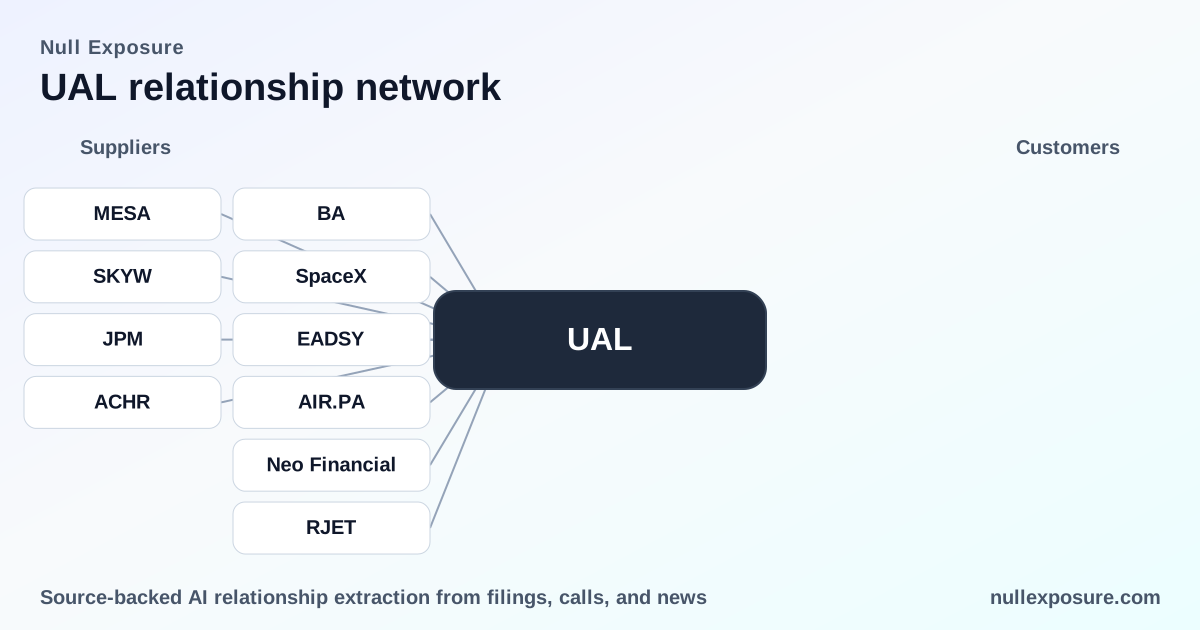
United Airlines (UAL) — Customer Relationships Under the Microscope
United Airlines is a global airline holding company that monetizes through passenger ticket sales, ancillary services (bags, seat selection, upgrades), and its MileagePlus loyalty program, distributing inventory both directly and through a web of travel intermediaries. For investors, the critical lens is how those distribution and partner arrangements convert flight capacity into predictable revenue and how partner disputes or operational dependencies can de-rate earnings visibility.
For a focused read on partner exposure and commercial risk, visit https://nullexposure.com/ for relationship-level intelligence and sources.
How United’s commercial fabric actually works — a compact investor view
United operates a hub-and-spoke passenger network with metropolitan hubs across the United States and routes on six continents. Revenue recognition is predominantly service-based: passenger transportation is recognized when carried, and ancillary sales are captured at point of sale across direct and intermediary channels. United sells via its direct channels (website and mobile app), traditional travel agencies and online travel agencies (OTAs), and through interline/partner agreements that let other carriers include United inventory in packaged products. This multi-channel distribution is a feature that diversifies revenue but introduces counterparty and contract complexity.
Material customer and partner relationships you need on your radar
JetBlue (JBLU)
United’s commercial engagement with JetBlue includes interline and reciprocal sales arrangements that expand distribution and create shared-sell opportunities. A JetBlue press release on March 10, 2026 describes the Blue Sky arrangement enabling United flights to be sold through JetBlue Vacations package products, including flight + hotel offerings to long-haul destinations. Separately, legal reporting in May 2026 documents that JetBlue has faced legal action related to arbitration over the Blue Sky interline agreement, signaling commercial frictions that can interrupt product integration and incremental sales (JetBlue press release, March 10, 2026; TradersUnion coverage, May 3, 2026).
Priceline / Booking (PCLN)
Online travel agencies act as major distribution partners for United inventory; consumer-facing travel guides note that Priceline search results aggregate United flights alongside other majors, making United immediately available to OTA customers. This distribution through OTAs increases reach but cedes pricing and customer relationship control to intermediaries (NerdWallet travel guide, referenced May 2026).
SkyWest (SKYW)
Regional operators like SkyWest provide aircraft and crews under United Express branding for United’s regional network. Local reporting from May 2026 highlights SkyWest’s maintenance activity that covers United Express flights into and out of Salina, underscoring the operational interdependence between United and its regional partners for network reliability (KCLY Radio, May 3, 2026).
What the company-level constraints tell investors about risk and durability
United’s relationship constraints translate to a clear operating picture:
- Global footprint: United operates across six continents from multiple major U.S. hubs, which reduces single-market demand concentration but increases exposure to geopolitical, regulatory, and fuel-cost volatility across regions (company operational disclosures).
- Seller posture and multi-channel contracting: The company functions primarily as a seller of transportation and services, distributing through direct channels, OTAs and interline partners. That posture means contracts are large-volume, standardized where possible, but legally complex, and disputes (such as the JetBlue arbitration) can affect near-term revenue flows.
- Active loyalty-driven relationships: MileagePlus is an active retention mechanism that converts repeat flyers to a higher-margin segment; loyalty economics are integral to yield management and ancillary attach rates.
- Service-segment maturity: Passenger transportation is a mature, commoditized service with thin margins relative to capital intensity; United’s scale gives bargaining leverage with suppliers and partners but also creates significant fixed-cost exposure.
These constraints imply a contracting environment with standardized master agreements tempered by bespoke interline and regional contracts, moderate to low counterparty concentration on a global basis, high operational criticality for regional partners, and overall mature commercial relationships that can nonetheless produce episodic disputes.
Visit https://nullexposure.com/ for more granular partner contract signals and dispute tracking.
Investment implications and a short risk checklist
United’s financial profile—EBITDA of roughly $7.9 billion on $60.5 billion in trailing revenue and a ~6% profit margin—reflects scale economics and cyclical exposure to travel demand. Key implications:
- Revenue diversification vs. control tradeoff: OTAs and interline partners expand sales but dilute control over pricing and customer data. Monitor commission structures and the share of sales flowing through intermediaries.
- Operational leverage: Regional carriers such as SkyWest are critical to feed smaller markets; operational issues at these partners can have outsized schedule and cost impacts.
- Contract and litigation risk: The JetBlue arbitration matter demonstrates that commercial disputes can interrupt joint product offerings and require legal enforcement, potentially reducing near-term incremental revenue from packaged products.
- Margin sensitivity: United’s margins will remain sensitive to fuel, labor, and capacity adjustments; partner arrangements that preserve yields (e.g., loyalty monetization and ancillary product integration) are high-value drivers.
Actionable checklist for investors:
- Track the resolution and terms of the JetBlue arbitration for implications on interline revenue and packaging opportunities.
- Monitor OTA channel economics and any shifts toward direct booking incentives that would improve margin capture.
- Watch regional partner capacity and maintenance commitments for service continuity risks in smaller markets.
Final read: what to watch next
United’s business is fundamentally commercial and operational: the company’s ability to monetize seats across direct channels, OTAs, and packaged products determines near-term revenue growth, while regional partner performance determines service reliability. Interline disputes and intermediary economics are the most actionable relationship risks today, with the JetBlue episodes providing a live example.
For investor-focused relationship intelligence and ongoing monitoring of partner disputes, contract signals, and distribution concentration, explore the research hub at https://nullexposure.com/.