United States Antimony (UAMY) — Customer Relationships and Revenue Implications
United States Antimony Corporation operates as a vertically oriented producer of antimony, zeolites and precious metals, monetizing through direct sales of refined antimony products and long‑term supply contracts with industrial and government buyers. Recent contract wins and a strategic joint venture materially shift revenue visibility from spot sales toward multi‑year offtake and processing partnerships, increasing the company's scale relative to historic revenue levels. Learn more at https://nullexposure.com/.
What changed: a government offtake that rewrites the top line
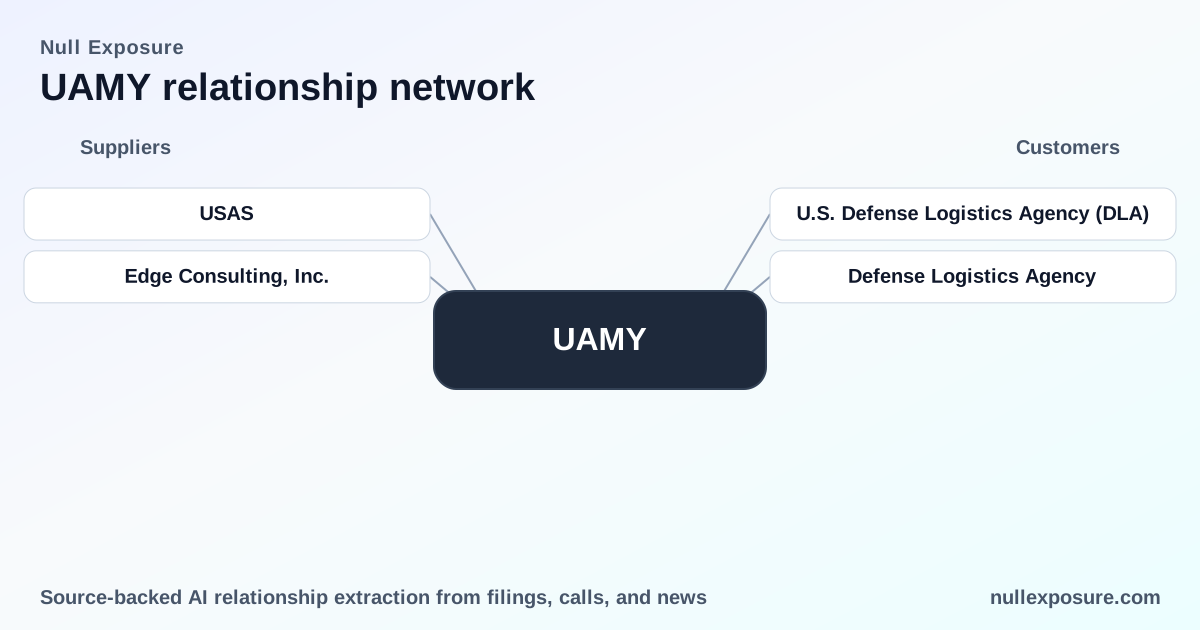
In September 2025 UAMY secured a sole‑source, five‑year indefinite delivery/indefinite quantity (IDIQ) contract with the U.S. Defense Logistics Agency (DLA) to supply antimony ingots, reported at roughly $245–$248 million in contemporary press coverage; the first delivery order has been received, giving the company immediate multi‑year revenue visibility. According to Markets.FinancialContent and corroborating reports in early 2026, the award is roughly 17x the company's revenue in the prior year, signaling an outsized, near‑term shift in scale and cash generation potential.
- Source: Markets.FinancialContent (reporting on the December 2025/early 2026 contract), and Mugglehead/TradingView coverage in March–May 2026.
Why the DLA contract matters for investors
The DLA award is transformational for UAMY in four ways: it converts cyclical spot demand into contracted revenue; it secures a government anchor customer with high delivery discipline; it materially reduces revenue uncertainty for the next five years; and it elevates execution and compliance risk by placing the company into the defense supply chain. This contract alone changes valuation geometry because of its size relative to historical sales, and it underpins near‑term growth expectations that analysts have started to bake into forward multiples.
Strategic industrial partnership: the USAS joint venture
UAMY signed a joint venture in February 2026 with Americas Gold and Silver (USAS) to build and operate an antimony processing facility in Idaho’s Silver Valley, designed to capture antimony as a valuable by‑product from Galena operations and expand domestic processing capacity. This JV accelerates downstream integration and provides UAMY with a second, industrially anchored revenue pathway beyond government sales.
- Source: InvestingNews reporting on the February 2026 JV announcement.
Company‑level signals from filings and commercial disclosures
Beyond discrete transactions, filings and company disclosures deliver consistent, investor‑relevant signals about how UAMY runs its commercial book:
- Geographic footprint: UAMY sells antimony, zeolites and precious metals primarily in the United States and Canada, with documented revenues in Mexico (reported Mexico revenues ~368,627 in the filing), demonstrating North America as the core market while maintaining modest LatAm exposure. This regional concentration simplifies logistics but exposes the company to North American pricing and policy cycles.
- Customer concentration and materiality: Customers accounting for 10%+ of sales together represent a material share of total revenues (reported at ~43%–46%), indicating a concentrated customer base where a handful of large contracts or buyers can move the income statement materially.
- Active relationships and core product focus: Filings list active customers and confirm that antimony is a core product; this underlines the company’s strategic priority on antimony offtake and processing as the revenue engine.
These signals combine into a commercial model that is contract‑driven, regionally concentrated, and material‑sensitive: long‑term contracts dramatically increase predictability but raise execution and customer‑dependence risk.
How the relationships shape the operating posture
- Contracting posture: The DLA IDIQ demonstrates UAMY’s ability to win sole‑source government contracts, shifting the company toward a hybrid model of spot sales plus negotiated multi‑year offtake agreements. This increases revenue visibility but demands more rigorous compliance, security, and delivery infrastructure.
- Concentration: With a small number of large customers representing nearly half of revenue, customer concentration is a structural feature of the business, amplifying upside when large contracts are secured and downside if any significant buyer pauses purchases.
- Criticality and maturity: Antimony is a critical mineral for defense and industrial applications; the DLA contract underscores the product’s strategic importance and places UAMY as a domestic supplier of a security‑sensitive input. The five‑year tenor and the USAS JV both indicate a move toward more mature, longer‑dated commercial relationships versus purely transactional spot sales.
Key risks and valuation implications
- Execution risk rises with scale. Delivering on a multi‑year government program and ramping a new processing JV require capital discipline, operational upgrades, and timely permitting; execution shortfalls would have outsized P&L impact given contract size.
- Concentration risk is double‑edged. The DLA award reduces short‑term revenue volatility but increases reliance on a small set of counterparties. A single large contract now drives near‑term cash flow and therefore valuation multiples.
- Repricing potential. Institutional ownership and analyst coverage have increased alongside the contract news; markets often reprice companies that convert spot commodities to secured offtake, especially for defense‑sensitive materials.
- Geopolitical and policy tailwinds. U.S. and allied strategies to shore up critical mineral supply chains strengthen the strategic value of a domestic antimony supplier, supporting a premium on contracted, secure supply.
Quick investor takeaways
- DLA contract is transformational: a sole‑source, five‑year IDIQ at roughly $245–$248 million gives UAMY unprecedented revenue visibility and changes nearer‑term cash dynamics (Markets.FinancialContent; Mugglehead; TradingView; MiniChart).
- JV with USAS adds industrial optionality: the Idaho processing facility JV creates a second pillar of growth tied to by‑product capture and vertical integration (InvestingNews, Feb 2026).
- Company signals point to concentrated, North America‑centric commercial exposure with customers representing a material share of sales and active, core product relationships evident in filings.
For a deeper read on how these vendor and customer relationships affect risk and valuation, visit https://nullexposure.com/ for our full relationship mapping and analyst brief.
United States Antimony has moved from small‑scale commodity seller toward a contracted, strategically anchored supplier of a critical mineral; investors should balance the uplift in revenue visibility against elevated execution and concentration risk when modeling forward cash flows.