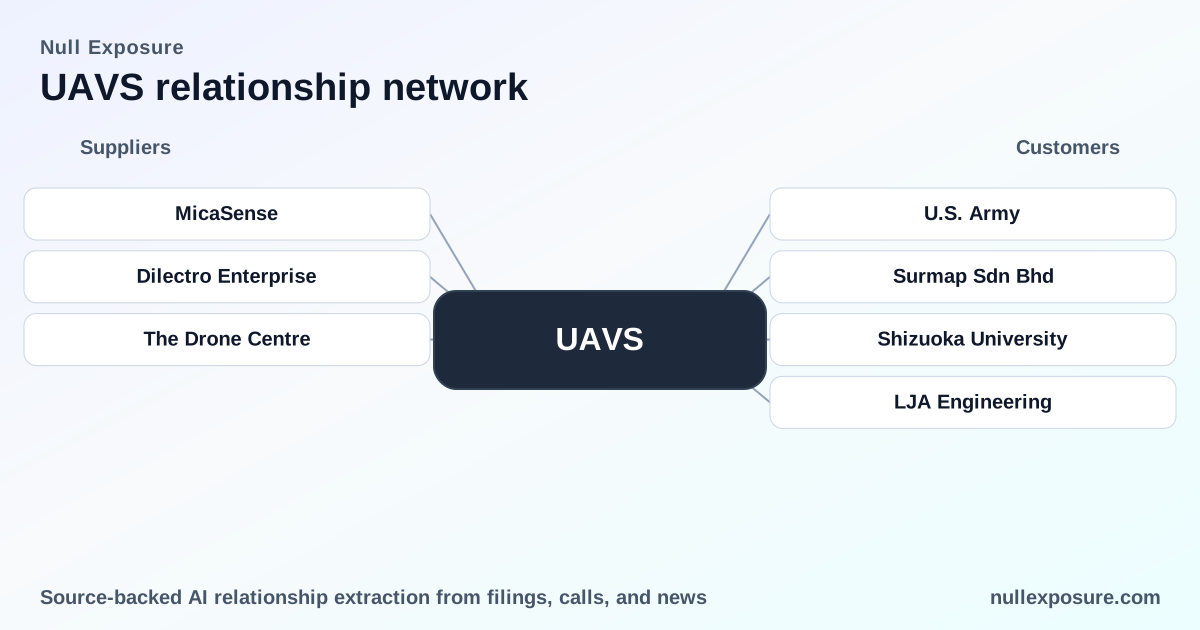
UAVS customer map: where AgEagle sells drones, sensors and services
AgEagle Aerial Systems (NYSE: UAVS) monetizes by selling mapped hardware (fixed-wing and tactical drones), multispectral sensors and related spare parts, supplemented historically by software subscriptions; revenue is generated through direct product sales, a global reseller network and government procurement channels. Investors should value UAVS as a hardware-led business with software as an adjunct selling point, a concentrated top-customer profile and growing traction in defense procurement. For a concise company-level view, visit https://nullexposure.com/.
Why the customer list matters for valuation
AgEagle’s commercial logic is straightforward: unit sales of drones and sensors drive near-term revenue and gross profit, while any software subscription or services improve lifetime value. The company reported TTM revenue of roughly $12.8M and negative operating margins, underscoring a business still scaling unit economics. Procurement wins with government buyers and regional resellers are the primary routes to scale—these relationships determine backlog, spare-parts follow-on revenue and aftermarket service economics.
Key investment takeaway: defense and institutional customers lift order size and credibility, while reseller channels expand addressable markets; however, revenue concentration and negative margins are material near-term risks that investors must monitor.
What the corporate relationships tell us (complete coverage)
Below I summarize every customer relationship disclosed in the provided results, with source context.
-
U.S. Army — AgEagle sold six eBee TAC tactical mapping drones, equipped with S.O.D.A. 3D and Duet M sensors with RTK/PPK activation, reflecting a direct defense sale for tactical mapping capability (GlobeNewswire, Jan 2, 2026).
According to a separate GlobeNewswire release (Mar 19, 2026), the U.S. Army also selected AgEagle’s eBee VISION UAS to support hands-on unmanned systems training and operator proficiency, signaling multiple procurement pathways with the DoD. -
Surmap Sdn Bhd — A Malaysia-based reseller facilitated a strategic procurement that included the eBee TAC plus spare parts to sustain an existing eBee X fleet, confirming reseller-led expansion in APAC and aftermarket parts demand (GlobeNewswire, Feb 12, 2026).
-
Shizuoka University — AgEagle sold a MicaSense RedEdge-P Green sensor to complete a triple-sensor package for climate and agricultural research, demonstrating demand from academic and research institutions for multispectral sensor capability (GlobeNewswire, Feb 17, 2026).
-
LJA Engineering — An Austin-based engineering firm acquired an eBee VISION for surveying applications, indicating commercial/engineering end-users deploy AgEagle platforms beyond agriculture into mapping and infrastructure workflows (GlobeNewswire, Mar 6, 2026).
How these relationships map to AgEagle’s business model
-
Government procurement is strategic and growing. Multiple items tied to the U.S. Army confirm that defense contracts are now a measurable channel. AgEagle’s GSA Multiple Award Schedule (five-year MAS contract awarded in April 2023) institutionalizes federal access and supports longer sales cycles and larger unit orders. This is a company-level contract posture signal rather than a relationship-specific claim.
-
Reseller network is the primary international distribution mechanism. The Surmap transaction illustrates how AgEagle leverages regional partners to access APAC customers and deliver spare parts—this supports both initial hardware sales and recurring parts revenue.
-
Product mix drives revenue timing. Sensor and spare-parts sales are recognized on shipment (spot sales), while software was historically subscription-based; however the company elected not to renew SaaS subscriptions in 2024, which changes recurring revenue dynamics and increases reliance on hardware and parts sales for near-term cash flow.
-
Customer concentration is material. AgEagle disclosed that a single customer accounted for over 10% of consolidated revenue as of year-end 2024, signaling concentration risk investors must price into valuation models.
Operational constraints and what they imply for investors
- Contracting posture: the company holds long-term government procurement access through a five-year MAS vehicle, which improves its ability to win federal orders and reduces procurement friction.
- Revenue model mix: hardware is core, software historically contributed subscription revenue but was deprioritized in 2024, increasing the company’s exposure to cyclical capital purchases.
- Sales channel structure: a global network of ~200 resellers and distributors underpins international reach, but also creates dependency on partner execution for market penetration.
- Geography and addressable markets: AgEagle reports sales and distribution across North America, EMEA, LATAM and APAC, indicating a global opportunity set that requires regional go-to-market resources.
- Materiality and concentration: a top-customer contributing >10% of revenue creates single-client exposure that elevates volatility in reported results.
- Segment maturity: hardware and sensor products are commercialized and generating revenue, while software offerings have been scaled back—this implies near-term cash conversion tied to unit sales and aftermarket parts.
Bottom-line operational assessment: AgEagle’s model is hardware-first, defense- and reseller-enabled, and exposed to customer concentration, which together shape revenue predictability and margin progression.
Risks investors should weigh now
- Concentration risk from large single customers can amplify quarter-to-quarter volatility.
- Margin pressure remains, with TTM operating margin deeply negative and EBITDA loss on the books; scaling hardware sales alone will not quickly restore profitability without higher gross margins or cost structure changes.
- Channel execution is critical—resellers expand reach but introduce execution variability and local competitive dynamics.
- Shift away from SaaS reduces recurring revenue predictability and heightens reliance on spot hardware cycles and aftermarket parts.
Where to watch next
Monitor order announcements for additional DoD awards, reseller-led national procurements, and any reversal in the company’s SaaS posture. Early indicators of durable margin improvement would be increased sensor/spare-part attach rates and higher gross profit per unit.
For a practical investor view and ongoing tracking of contract-driven momentum, visit https://nullexposure.com/ for coverage and alerts.
Bold final takeaway: UAVS has tangible traction in defense and institutional customers, yet revenue concentration and negative margins require disciplined risk-adjusted valuation—growth will follow repeatable, reseller-enabled hardware sales and sustained defense procurement wins.