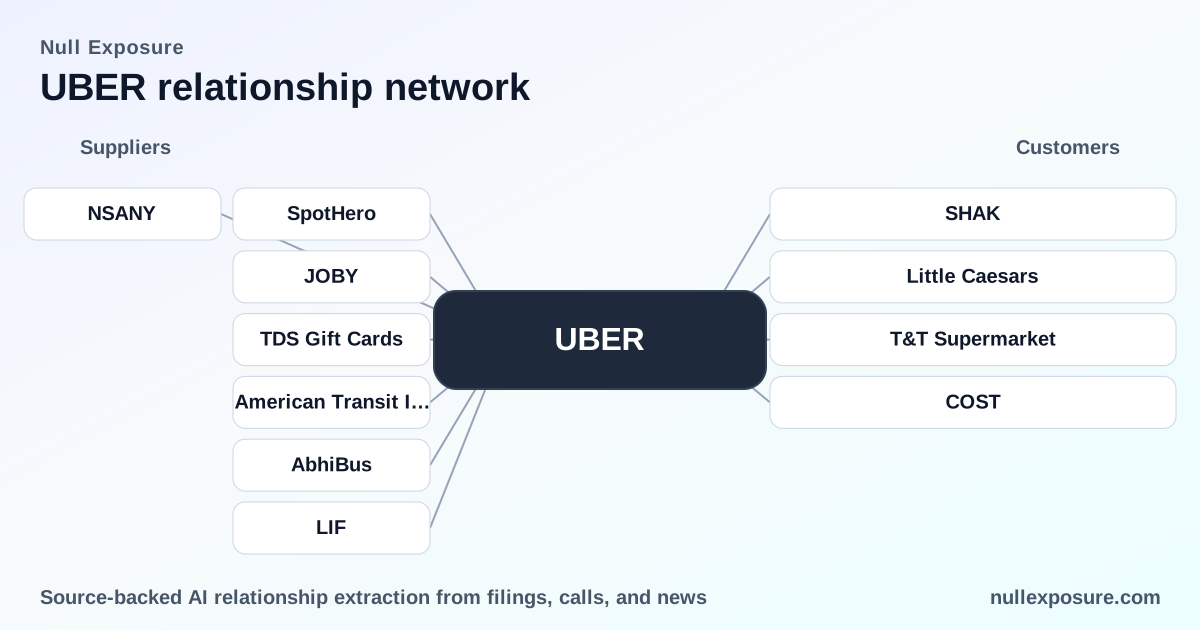
Uber’s customer map: who pays, who relies on the app, and why it matters for investors
Uber is a two‑sided mobility and logistics platform that monetizes through service fees, delivery charges and subscriptions (Uber One / Eats Pass), while expanding into freight, grocery and integrated enterprise offerings. Investors should value Uber as a global services commerce engine that extracts a margin on transaction volume, sells memberships for predictable revenue, and leverages network effects to scale adjacent businesses. For a comprehensive read on how these customer relationships translate into revenue and operational risk, visit https://nullexposure.com/.
What the operating model signals mean for valuation and risk
Uber’s customer relationships reflect a hybrid commercial posture: framework contracting for scale, subscription products for retention, and usage‑based fees for volume. Company disclosures indicate Master Services Agreements with Drivers and Merchants, a large Uber One membership base (30 million as of Dec 31, 2024), and continuing reliance on per‑transaction delivery/rides fees. This structure produces:
- High revenue variability tied to consumer discretionary spending and delivery volumes, counterbalanced by membership revenue that cushions occasional demand shocks.
- Diversified counterparty mix: a mix of individual consumers and drivers, many small business merchants, and some mid‑market customers (e.g., freight shippers), lowering single‑counterparty concentration but increasing operational complexity.
- Global footprint and regional sensitivity: platforms operate in 70+ countries with material revenue in North America and Europe; regional macro and regulatory shifts therefore materially affect revenue composition.
- Platform criticality to customers: for many merchants (restaurants, grocers, retail), Uber functions as a critical distribution channel; for enterprise clients and freight partners, integration maturity is improving as pilots convert to commercial pilots.
These signals imply scalable gross margins with non‑trivial execution and regulatory risks, particularly where merchant economics or autonomous/robotic delivery adoption change unit costs.
If you are modeling counterparty exposure or channel concentration, our platform analysis can help — learn more at https://nullexposure.com/.
The customers: concise relationship snapshots you can act on
Below are each of the customer mentions pulled from public disclosure and news, with a one‑to‑two sentence plain‑English summary and the source context.
Darden (DRI)
Darden reports promotions that integrate Uber for delivery — Olive Garden ran a multi‑channel campaign offering “1 million free deliveries” that was partially funded by Uber, and the company noted Uber Direct delivery fees improved check mix (40 bps) but were passed to Uber. Source: Darden 2025 Q4 earnings call (2026 reporting).
Leslie’s (LESL)
Leslie’s expanded same‑day delivery through a partnership with Uber as part of a transformation plan to improve customer convenience and retention. Source: company press coverage and FY2026 commentary (March 2026).
Life360 (LIF)
Uber and Life360 expanded a strategic integration enabling linked accounts, real‑time trip tracking, ride booking and membership benefits targeted at families. Source: Life360 / Uber partnership announcement (Feb 17, 2026).
Papa John’s (PZZA)
Papa John’s management called out the need to compete harder on third‑party delivery channels and cited strength in Uber Eats performance in recent quarters. Source: Papa John’s earnings commentary and FY2026 news (March–May 2026).
Shake Shack (SHAK)
Shake Shack is listed among brands using robotic and autonomous partners to power deliveries through platforms such as Uber Eats, reflecting Uber’s participation in pilot autonomous delivery programs. Source: Serve Robotics / partner news and FY2025–FY2026 reports (Nov 2025–Mar 2026).
Cinemark (CNK)
Cinemark announced national partnerships with Uber Eats (alongside other aggregators) to deliver theater concessions to consumers at home, expanding concession channels. Source: Cinemark press releases and FY2026 marketing materials (Mar–May 2026).
1‑800‑Flowers (FLWS)
1‑800‑Flowers highlighted expansion of third‑party marketplace offerings including Uber to support same‑day and seasonal delivery (e.g., Valentine’s Day), signaling Uber’s use in retail peak logistics. Source: company news and FY2025–FY2026 commentary (2026).
WeRide / WRD
WeRide referenced drawing on Uber’s user base and app infrastructure in markets like Dubai, indicating Uber’s platform is a distribution partner for autonomous taxi pilots. Source: travel/tech news coverage (May 2026).
Little Caesars
Little Caesars is named as a merchant partner supported by autonomous delivery partners and platforms such as Uber Eats, showing chain participation in new delivery modalities. Source: Serve Robotics news release (Mar 2026).
T&T Supermarket
Uber Eats struck a deal to offer grocery delivery with T&T Supermarket across Canada, advancing Eats’ push into grocery and higher‑frequency orders. Source: market press coverage and FY2026 news alerts (Mar 2026).
Costco (COST)
Costco’s same‑day delivery outside the U.S. leverages Uber Eats (and DoorDash) internationally, positioning Uber as a partner in big‑box on‑demand fulfillment. Source: trading and analyst commentary on FY2026 operational notes (Mar 2026).
Joby Aviation (JOBY)
A deal allows Joby flights to be bookable via the Uber app, expanding Uber’s travel marketplace and Joby’s distribution reach through the Uber ecosystem. Source: trading‑platform commentary and FY2026 news (May 2026).
Aurora (AUR)
Aurora announced a multiphase commercial pilot with Uber Freight to move freight in Texas and explore network integration, reflecting Uber Freight’s role in B2B logistics pilots. Source: Aurora/FutureTransport announcement (historical FY2021 reference surfaced in 2026 reporting).
Expedia (EXPE)
Following a pilot, Uber rides were slated for integration into the Expedia app, enabling in‑app ride booking and closer travel commerce integration. Source: hospitality/industry news (June 2026 pilot timeline referenced in May 2026 reporting).
Expensify (EXFY)
Expensify entered a multiyear integration with Uber for Business to automate travel and meal receipts and strengthen corporate policy controls through automated e‑receipts. Source: Expensify announcements and FY2026 commentary (Mar–May 2026).
Staples (SPLS)
Uber Eats added Staples to its items‑delivery roster to deliver office and school products nationwide, demonstrating Uber’s push beyond food into general merchandise. Source: Uber press release / PR Newswire (2023, cited in 2026 collection).
BFIIW (reef/virtual kitchens reference)
Industry commentary cites leveraging traffic from digital service providers like Uber Eats to expand into new areas quickly via kitchen partners, emphasizing Uber’s role as a traffic and distribution engine for scaled food concepts. Source: sector analysis and FY2021/2026 themed commentary.
Portillo’s (PTLO)
Portillo’s announced delivery orders executed exclusively via Uber Eats for certain promotions, indicating exclusive channel strategies with Uber for targeted campaigns. Source: Portillo’s press coverage and FY2025 news (Dec 2025–Mar 2026).
Domino’s (DPZ)
Domino’s management discussed partnerships with aggregators like Uber to expand market reach, while also noting share gaps on certain platforms, highlighting competition for platform presence. Source: Domino’s earnings commentary and FY2026 analyst transcripts (Mar 2026).
Investment implications and closing takeaways
- Revenue model diversity is a strength: membership, per‑ride/delivery fees, and freight/grocery initiatives create multi‑channel monetization.
- Operational risk centers on merchant economics and regulatory regimes: many counterparties are small businesses and individual drivers, increasing platform governance complexity.
- Strategic optionality is real: integrations with Life360, Expedia, Joby and pilots with Aurora/Serve Robotics show Uber is converting distribution advantages into new revenue streams.
Bold, strategic customer relationships underpin Uber’s valuation but require active monitoring of merchant profitability, autonomous delivery adoption, and region‑specific regulatory shifts. For a deeper counterparty and contract‑level review tailored to due diligence workflows, explore our platform at https://nullexposure.com/.