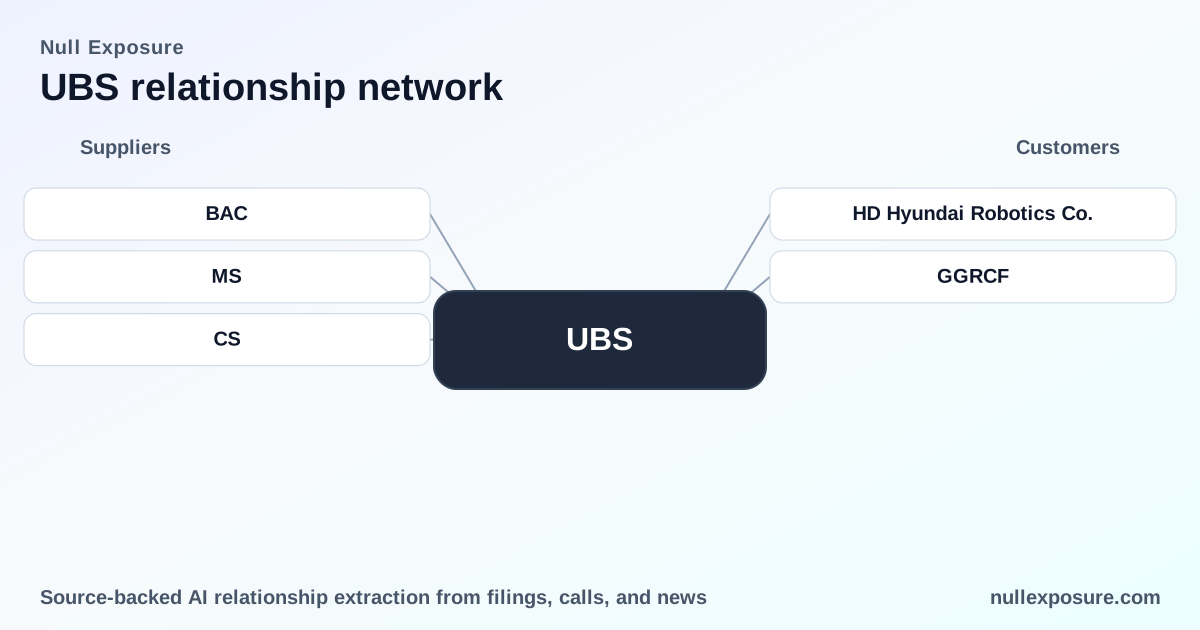
UBS: Client Relationships and Deal Flow — What Investors Should Know
UBS Group AG is a global commercial and investment bank that monetizes through advisory fees, underwriting and syndication fees, securities trading and principal lending. The firm captures recurring revenue from capital markets underwriting and asset management distribution while earning spread and fees from credit and liquidity facilities. For investors, the client roster documented here highlights UBS’s role as both a principal lender and a lead capital-markets provider across buybacks, IPOs, rights offerings and corporate finance mandates. Learn more about how we source and surface relationship intelligence at https://nullexposure.com/.
How UBS converts relationships into revenue
UBS operates as a full-service investment bank and wealth manager: it wins mandates as lead bookrunner, exclusive advisor, dealer/placement agent and lender, then collects underwriting fees, advisory fees, trading commissions and interest on credit lines. The breadth of clients — from REITs to industrial borrowers, media sellers, and blue‑chip global corporates — demonstrates a diversified revenue base anchored in capital markets execution and credit provision. Its contracting posture ranges from one-off deal mandates (M&A and IPOs) to multi-year credit facilities and repurchase/repo-style arrangements that generate predictable fee and interest income.
Operating-model signals investors should note
- Contracting posture: UBS commonly acts as lead bookrunner, exclusive financial advisor or lender, which positions the bank to negotiate fees and follow-on mandates.
- Concentration and diversification: Client list spans industries — energy, shipping, technology, consumer, REITs — reducing sector concentration risk while concentrating revenue in capital markets cycles.
- Criticality: For many clients UBS provides mission-critical execution (buyback management, rights offerings, credit facilities) where replacement is operationally complex and time-sensitive.
- Maturity: Relationships evidence both one-off advisory roles and multi-year credit arrangements; this mix supports both transactional booms and steady fee generation.
If you want a structured view of these counterparties and the exact public disclosures that document them, visit https://nullexposure.com/.
Relationship roll call: what UBS is doing and for whom
Below is a plain-English line-by-line summary of every relationship found in the public record we reviewed. Each entry includes a concise source pointer.
- NXG — UBS Securities LLC signed as a dealer manager and sub-placement agent to support NXG NextGen Infrastructure Income Fund’s rights and equity offerings in 2026. A filing and contemporaneous press reports documented the dealer manager/sub-placement arrangement (Investing.com; TradingView; MarketScreener, May 2026).
- ARKO / APC — UBS Investment Bank served as a lead book-running manager for ARKO Petroleum’s IPO of its fuel-distribution subsidiary (APC), including pricing and closing coverage in early 2026 (GlobeNewswire; CSPDailyNews; QuiverQuant, Feb–May 2026).
- BZFD (BuzzFeed) — UBS Investment Bank acted as exclusive financial advisor to BuzzFeed on the sale of First We Feast, per the company’s announcement (BuzzFeed press release, 2026).
- IFED — The ETN IFED is issued by UBS Group AG, establishing UBS as issuer for that structured product (TradingView; DefenseWorld report, 2026).
- CICB — Murray Hill Funding II and the company amended repurchase/termination arrangements with UBS as lender and counterparty, recorded in the company’s FY2024 filing (CION Investments filings, 2024–2026).
- MCB (Metropolitan Bank Holding) — UBS and Hovde acted as joint book-running managers for Metropolitan’s equity exercise and overallotment closing in March 2026 (TradingView; BizWire/FinancialContent, Mar 2026).
- RELX — RELX PLC executed multiple buyback transactions through UBS AG London Branch, with UBS handling execution under the company’s repurchase program in early 2026 (Reuters/TradingView/TS2.tech coverage, Feb–Mar 2026).
- BANX (ArrowMark Financial) — UBS Securities served as dealer manager and sub-placement agent for ArrowMark’s transferable rights offering launched in January 2026 (The Globe and Mail; Investing.com, Jan–May 2026).
- ILPT (Industrial Logistics Properties Trust) — UBS Investment Bank was part of the underwriting syndicate for ILPT’s IPO, alongside several global banks (MarketBeat/Zacks, 2026).
- FRBN (Forbion European Acquisition Corp / FEAC advisors) — UBS Securities and Leerink Partners acted as capital markets and financial advisors to FEAC in connection with the business combination announced in 2023 and referenced in later press (MarketScreener, 2023/2026).
- ULS (UL Solutions) — Jefferies, UBS Investment Bank and BNP Paribas were co-lead underwriters on UL Solutions’ $975m follow‑on equity raise completed in December 2025 (Yahoo Finance; Sahm Capital coverage, Dec 2025–2026).
- ASTS (AST SpaceMobile) — UBS acted as placement agent and financial advisor on proposed repurchases and placements and, separately, UBS AG Stamford provided a $420m cash-collateralized term loan to an AST-related entity in late‑2025 (SEC filings and press, Oct 2025–Mar 2026).
- PAII (Pyrophyte Acquisition Corp II) — UBS Investment Bank served as lead bookrunner on the SPAC offering which completed an over-allotment in 2025 (FinancialContent/Markets coverage, Jul 2025).
- NX (Quanex Building Products) — UBS Investment Bank served as sole financial advisor to Quanex on a strategic transaction announced in 2026 (ADVFN/press release, May 2026).
- SEVN (Seven Hills Realty Trust) — UBS Investment Bank acted as sole dealer manager on a rights offering and later extended financing maturities with UBS facilities (BizWire; company call transcripts, Dec 2025–May 2026).
- ZWS (Zurn Elkay Water Solutions) — UBS AG Stamford Branch had been the administrative and collateral agent on a revolving credit facility that was referenced in a facility amendment in 2026 (Investing.com, May 2026).
- ICMB (Investcorp Credit Management BDC / ICMB) — The company discloses revolving credit facilities including lines with UBS, reflecting UBS’s role as liquidity provider to specialty BDCs (10‑K style review / analyst note, 2025–2026).
- OZON — UBS Securities was one of the placement/organizing banks on OZON’s listing/placement in historical documents (Moscow Exchange release, FY2020 disclosure cited 2026).
- ZGN (Ermenegildo Zegna) — UBS Investment Bank acted as exclusive financial advisor and co‑lead placement agent on Zegna’s NYSE listing and PIPE in 2021 (historical press, cited in later coverage).
- GSL (Global Ship Lease) — GSL refinanced credit facilities with an $85m UBS credit line in 2025, improving maturity schedule and liquidity flexibility (company press release/ManilaTimes, Mar 2026).
- EQPT (EquipmentShare) — UBS Investment Bank was part of the lead bookrunning syndicate at EquipmentShare’s IPO in 2026 (Equipment Finance News, May 2026).
- TBLD (Thornburg Income Builder Opportunities Trust) — UBS was a lead manager in the 2021 underwriting syndicate, cited in its offering announcement (PR Newswire historical filing).
- NLY-P-G (Annaly Capital preferred tranche) — Annaly signed a distribution agency agreement with UBS Securities as part of a preferred issuance (TradingView summary of March 2025–2026 activity).
- RITM‑P‑B (Rithm) — UBS Investment Bank and Citigroup acted as financial advisors on Rithm’s strategic transaction with Paramount, per industry coverage (CommercialSearch/press, 2025–2026).
- SHLS (Shoals Technologies) — UBS Investment Bank acted as a joint book-runner on Shoals’ IPO and subsequent upsized offering (Guggenheim/GlobeNewswire, 2021–2022, cited in later summaries).
- TOP (Zhong‑Yang Financial Group) — TOP has referenced connecting CFD liquidity to UBS among other liquidity providers as it developed Hong Kong operations (GlobeNewswire/2022 disclosure).
- CFMS (Conformis) — UBS Investment Bank served as Conformis’ financial advisor on the 2023 sale to Restor3D (GlobeNewswire/CityBiz press, Jun 2023/2026).
- PTLO (Portillo’s) — UBS was listed as a lead book-runner on Portillo’s proposed offering filings (SEC prospectus, FY2021 filings cited).
- BEAGR (Bold Eagle Acquisition Corp) — UBS Investment Bank served as an underwriters’ representative alongside Jefferies for the SPAC offering (GlobeNewswire/ManilaTimes, Oct 2024).
- SRTA (Blade Air Mobility) — UBS Investment Bank served as exclusive financial advisor to Blade on the sale of its passenger division (Dronelife/2025 transaction coverage).
- CG (Carlyle Group) — Reports indicate Carlyle and co‑sponsors agreed to pay UBS for product‑selling services; UBS participates in distribution and performance‑fee arrangements (MarketScreener, Mar 2026).
- APO (Apollo) — UBS AG served as financial advisor to Apollo on a strategic acquisition of Forvia’s interiors unit (Apollo press release, 2026).
- BTI (British American Tobacco) — BAT engaged UBS to execute buyback transactions, including prearranged purchases during closed periods in early 2026 (TS2.tech reporting/Jan–Feb 2026).
- NWG (NatWest Group) — NatWest disclosed share purchases from UBS AG London Branch and UBS acted as financial adviser on separate mandates for NatWest (Reuters/TradingView coverage, Feb–Mar 2026).
- HT (Hersha Hotels) — A board member’s prior UBS role is referenced as the bank’s historical involvement in Hersha’s re‑IPO, indicating long-standing advisory ties (HotelsMag feature referencing earlier UBS mandate).
- BCAX (Bicara Therapeutics) — SEC filings name UBS Financial Services as broker for small block sales reported in March 2026 (SEC/StockTitan filing, Mar 2026).
- CLF (Cleveland‑Cliffs) — UBS Securities LLC acted as sole underwriter on a proposed offering, with an option to purchase additional shares, per the company’s 2025 offering notice (Markets FinancialContent, Oct 2025–Mar 2026).
- ABT (Abbott Laboratories) — UBS Financial Services is named as a securities exchange broker in recent SEC documentation (SEC/StockTitan disclosure, 2026).
- 360 One (360ONE.BSE) — 360 One agreed to acquire UBS’s India wealth business for INR 3,070 million, representing UBS’s strategic divestiture in a regional market (SimplyWall.St summary, Apr 2026).
- Golden Goose / GGRCF — UBS participated in arranging debt financing for the Golden Goose buyout, alongside Goldman Sachs and JPMorgan (TradingView coverage, 2026).
- Cantor Fitzgerald, L.P. — Cantor Fitzgerald entered a definitive agreement to acquire UBS O’Connor LLC from UBS, a sale of a specialty business line announced in 2026 (SimplyWall.St summary, Apr 2026).
- American Express Swiss Holdings GmbH — American Express Swiss Holdings agreed to acquire the remaining 50% stake in Swisscard from UBS AG, indicating UBS divestment of a joint-venture card business (SimplyWall.St reporting, 2026).
Bottom line for investors
UBS’s client activity in the public record demonstrates dominant positioning in capital markets execution, buyback management and corporate credit provision. The relationship mix produces fee‑heavy, transactional revenue in strong markets and interest income from credit facilities that smooths cycles. Monitor deal flow volumes and the mix between advisory/underwriting and credit exposure to assess near‑term revenue sensitivity to capital markets conditions.
For an investor-ready visualization of these counterparties and the underlying filings, visit https://nullexposure.com/.