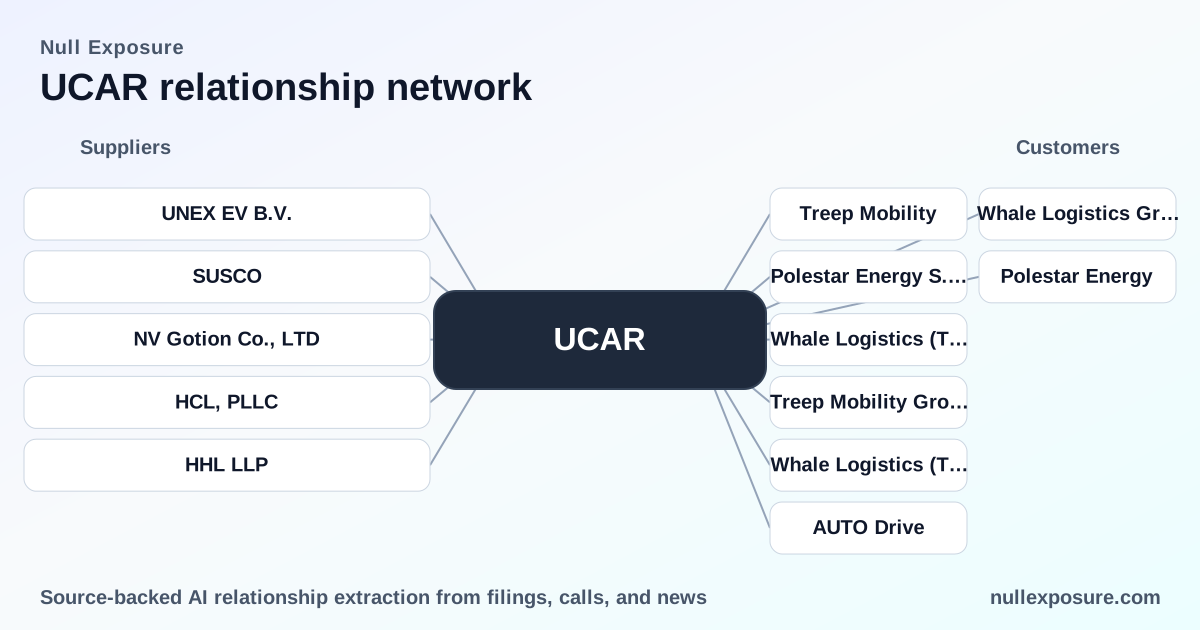
U Power (UCAR) — customer map and commercial implications for investors
U Power develops and sells new-energy vehicles and battery-swapping stations, monetizing through hardware sales, station deployments and strategic commercial partnerships that convert pilots into fleet rollouts. The company’s revenue mix is hardware-first with nascent recurring service potential tied to battery-swapping infrastructure, and recent customer wins show a deliberate strategy to convert pilot programs into regional deployments. For direct updates and ongoing relationship monitoring, see https://nullexposure.com/.
Why the customer list matters: a concise thesis for investors
U Power is executing a classic hardware-led EV playbook: sell vehicles and supporting swapping stations to fleet operators and energy integrators, then scale by converting anchor customers into multi-hundred or multi-thousand unit programmes. Early anchor contracts — not broad retail volumes — will determine whether U Power can move from small commercial revenues to scaling recurring infrastructure fees, so each named customer in the company’s public releases is strategically important.
What the deal flow reveals about commercial posture
The disclosed relationships show a pattern: targeted strategic partnerships and initial orders in key geographies (Thailand, Peru, Southern Europe) rather than mass-market retail. That posture signals a contracting approach focused on pilots and phased rollouts, where a small number of large customers will drive near-term revenue volatility and long-term scale if conversion succeeds.
For a snapshot of the company’s financial base-line: according to company filings through Q3 2025, U Power reported roughly $48.8 million in trailing twelve‑month revenue and negative operating performance (TTM EBITDA of -$36.6 million), which frames these customer agreements as early commercial validation rather than margin-generating scale.
Customer-by-customer: what investors need to know
Whale Logistics (Thailand) Co., Ltd.
U Power has entered a strategic partnership to support the deployment of up to 1,000 battery‑swapping heavy trucks in Thailand over three years, with pilot production of 30 trucks completed and pilot shipments scheduled in late May 2026. This is the company’s most material commercial commitment in Southeast Asia and represents the clearest path to volume if execution continues as announced (PR Newswire / May 2026; Investing.com / May 2026).
Whale Logistics Group (consolidated reporting)
Multiple press releases and market outlets reference the Whale Logistics Group relationship as a strategic agreement to promote commercial battery‑swapping truck tractors in Thailand and the region, underlining U Power’s emphasis on logistics fleets as anchor customers for heavy-duty electrification (Marketscreener / March 2026; Barchart / March–May 2026).
Treep Mobility (Treep Mobility Group S.A.C)
U Power signed an initial sales agreement to deploy fifty two‑ and three‑wheeled battery‑swapping vehicles, eight cabinets and the corresponding batteries in Peru, marking the company’s first official order in South America and an entry into last‑mile and ride‑hailing segments in that market (Yahoo Finance / PR Newswire release, March 2026).
Polestar Energy S.L. (Polestar Energy)
U Power executed an initial €540,000 sales agreement with Polestar Energy for twenty UOTTA™ battery‑swapping vans and a semi‑autonomous three‑slot swapping station intended for Southern Europe—a targeted European pilot that combines vehicle and station hardware in a single transaction (Yahoo Finance / PR Newswire release, March 2026).
AUTO Drive
AUTO Drive, one of Thailand’s larger taxi and ride‑hailing operators, was an early adopter in U Power’s April 2025 pilot batch, operating swappable EVs on Phuket routes. This relationship illustrates the company’s customer strategy of converting local taxi and ride‑hail fleets into demonstration sites for broader municipal and regional rollouts (Media‑Outreach / July 2025).
What these relationships signal about U Power’s operating model
- Contracting posture: U Power pursues strategic, partnership-style agreements and initial sales orders that bundle vehicles with stations; this is more commercial‑contract oriented than retail distribution. The company is prioritizing anchor deals that enable scale pilots.
- Customer concentration: The public record shows a small number of named customers with large, multi‑vehicle programs; revenue concentration risk is high until order flow broadens.
- Criticality: For customers like Whale Logistics and AUTO Drive, battery‑swapping capability is positioned as operationally critical to green logistics and urban fleet operations, making U Power’s hardware a mission‑critical vendor in those deployments.
- Maturity: These are early commercial engagements and pilots across several regions—the business is in early commercialization rather than mass deployment, with hardware sales today and potential recurring service revenues if swapping networks scale.
No formal contracting constraints were recorded in our relationship feed; investors should therefore treat disclosed deal terms as commercial announcements rather than detailed contractual covenants.
Investment implications and risk checklist
- Upside: Large anchor orders such as the 1,000‑truck Whale Logistics program and the regional pilots with Polestar and Treep provide clear step‑function revenue potential if executed and scaled.
- Execution risk: Converting pilots into multi‑year, multi‑thousand unit deployments is operationally and capital‑intensive; U Power’s TTM revenue (~$48.8M) and negative EBITDA position the company as an early-stage commercial operator, not a scaled operator.
- Concentration risk: A small number of customers drive headline growth—investors should watch order cadence and geographic diversification closely.
- Capital and margin pressure: Hardware-led models typically require working capital for production and inventory; margins will only expand with scale and any recurring swapping or subscription services.
Tracking the story and next steps
Monitor primary sources of future disclosures—company press releases, PR Newswire milestones, and regional trade press—for shipment confirmations, station commissioning, and follow‑on orders. For consolidated monitoring and relationship intelligence on U Power, visit https://nullexposure.com/.
Bold takeaway: U Power’s named customer wins are strategically meaningful but materially concentrated; the investment case pivots on execution of Whale Logistics and successful conversion of pilot agreements into sustained fleet rollouts.