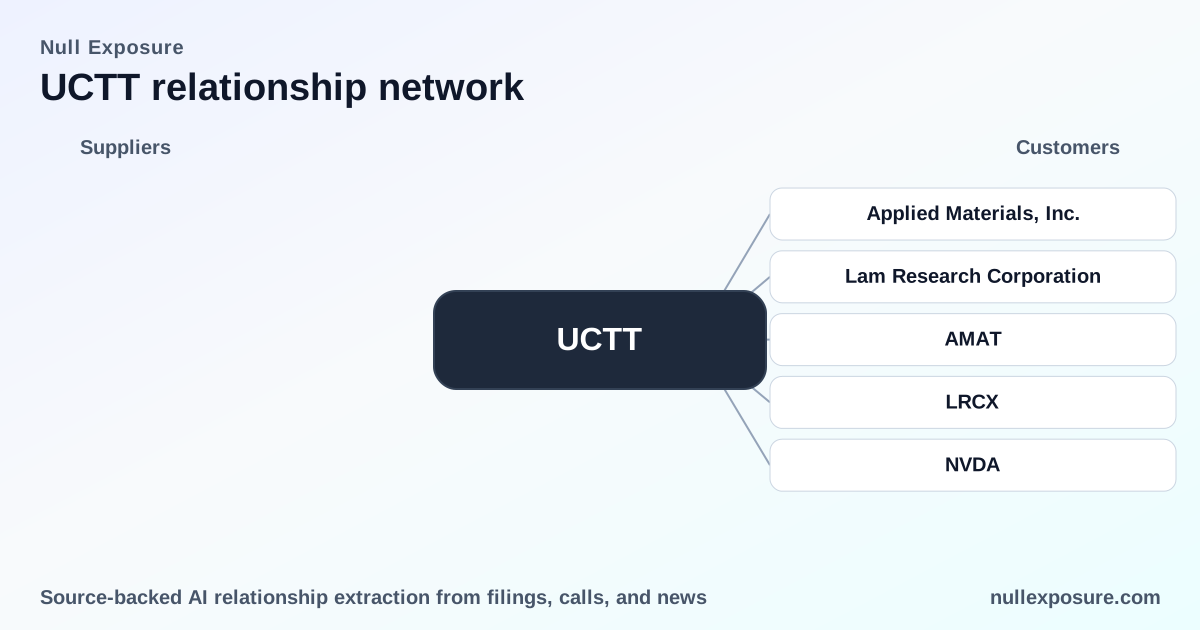
Ultra Clean Holdings (UCTT): Customer Map and Commercial Signals for Investors
Ultra Clean Holdings monetizes by designing and manufacturing production tools, modules, subsystems and complementary ultra‑high purity services for the semiconductor capital equipment and integrated device manufacturing ecosystems. Revenue derives from a mix of engineered product sales and recurring services (parts cleaning, coatings and micro‑contamination analysis) sold to a concentrated set of large, global equipment and semiconductor manufacturers. For investors, the investment thesis rests on operational leverage as the company ramps utilization against a stated ~$3 billion revenue capacity, tempered by material customer concentration and short-term commercial posture. Learn more at https://nullexposure.com/.
Why the customer base matters more than ever
Ultra Clean’s customer set defines both upside and structural risk. The company reports that its top two customers together accounted for roughly 54.5% of revenue in FY2024, and international revenue consistently represents roughly 70% of total sales, creating exposure to a handful of large multinational buyers and global fab investment cycles. The firm generally sells on short-term ordering and 30–60 day payment terms rather than minimum purchase commitments, which produces revenue volatility tied to customer capex timing but preserves margin upside when demand reaccelerates.
How Ultra Clean actually contracts and delivers
Ultra Clean conducts business as a seller of engineered subsystems and high‑value services. Contracts are typically non-binding volume forecasts rather than long-term guaranteed orders; payment terms are short. This implies a business model where capacity utilization and order cadence from a few major customers drive near‑term revenue, while engineering capabilities and service stickiness underpin long‑term customer relationships.
Customer relationship breakdown (what the filings and news say)
Below are the named customers that figure in Ultra Clean’s public disclosures and subsequent market coverage. Each entry contains a concise plain‑English summary and the specific public source.
Applied Materials, Inc.
Applied Materials is one of Ultra Clean’s two largest customers and has accounted for more than 10% of total revenues across FY2022–FY2024; Applied is therefore a material, high‑value buyer of UCTT’s products and services. — Source: Ultra Clean FY2024 Form 10‑K (filed Dec 2024).
Lam Research Corporation
Lam Research is the other of Ultra Clean’s two largest customers, also exceeding 10% of revenues during FY2022–FY2024, making Lam a second focal point of revenue concentration. — Source: Ultra Clean FY2024 Form 10‑K (filed Dec 2024).
Applied Materials / AMAT (press coverage)
Market commentary reiterates that Applied Materials (AMAT) is a principal demand driver for Ultra Clean and that maintaining that relationship is central to revenue outcomes. — Source: TradingView news coverage summarizing the company’s 10‑K (March 2026).
Lam Research (press coverage)
Independent coverage highlights Lam Research alongside Applied as the small set of customers that together represent a large share of Ultra Clean’s revenue, reinforcing concentration risk in market commentary. — Source: TradingView news coverage summarizing the company’s 10‑K (March 2026).
Intel
Intel is identified in recent market coverage as one of Ultra Clean’s largest customers and a key end market for new factory launches; Intel’s fab investments directly influence Ultra Clean order flow for both products and services. — Source: InsiderMonkey and other press coverage of Q1 2026 commentary (May 2026).
TSMC
TSMC is cited in earnings‑call coverage as one of the leading customers driving new leading‑edge factory launches, and therefore a strategic demand source for Ultra Clean’s engineered subsystems and services. — Source: InsiderMonkey coverage of the Q1 2026 earnings call (May 2026).
Samsung
Samsung is listed alongside TSMC and Intel as a major customer influencing demand for Ultra Clean’s products; Samsung’s greenfield and conversion investments contribute to medium‑term order visibility. — Source: InsiderMonkey coverage of the Q1 2026 earnings call and Tikr analysis (May 2026).
Nvidia (NVDA)
Nvidia is referenced in market write‑ups as a major customer historically tied to periods of elevated demand; a 2025 digestion phase among GPU customers is cited as a contributory cause to near‑term order softness. — Source: InsiderMonkey and Finviz coverage of market commentary (March 2026).
Micron
Micron is named in analyst coverage as a representative memory customer whose multi‑year commitments to greenfield and conversion investments support Ultra Clean’s operating‑leverage thesis as utilization ramps. — Source: Tikr analysis of Q4/earnings commentary (May 2026).
SK Hynix
SK Hynix is listed with other memory customers in market commentary as part of the multi‑year investment commitments that underpin the company’s second‑half 2026 demand expectations. — Source: Tikr coverage summarizing management commentary (May 2026).
What the company‑level constraints tell investors
Use these constraints as structural signals rather than per‑customer facts:
- Short‑term commercial posture: Ultra Clean typically operates on 30–60 day payment terms and without long‑term minimum purchase commitments, so revenue is closely tied to customer capex timing and forecasted volumes.
- Concentration with large enterprises: The customer base skews toward large multinational semiconductor capital equipment manufacturers, which creates customer concentration risk but also high contract discipline and credit quality.
- Global revenue profile: Roughly 70% of revenue is international, so Ultra Clean’s performance tracks global fab cycles and regional incentive programs.
- Mixed product + services model: The business combines engineered core products (subsystems, modules) with recurring services (cleaning, recoating, contamination analysis), which helps diversify revenue streams and increases stickiness with long‑running OEM tool lifecycles.
- Materiality: The top two customers together represented more than half of revenues in FY2024, making client retention and order cadence the primary drivers of near‑term earnings volatility and upside.
Risk, runway and what to watch next
Ultra Clean’s financial leverage to customer capex is both the asset and the liability of the equity story. Key monitoring items for investors:
- Execution on ramping utilization from the reported 65% toward the company’s stated $3 billion capacity ceiling; moves to higher utilization drive operating leverage and margin expansion.
- Order cadence and backlog changes from Applied, Lam, Intel and the memory OEMs (Micron, Samsung, SK Hynix); small shifts at the top customers produce outsized revenue swings.
- Receivable and working capital trends given short payment terms and concentrated sales.
Short checklist:
- Watch quarterly disclosures for changes in the percentage of revenue from the top two customers.
- Track management comments about non‑binding forecasts versus firm purchase orders.
- Follow capacity utilization and reported revenue capacity figures.
Conclusion: positioning for a cyclical upcycle
Ultra Clean’s business is highly engineered and deeply dependent on a handful of large global customers, which creates asymmetric upside if the semiconductor build cycle accelerates and symmetric downside through order digestion. Investors should value UCTT as a leveraged play on OEM and memory capex, where operational execution on capacity and customer retention determine whether the company captures outsized margins as utilization rises. For a deeper set of customer‑level signals and timely updates, visit https://nullexposure.com/.
Bold takeaway: customer concentration and short contract terms mean the stock’s trajectory is driven by a small number of large customer orders — monitor those counterparties closely.