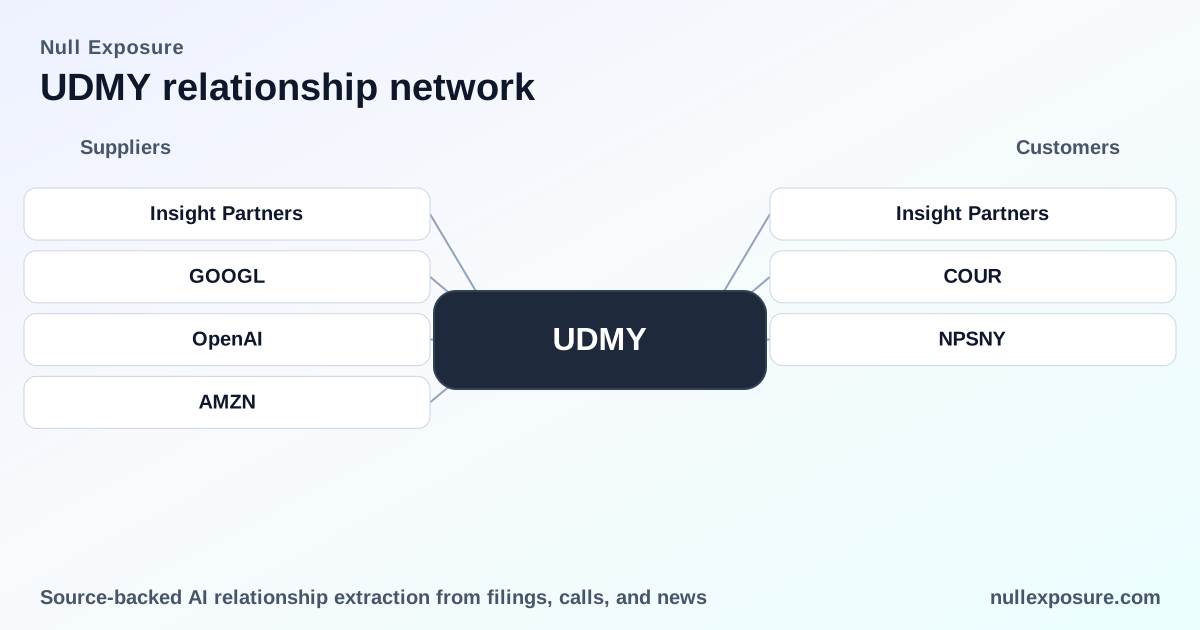
Udemy’s customer relationships: the revenue engine behind the learning platform
Udemy operates a two-sided learning marketplace and a complementary enterprise SaaS business. The consumer marketplace sells individual course access to millions of learners worldwide, while Udemy Business sells annual or multi‑year, per‑seat subscription licenses to enterprises and governments — the enterprise line now represents the majority of revenue and is the primary driver of predictable recurring cash flow. For investors, the thesis is straightforward: value is tied to enterprise contract scale, renewal economics, and how the Coursera acquisition alters ownership and integration risk.
For a concise view of related research and monitoring tools, visit https://nullexposure.com/.
Why customer relationships matter for valuation and risk
Udemy’s monetization model splits into transactional consumer sales and recurring enterprise subscriptions. Enterprise subscriptions are material — 63% of total revenue in FY2024 — which shifts Udemy from pure marketplace volatility toward SaaS‑like revenue predictability. Annual and multi‑year per‑seat contracts create durable cash flow when retention holds; at scale, large enterprise accounts can both depress and accelerate volatility depending on concentration. The announced acquisition by Coursera transforms counterparty and exit risk into merger-integration exposure and share-swap valuation dynamics.
Operating model signals investors should treat as structural
The company’s public filings and disclosures establish a clear operating posture:
- Subscription-first contracting: Udemy Business sells annual or multi‑year enterprise license subscriptions on a per‑seat basis, which underpins recurring revenue and predictable renewal cadence, according to Udemy’s 2024 Form 10‑K.
- Longer-term customer relationships: The enterprise offering’s annual and multi‑year terms create multi‑period revenue visibility and reduce near‑term churn sensitivity relative to pure consumer sales.
- Customer mix with concentration in large accounts: Large enterprises (≥1,000 employees) represent about 75% of Udemy Business revenue and are the fastest-growing cohort, concentrating revenue in a relatively small number of accounts.
- Global footprint with regional revenue balance: Udemy conducts business across 180+ countries; FY2024 revenue split shows meaningful diversification across North America, EMEA, APAC and Latin America.
- Retention and expansion dynamics: Net Dollar Retention for Udemy Business was 98% overall and 103% for large customers as of December 31, 2024 — evidence that large accounts expand spend over time.
- Materiality: Enterprise revenue accounted for 63% of total revenue in FY2024, making enterprise performance a company‑level earnings lever.
- Roles and sales motion: The company both sells subscription licenses to enterprises and acts as the licensor for consumer course content; enterprise sales occur both direct and through channels.
Each of these signals is drawn from Udemy’s FY2024 Form 10‑K and accompanying fiscal disclosures.
For an investor dashboard and monitoring setup on Udemy relationships and filings, see https://nullexposure.com/.
Named counterparties and press coverage — what’s on record
Below I cover each relationship in public results with a concise investor‑oriented summary and source note.
Insight Partners
Udemy discloses that affiliates of Insight Partners — where a member of Udemy’s board is a Managing Director — are customers of Udemy’s Enterprise subscription offering, indicating Insight‑affiliated entities consume Udemy Business services. This is documented in Udemy’s 2024 Form 10‑K.
COUR (Tokenist coverage)
Tokenist reported that Coursera announced plans to acquire Udemy in an all‑stock transaction valuing Udemy at roughly $2.5 billion, a corporate event that converts Udemy’s customer and contract exposures into part of Coursera’s combined enterprise. The Tokenist article covering the acquisition was published March 10, 2026.
Coursera, Inc. (Finviz news item)
A Finviz news report described the transaction terms as 0.800 shares of Coursera common stock for each share of Udemy common stock, detailing the exchange mechanics investors should use to model implied consideration and post‑deal ownership. The Finviz item appeared May 4, 2026.
Naspers
Udemy’s 2024 Form 10‑K states that Naspers and certain entities it controls are customers of Udemy’s Enterprise subscription offering, signaling that large multinational media/tech groups are consuming Udemy Business at a corporate level. This relationship is recorded in the FY2024 10‑K.
NPSNY (duplicate listing of Naspers)
The filing also identifies Naspers under the ticker NPSNY as a customer group for enterprise subscriptions, reinforcing that entities connected to Naspers participate in Udemy Business deployments; the source is Udemy’s FY2024 Form 10‑K.
What these relationships mean for investors and operators
- Governance and related‑party optics: The Insight Partners relationship raises governance oversight questions because a board member is affiliated with a customer investor; investors should model potential conflicts and treatment of favorable commercial terms.
- Acquisition changes the counterparty landscape: The announced Coursera deal immediately reframes Udemy’s future revenue recognition and strategic priorities under new ownership; modeling should switch from Udemy standalone growth assumptions to combined entity synergies and integration risk.
- Concentration risk vs. expansion upside: Large enterprise customers deliver outsized revenue and expanding seat counts (103% NDRR for large customers) but concentrate downside if a small number of accounts contract; underwriting scenarios should include both renewal and large‑account loss cases.
- Geographic diversification reduces single‑market exposure: Revenue across NA, EMEA, APAC and LATAM spreads political and macro risk but requires multi‑regional go‑to‑market execution, which increases operational complexity.
- Subscription economics enable higher multiple if retention holds: With enterprise subscriptions dominant and improving NDRR among large customers, Udemy’s revenue profile aligns more with SaaS comparables — but investors must price in competitive content markets and integration execution under Coursera.
Short checklist for ongoing monitoring
- Track post‑deal integration updates from Coursera and any reported customer retention or contract transitions.
- Monitor Udemy Business NDRR and large customer cohort growth on quarterly calls.
- Watch disclosures around related‑party contracts tied to Insight Partners and Naspers for any preferential terms.
- Validate regional revenue trends against macro data in NA, EMEA, APAC and LATAM.
Udemy’s customer relationships are the core operational lever: enterprise subscription scale drives valuation; large‑account retention dictates margin stability; and the Coursera acquisition reshapes counterparty and shareholder outcomes. For continued coverage and alerts on filings and customer disclosures, visit https://nullexposure.com/.