Urban Edge Properties (UE): Tenant Relationships and What Investors Need to Know
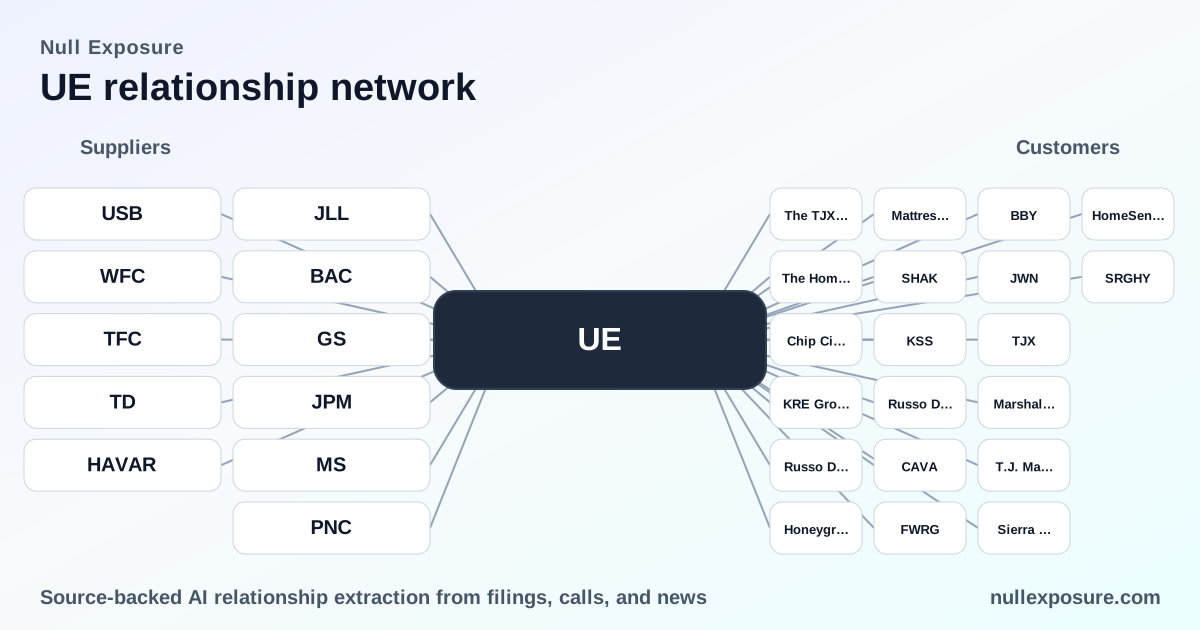
Urban Edge is a New York–listed REIT that owns, operates, redevelops and selectively acquires open‑air shopping centers and anchored retail assets in the Washington, D.C.–to–Boston corridor, monetizing through contractual base and percentage rents, tenant reimbursements and value‑add redevelopment that drives new rent commencements. For relationship-level visibility and a compact commercial map of UE’s tenant footprint, visit https://nullexposure.com/.
How Urban Edge structures its landlord business — the operating thesis
Urban Edge runs a classic landlord model with a contemporary twist: long-duration anchor leases (10–25 years) underpin cash flow while short-term shop commitments (<10k sf) provide leasing flexibility and rent roll turnover. Management emphasizes a tenant mix of grocers, discounters, healthcare operators and elevated food concepts to drive frequency and stabilize centers; revenues are derived principally from contractual rents and expense reimbursements, not one‑off property sales. According to the company’s 2025 Form 10‑K, no single tenant represented more than 10% of total revenue, which supports diversification of counterparty risk.
Contracting posture, concentration and portfolio characteristics
- Contract tenor is bifurcated. Urban Edge’s anchor leases are long‑term and renewal‑oriented (10–25 years), while smaller tenant leases generally run five years or less, giving management both stability and the ability to re‑tenant quickly.
- Counterparty mix tilts toward large, creditworthy operators. Management targets grocers, big‑box discounters and national food & service brands to anchor centers and drive traffic; this is a deliberate underwriting posture described in company disclosures.
- Geographic concentration is a strategy, not a flaw. UE focuses on the Washington–Boston corridor, which concentrates market expertise and leasing relationships but links cash flows to the health of Northeastern consumer markets.
- Materiality is low on any single tenant. The 2025 10‑K states that no tenant accounted for more than 10% of revenues, so tenant risk is dispersed across many relationships.
- Role and revenue model are straightforward. Urban Edge is a seller of space and landlord of record: substantially all revenue comes from rents and tenant expense reimbursements.
Tenant roster: line‑by‑line briefings
Below are concise, source‑linked summaries for every tenant relationship cited in the collected results.
- The Home Depot — UE’s filings reference Home Depot in the customer concentration disclosure and note transactions such as space sales and other property dealings. According to Urban Edge’s 2025 Form 10‑K, Home Depot is part of the broader tenant mix (FY2025 10‑K).
- The TJX Companies — TJX was UE’s largest tenant at year‑end 2025, with 28 stores totaling ~873,159 sf and generating about $26.5 million (5.6% of 2025 revenue), per the company’s 2025 10‑K.
- The Mango People Collective (f/k/a Fine Indian Dining Group) — Urban Edge announced this restaurant will open at The Plaza at Woodbridge, expanding food offerings at that center (CityBiz, May 2026).
- Chip City Cookies — UE signed an 800‑sf lease at Marlton Commons, adding another fast‑casual food tenant to the grocery‑anchored center (re‑nj.com, March 2026).
- Bob’s Discount Furniture (BOBS) — UE announced Bob’s joining Amherst Commons, occupying a portion of a former TJ Maxx box (CityBiz, March 2026).
- Tesla — Management reported Tesla as a new rent commencement within redevelopment projects that produced over $16 million of annualized rent in 2025 (Q4 2025 earnings call transcript, InsiderMonkey).
- Saks OFF 5TH — UE disclosed two Saks OFF 5TH locations at year‑end 2025 and noted rent exposure and a January closure of one location (Q4 2025 earnings call transcript, InsiderMonkey).
- Ross — Ross was one of the retailers contributing to UE’s 2025 new rent commencements (Q4 2025 earnings call transcript, InsiderMonkey).
- Nordstrom Rack — Cited among the national retailers that commenced or occupied space in UE projects during 2025 (Q4 2025 transcript, InsiderMonkey).
- Summit Health — Summit Health anchors acquired and redeveloped assets such as The Village at Bridgewater Commons; UE cited Summit Health as an anchor for stabilized centers (re‑nj.com / ShoppingCenterBusiness, May 2026).
- Kohl’s — Management discussed reducing Kohl’s exposure through asset repositioning and lease turnover, which affects tenant ranking by revenue (Q4 2025 earnings call transcript, InsiderMonkey).
- Dick’s Sporting Goods — UE executed a lease termination with Dicks at Sunrise Mall, the last tenant remaining at that property, as part of redevelopment actions (Q4 2025 transcript, InsiderMonkey).
- Russo Development, LLC — Russo was part of the joint‑venture buyer that closed on a Bergen Town Center parcel UE sold for redevelopment (DailyVoice / re‑nj.com, March 2026).
- Chipotle Mexican Grill (Chipotle / CMG) — Chipotle is listed among high‑quality shop tenants in new redevelopment projects and acquired centers (Q4 2025 transcript and ShoppingCenterBusiness, 2026).
- TruGolf Links (TRUG) — UE announced a lease with TruGolf Links for a flagship 6,045‑sf location at The Plaza (PR Newswire / March 2026).
- Cava — Cava appears repeatedly as a high‑performing shop tenant across multiple UE centers and specific lease rollouts (Q4 2025 transcript; re‑nj.com and ShoppingCenterBusiness, 2025–2026).
- KRE Group — KRE was the JV partner with Russo Development that purchased a Bergen Town Center parcel UE sold, enabling a multifamily project (re‑nj.com, March 2026).
- Trader Joe’s — Trader Joe’s was cited among new anchor retailers opening and generating new annualized gross rent in 2025 (Q4 2025 transcript; CityBiz, May 2026).
- Canton Rodeo — Canton Rodeo signed for a flagship Hong Kong BBQ concept at Bergen Town Center as part of a six‑tenant leasing package (re‑nj.com, May 2026).
- Burlington — Burlington contributed to the 2025 rent commencements and project leasing momentum (Q4 2025 transcript, InsiderMonkey).
- Elev8tion Fitness — Elev8tion Fitness agreed to a 14,750‑sf lease at Bergen Town Center, expanding fitness and experiential offerings (re‑nj.com, May 2026).
- BJ’s — BJ’s was listed as an upcoming tenant in redevelopment projects adding grocer density (Q4 2025 transcript, InsiderMonkey).
- Nail Art Spa — Nail Art Spa signed a small‑format lease at Bergen Town Center as part of a package of six new commitments (re‑nj.com, May 2026).
- Pilates Addiction — Pilates Addiction committed to a small shop lease at Bergen Town Center in UE’s leasing push (re‑nj.com, May 2026).
- Swarovski — Swarovski leased a compact specialty shop at Bergen Town Center, bringing a premium accessory brand to the center (re‑nj.com, May 2026).
- Tatte Bakery & Café — Tatte signed for a ~3,840‑sf unit at Bergen Town Center with an opening slated for May 2026 (re‑nj.com, May 2026).
- T‑Mobile — T‑Mobile is named among high‑quality shop tenants in UE redevelopment projects (Q4 2025 transcript, InsiderMonkey).
- Starbucks / Starbucks Coffee — Starbucks appears across multiple center acquisitions and acquisitions (Village at Bridgewater Commons acquisition) and is a recurring food & beverage tenant (ShoppingCenterBusiness, May 2026).
- Best Buy — Best Buy anchors centers such as The Plaza at Woodbridge and Shoppers World; UE referenced Best Buy when describing property anchors (CityBiz and ConnectCRE, 2025–2026).
- Raymour & Flanigan — Raymour & Flanigan anchors The Plaza at Woodbridge and is cited in local leasing announcements (CityBiz, May 2026).
- ShopRite — ShopRite anchors grocery‑anchored complexes and was cited in local leasing announcements and center tenant mixes (re‑nj.com and InsiderMonkey, 2025–2026).
- First Watch — First Watch was a new shop tenant with rent commencements cited among 2025 projects (Q4 2025 transcript; re‑nj.com).
- Honeygrow — Honeygrow is listed among food tenants in grocery‑anchored centers such as Marlton Commons (re‑nj.com, March 2026).
- Mattress Firm — Mattress Firm is included among non‑food tenants at Marlton Commons and other centers (re‑nj.com, March 2026).
- Big Chicken — Big Chicken is cited among quick‑service tenants at recently acquired or redeveloped centers (ShoppingCenterBusiness / re‑nj.com, May 2026).
- Marshalls — Marshalls is one of the TJX banners anchoring Shoppers World, referenced in financing and acquisition materials (ConnectCRE, 2025).
- T.J. Maxx — T.J. Maxx is noted as part of the TJX cluster anchoring Shoppers World (ConnectCRE, 2025).
- HomeSense — HomeSense is listed among the TJX family tenants at acquired mall assets (ConnectCRE, 2025).
- Sierra Trading — Sierra Trading appears as an occupant within the TJX cluster at Shoppers World (ConnectCRE, 2025).
- Club Pilates — Club Pilates was cited among high‑performing shop tenants contributing to 2025 rent commencements (Q4 2025 transcript, InsiderMonkey).
- Chick‑fil‑A — Chick‑fil‑A was named among new retailer commitments in UE development plans (Q4 2025 transcript, InsiderMonkey).
- Atlantic Health — Atlantic Health was listed among larger institutional tenants anchored in redevelopment projects (Q4 2025 transcript, InsiderMonkey).
- Aldi — Aldi is part of the grocer mix UE referenced when describing multi‑grocer strategies at some centers (Q4 2025 transcript, InsiderMonkey).
- Dave’s Hot Chicken — Dave’s Hot Chicken was one of the stabilized projects in Q4 2025 where rent commenced following redevelopment (Q4 2025 transcript, InsiderMonkey).
- Amazon — UE discussed entitlement progress to host a potential Amazon distribution center on a portion of Sunrise Land as part of redevelopment strategy (Q4 2025 transcript, InsiderMonkey).
- Saks OFF 5TH (reiteration) — Additional reporting and earnings commentary referenced Saks OFF 5TH locations and related rent exposure (Q4 2025 transcript, InsiderMonkey).
What this roster means for investors
- Diversified revenue base. UE’s tenant list mixes national grocers, discounters and food concepts—anchoring centers and driving foot traffic—while no single tenant exceeds 10% of revenue (2025 10‑K).
- Stable cash flow with selective upside. Long‑term anchor leases supply predictable cash flow, while redevelopment and re‑tenanting drive new annualized rent commencements (management commentary, Q4 2025).
- Execution risk lies in leasing and redevelopment cadence. Concentration in the Northeast is a source of operational advantage and exposure; management’s ability to convert vacant boxes into high‑yield shop and experiential tenants will determine near‑term growth.
For a concise, relationship‑level view that investors and operators can act on, see the Urban Edge profile and tenant map at https://nullexposure.com/.
Bold takeaways: UE runs a diversified, anchor‑led landlord model; long anchor tenors stabilize cash flow; small‑format tenants provide re‑tenanting upside; portfolio concentration in the D.C.–Boston corridor is strategic and material to underwriting.