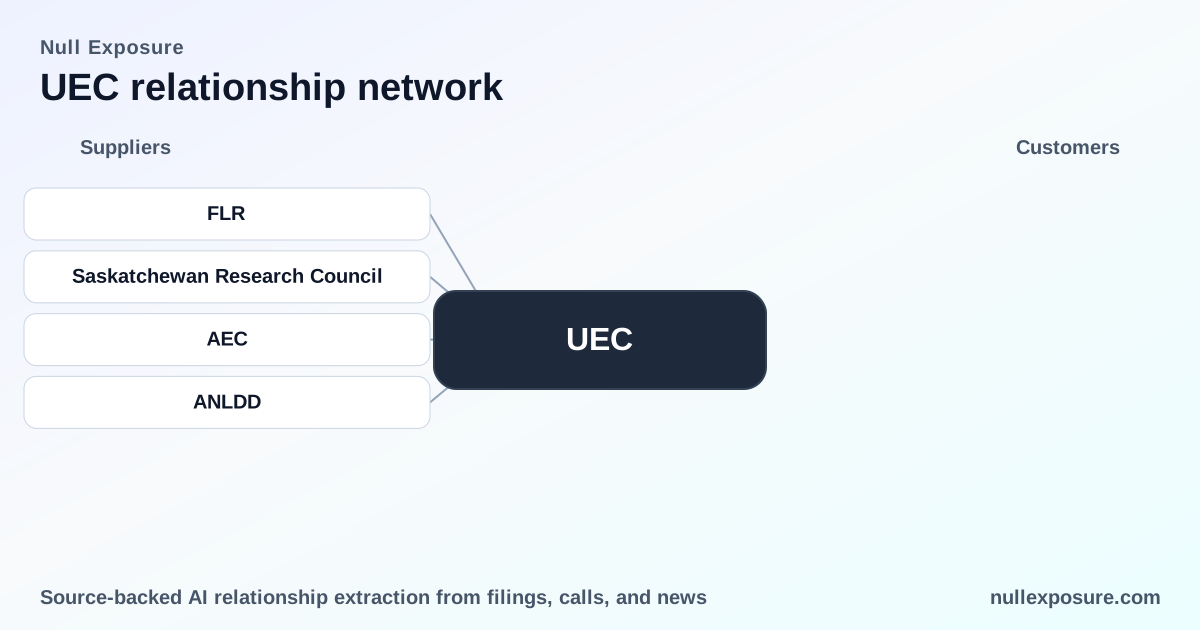
Uranium Energy Corp (UEC): Commercial relationships, constraints, and what investors should price in
Thesis — Uranium Energy Corp operates an asset-led hub-and-spoke ISR (in-situ recovery) platform centered on its Hobson processing facility and monetizes primarily through sales of U3O8 purchased and processed under its Physical Uranium Program and from processed material produced at its ISR projects; its economics are therefore tightly tied to spot uranium pricing and inventory disposition rather than long-term offtake contracts. For investors, the debate is not whether UEC can produce uranium, but how revenue volatility, processing concentration, and a capital-to-deal pipeline (including equity financings) will determine realized cash flows and valuation. Learn more about coverage and signals at https://nullexposure.com/.
How UEC actually earns its revenue — asset control, not term contracts
UEC’s revenue model is straightforward and asset-centric. The company operates a single processing “hub” in Texas (Hobson) that receives uranium-loaded ion‑exchange resin from satellite ISR projects — a configuration the company describes as the core of its hub‑and‑spoke approach. Revenue is centered on sale of U3O8 that the company either purchases under its Physical Uranium Program or processes from its own mines; the processing output is the firm’s only marketed commodity product. Company filings through July 31, 2025 explicitly state that UEC had no supply or offtake agreements in place, and future sales are expected to occur through the uranium spot market, making UEC a price‑taker with direct exposure to spot volatility.
The numbers underline this structure: UEC reported roughly $20.2 million in trailing twelve‑month revenue and negative operating margins as of the latest reported quarter (2026-01-31), while market participants value the company at a materially higher enterprise level (market capitalization reported at approximately $7.26 billion). Those metrics frame a business whose asset optionality and inventory holdings drive implied upside, but whose near‑term cash generation is conditional on spot realization and financing actions.
Capital and counterparty activity investors should watch
UEC is active on the financing front as a lever to execute growth and acquisitions. A recent market report noted a transaction where Uranium Royalty Corp (UROY) was arranging a deal that involved UEC providing capital support: UEC was expected to provide $40 million via a subscription receipt financing at $3.64 per share to help fund UROY’s transaction. This is a direct example of UEC deploying balance sheet capacity to facilitate sector consolidation and to secure strategic outcomes. Source: Investing.com news report, May 4, 2026.
Relationship: UROY (Uranium Royalty Corp)
Uranium Royalty Corp (UROY) — UEC is expected to provide $40 million through a subscription receipt financing at $3.64 per share to support UROY’s merger/transaction financing, indicating UEC is using equity-linked capital to influence adjacent industry consolidation and preserve optionality. Source: Investing.com, May 4, 2026.
Operational and commercial constraints that define counterparty risk
Investors evaluating UEC’s customer and partner relationships must price several company-level signals drawn from filings and disclosures:
-
Contracting posture — spot-centric sales. The company discloses it had no uranium supply or offtake agreements as of July 31, 2025, and expects future sales to occur generally through the uranium spot market; that means revenue is exposed to spot price swings rather than locked‑in margins. This is a company-level commercial profile, not specific to any single counterparty.
-
Geographic scope — U.S. focus with global ambition. UEC emphasizes scaling to meet nuclear demand in the U.S. and globally while operationally concentrating processing in Texas; that balance creates domestic operational concentration with a broader market addressable base.
-
Role mix — seller and processor. Filings show UEC’s revenues are primarily from selling U3O8 purchased under its Physical Uranium Program and from processing at Hobson; the company historically operated as a toll processor for third parties, but that specific agreement was terminated in Fiscal 2024, reducing that source of diversified service revenue.
-
Concentration and criticality — a single processing hub. The Hobson Processing Facility functions as the central hub; satellites feed the hub, making the Hobson CPP operationally critical, and any disruption there would have outsized impact on near‑term production and sales.
-
Segment focus — core product dependence. UEC’s commercial output is almost entirely U3O8 sales, so counterparty and market risk centers on a single primary commodity product.
These constraints combine into a clear investor checklist: spot-price exposure, processing concentration, limited contractual sales coverage, and reliance on capital markets to bridge timing between production and monetization.
Valuation and risk — what the market has to reconcile
UEC’s market valuation and fundamentals look asymmetric. The company shows negative operating metrics (operating margin TTM -1.167, diluted EPS -$0.18) and modest trailing revenues, yet institutional ownership is high and the market values the equity at billions. Investors must reconcile two drivers:
- Optionality premium: the market is pricing future scarcity and the optionality of UEC’s reserves/processing capacity into the share price.
- Execution and liquidity risk: with spot‑based sales and a history of financing activity (including the $40M support to UROY), UEC needs recurring access to capital to pursue growth and manage inventory timing.
Key reported ratios illustrate the divide: Price-to-Sales around 360x and Price-to-Book over 5x, which implies the market is valuing UEC largely on forward scenarios rather than present earnings. These valuation multiples demand sustained commodity price improvement and successful capital deployment to compress downside risk.
What this means for investors and operators
-
For investors: price in the company’s spot-price sensitivity, the operational concentration at Hobson, and the demonstrated willingness to use balance sheet capital to shape sector outcomes (as in the UROY financing). Monitor spot uranium prices, inventory drawdown plans, any new offtake agreements, and follow‑on financing terms closely.
-
For operators/partners: UEC is a counterparty that provides processing capacity and capital support, but counterparties should account for limited long-term contractual coverage and an appetite for equity-linked financing as a mechanism to underwrite transactions.
A concise, investor-focused verdict: UEC is an asset-heavy uranium play combined with market-price exposure and capital-market dependency—the upside is tied to uranium market normalization and execution; the downside is tied to spot volatility and the single-hub processing model.
For deeper signal layering on UEC counterparties and to track evolving relationship flows, visit https://nullexposure.com/ for ongoing coverage and alerts.