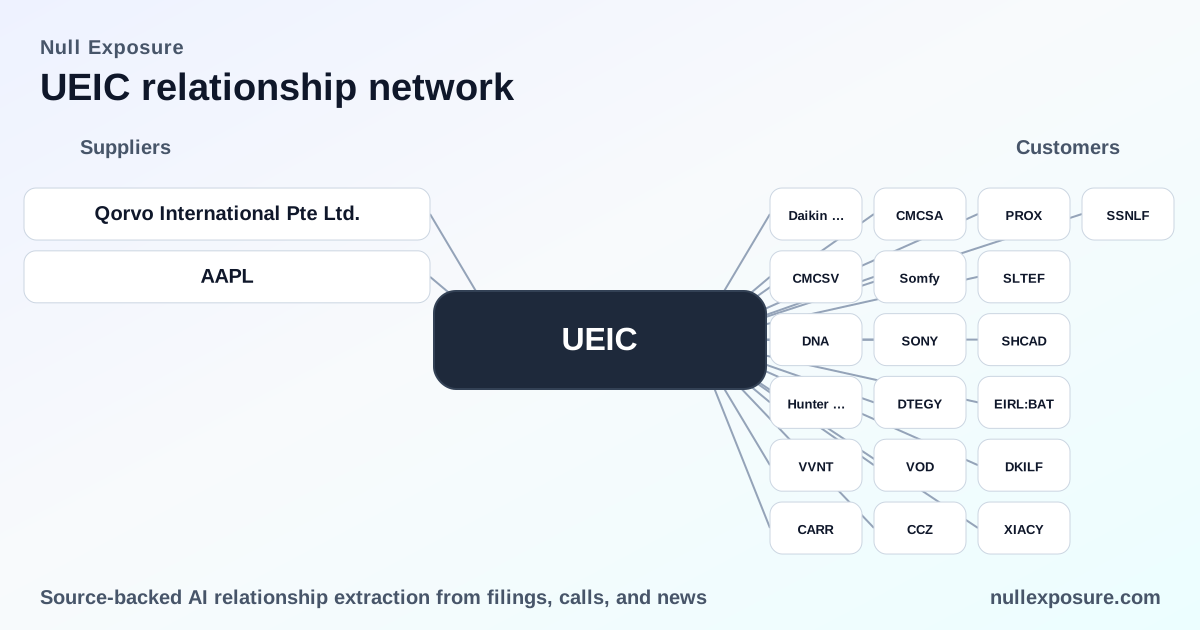
Universal Electronics (UEIC): customer map and implications for investors
Universal Electronics (UEIC) designs, manufactures and licenses wireless control hardware and cloud software for smart TVs, set‑top boxes, HVAC and connected‑home devices, monetizing through hardware sales, recurring licensing/royalty streams and cloud services (firmware updates, DRM provisioning and remote support). UEIC’s revenue mix is a blend of short‑duration product contracts and ongoing licensing/recurring services, with a small number of very large customers driving material share of sales. Learn more about the company and its customer intelligence at https://nullexposure.com/.
Why the customer base matters for valuation
- Concentration and materiality: UEIC discloses multiple customers that individually exceed 10% of net sales, making customer retention a primary revenue risk factor.
- Hybrid monetization: UEIC generates hardware revenue alongside licensing and cloud services that are recognized over time, producing a mix of volatile product revenue and sticky software/royalty streams.
- Global footprint and go‑to‑market roles: The company operates globally across NA, EMEA, APAC and LATAM and acts as manufacturer, distributor, reseller and licensee — a vertically integrated supplier serving OEMs and service providers.
For institutional readers: if you evaluate UEIC, focus on contract cadence (short‑term product orders), the health of top customers (retention and share), and the trajectory of software/cloud revenue that improves margin visibility. For deeper customer maps and analytics visit https://nullexposure.com/.
Operating model constraints that shape revenue quality
- Contracting posture: UEIC states that many contracts have anticipated duration of less than a year and consideration can be variable based on volumes — a company‑level signal that product revenue is transactionally driven and seasonally lumpy.
- Licensing and recurring recognition: The company licenses patented technologies and a control‑code database; royalty revenue is recognized over time, supporting higher‑visibility recurring revenue components.
- Customer profile: UEIC serves large and very large enterprises, including multiple Fortune 500 OEMs and service providers — a signal of high counterparty credit quality but also concentration risk.
- Global sales mix: UEIC reports significant revenue across North America, Europe, APAC (including PRC) and Latin America, indicating geographic diversification but requiring execution across multiple regional channels.
- Vertical integration and roles: UEIC is vertically integrated across design and manufacturing while also acting as a distributor, reseller and licensee; this structure supports margin capture but increases operational complexity.
Customer roster — line‑by‑line coverage Below I list every customer relationship pulled from public results with a plain‑English summary and the original source context.
-
Daikin Industries Ltd. — According to UEI’s FY2024 Form 10‑K, Daikin accounted for 13.3% of net sales in 2024 (14.0% in 2023 and 14.4% in 2022), establishing Daikin as a multi‑year material customer. (UEI FY2024 10‑K)
-
Comcast Corporation — UEI disclosed in its FY2024 10‑K that Comcast accounted for more than 10% of net sales in 2022, historically a material services provider customer. (UEI FY2024 10‑K)
-
CMCSV — The filing also lists CMCSV (a Comcast entity) as contributing material sales in FY2022, reinforcing Comcast‑group concentration disclosed in the 10‑K. (UEI FY2024 10‑K)
-
DNA — A 2022 industry report notes Finland’s DNA selected UEI’s Android TV remote (UEI KITA) for its Hubi product, showing operator OEM relationships in Europe. (BroadbandTV, June 22, 2022)
-
Somfy — UEI’s December 30, 2025 press release lists Somfy among leading connected‑home brands that trust UEI solutions, indicating OEM/service relationships in home automation. (BizWire / FinancialContent, Dec 30, 2025)
-
Carrier — The same December 2025 company announcement lists Carrier among UEI’s customers in HVAC/climate control markets, a sign of OE OEM engagement. (BizWire / FinancialContent, Dec 30, 2025)
-
Comcast — UEI’s 2025 corporate communications again reference Comcast as a trusted customer across home entertainment and connected home markets, affirming ongoing Comcast relationships. (BizWire / FinancialContent, Dec 30, 2025)
-
Hunter Douglas — UEI includes Hunter Douglas in its roster of connected‑home customers in the Dec 2025 corporate notice, showing exposure to motorized window‑cover OEMs. (BizWire / FinancialContent, Dec 30, 2025)
-
Sony — The December 2025 company release lists Sony among enterprise customers using UEI’s control and software solutions, underlining relationships with major CE brands. (BizWire / FinancialContent, Dec 30, 2025)
-
Vivint Smart Home — UEI’s 2025 announcement positions Vivint as a connected‑home/security partner, reflecting service‑provider integrations for security and sensors. (BizWire / FinancialContent, Dec 30, 2025)
-
DTEGY — UEI announced in 2021 that Deutsche Telekom would adopt a branded Apple TV remote produced by UEI and ship it to MagentaTV subscribers, an operator distribution win reported by AppleInsider. (AppleInsider, Aug 19, 2021)
-
Deutsche Telekom — BroadbandTV’s 2021 coverage similarly reported Deutsche Telekom offering UEI’s Apple TV remote to its customers, confirming multiple operator rollouts in Europe. (BroadbandTV, Aug 20, 2021)
-
Vodafone — Industry reporting from 2020 references Vodafone as an operator offering Apple TV hardware where UEI targeted operator remote enhancements, reflecting operator channel engagements. (BroadbandTV, Nov 20, 2020)
-
Comcast (earnings call) — A Q3 2025 earnings transcript cited by insiders notes UEI had two customers above 10% that quarter: Daikin at 20.5% and Comcast at 14.9%, underscoring quarter‑level concentration. (Q3 2025 earnings call transcript, InsiderMonkey)
-
Proximus — BroadbandTV in 2020 named Proximus among operators offering Apple TV devices where UEI’s remotes were relevant, indicating additional European operator customers. (BroadbandTV, Nov 20, 2020)
-
PROX — The PROX listing is the same Proximus operator referenced in the industry report, reinforcing operator channel presence in Belgium. (BroadbandTV, Nov 20, 2020)
-
Salt — BroadbandTV reported Salt (Swiss telco) added a branded Apple TV remote produced by UEI in 2021, another operator distribution example. (BroadbandTV, Sep 2, 2021)
-
SLTEF — The SLTEF entry corresponds to Salt’s adoption of UEI’s branded remote as reported in 2021, indicating multiple European operator clients. (BroadbandTV, Sep 2, 2021)
-
Sharp — A Q3 2025 earnings call transcript states UEI added Sharp as a smart TV brand customer that will use UEI’s DRM protection services beginning Q1 2026. (Q3 2025 earnings call transcript, InsiderMonkey)
-
SHCAD — The SHCAD entry mirrors the Sharp addition and confirms UEI’s move into DRM services for new TV brands. (Q3 2025 earnings call transcript, InsiderMonkey)
-
Xiaomi — The Q3 2025 transcript also notes Xiaomi as a new smart TV brand customer for UEI’s digital rights management services starting Q1 2026. (Q3 2025 earnings call transcript, InsiderMonkey)
-
XIACY — The XIACY entry reflects the same Xiaomi customer disclosure in the Q3 2025 call, consolidating the new‑brand wins for DRM. (Q3 2025 earnings call transcript, InsiderMonkey)
-
Daikin (press release) — The 2025 company announcement lists Daikin among Fortune‑level HVAC customers that trust UEI’s solutions, reinforcing a long‑standing strong relationship. (BizWire / FinancialContent, Dec 30, 2025)
-
DKILF — The DKILF entry corresponds to Daikin references in company communications and earnings transcripts, further documenting Daikin’s materiality. (Multiple UEI disclosures, 2025)
-
Eir — BroadbandTV’s 2020 coverage references Eir among operators offering Apple TV devices and associated remotes, indicating operator engagements in Ireland. (BroadbandTV, Nov 20, 2020)
-
Samsung — The December 2025 corporate announcement lists Samsung as a customer trusting UEI solutions, emphasizing UEI’s access to top global TV brands. (BizWire / FinancialContent, Dec 30, 2025)
Investment implications — concise takeaways
- Top‑customer exposure drives earnings volatility. Material customers such as Daikin and Comcast account for sizable single‑customer revenue share, amplifying execution and retention risk.
- Recurring software and licensing growth is strategically important. As UEI expands DRM and cloud services, the company can offset hardware cyclicality with higher‑margin recurring revenues.
- Global diversification reduces single‑market dependence but raises operational execution demands. UEI’s presence across NA/EMEA/APAC/LATAM requires stable manufacturing and channel management.
- Monitor contract cadence and order visibility. Short‑term product contracts create near‑term revenue uncertainty; investor focus should be quarterly bookings, renewal signals from top OEMs, and continued expansion of licensing and cloud services.
For portfolio managers and operators evaluating UEIC, the core decision is whether expanding software/recurring revenue and new smart‑TV DRM relationships sufficiently mitigate the concentration and short‑term nature of product orders. For a complete customer intelligence package and to track updates to these relationships, visit https://nullexposure.com/.