United Fire Group (UFCS): Customer Relationships and Commercial Signals for Investors
United Fire Group (UFCS) underwrites property & casualty insurance in the U.S. and monetizes through earned premiums, alternative distribution channels (treaty reinsurance, programs, and funds at Lloyd’s), and investment income; the operating model is centered on premium generation with measured reinsurance participation to manage volatility. For a concise feed of relationship signals and how they influence counterparty risk and concentration, see https://nullexposure.com/.
Business snapshot: United Fire Group holds roughly $1.02B market capitalization, reported $1.386B revenue TTM and a ~8.5% profit margin, with a 2025 fiscal footprint concentrated in a handful of U.S. states but with targeted EMEA exposure through Lloyd’s market participation.
How United Fire monetizes and where counterparty risk lives
United Fire sells insurance products and collects premiums; it then manages aggregate exposure through reinsurance and Lloyd’s-market placements. Revenue is driven by underwriting and distribution, not single large commercial customers: the company reports no individual customer accounting for 10% or more of revenue, which supports diversified counterparty risk. The firm’s reinsurance strategy — treaty, program business, and participation in Lloyd’s — is a deliberate lever to stabilize loss volatility and free up underwriting capacity.
Operational constraints and what they signal to investors
- Geographic concentration is material but not national: For the year ended December 31, 2024, 47.1% of P&C premiums were written in Texas, California, Iowa, Missouri, and Louisiana, indicating state-level exposure and catastrophe concentration risk in these jurisdictions.
- EMEA presence is targeted through Lloyd’s: United Fire conducts syndicate business in the United Kingdom as part of the Lloyd’s market, signalling a limited but strategic international footprint.
- Single-customer concentration is low: The company states it has no revenue from any single customer ≥10%, a credit-positive diversification signal.
- Contracting posture and role: Company-level disclosures characterize the firm as a participant in reinsurance channels (treaty and Lloyd’s), reflecting a buyer/seller posture within reinsurance markets to manage capital and exposure.
- Business maturity and run-off activity: United Fire emphasizes long-term reinsurance relationships while simultaneously completing a controlled wind-down of direct personal lines business (an immaterial residual primarily in New Jersey, with exposures expected to lapse by end-2025), which reduces legacy exposure and simplifies the portfolio.
- Single operating segment: Management reports one operating segment, with revenues primarily from premiums, underscoring the focused insurance operating model rather than a diversified financial-products business.
These constraints collectively point to a mature, underwriting-centric company with concentrated state-level exposures, diversified counterparty positioning, and active reinsurance usage to manage volatility.
Relationship snapshot — what our signals captured (complete set)
Below are every relationship returned in the customer-scope results, with a short, plain-English summary and a source citation for each.
PLAY (Dave & Buster’s)
United Fire’s relationship index includes PLAY based on a March 10, 2026 PR Newswire release announcing Dave & Buster’s exclusive "UFC Challenge" arcade game available through January 2027; the release documents a consumer-entertainment product rollout rather than an insurance commercial contract. According to the PR Newswire announcement (March 10, 2026), Dave & Buster’s launched a UFC-themed attraction with exclusive content. Source: PR Newswire, March 10, 2026.
THRN (Thorne)
Our records list THRN following a public partnership announcement: Thorne extended its multi-year sports performance nutrition partnership with the UFC and remains an official partner of the UFC Performance Institute; the cited text reflects Thorne’s role with the UFC rather than a direct commercial tie to United Fire Group, but the mention was captured in relationship signals. The partnership announcement was published on the UFC site (first seen March 10, 2026). Source: UFC.com, partnership announcement (FY2022/posted March 2026 capture).
Lloyd’s (Lloyd’s market participation)
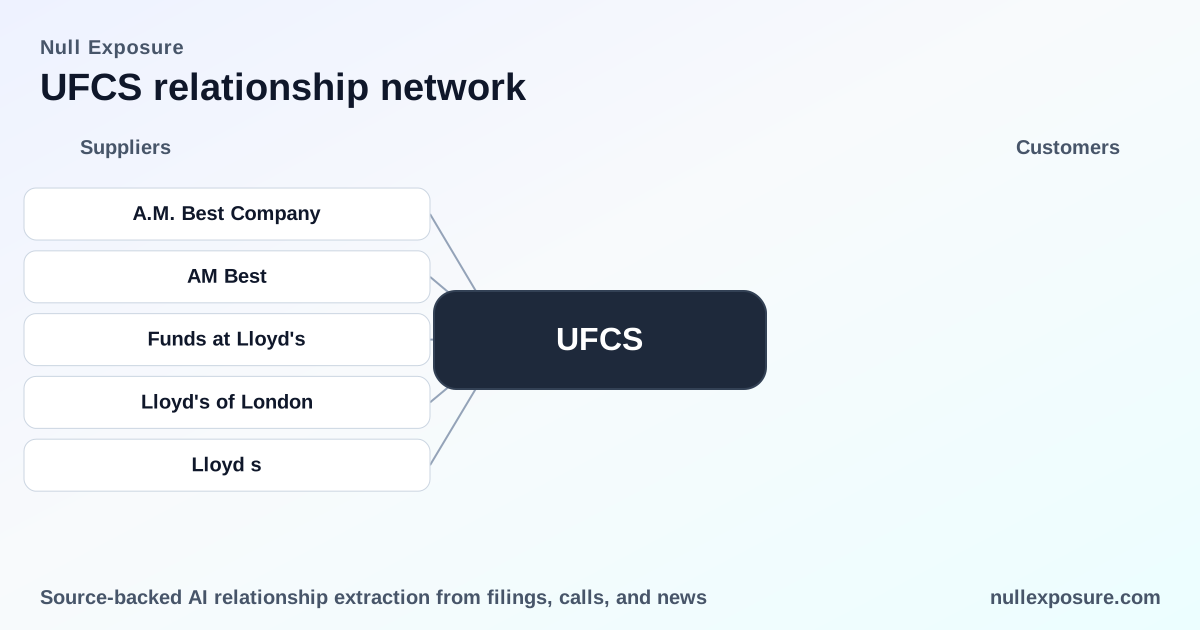
United Fire identifies Lloyd’s as a material channel for “alternative distribution,” with profitable business flowing through treaty, programs, and funds at Lloyd’s; this explicitly describes United Fire’s reinsurance and capital placement practices and signals continued strategic use of the Lloyd’s market for capacity and diversification. The reference comes from an earnings call transcript and investor coverage of UFCS Q4 2025 (May 4, 2026). Source: The Globe and Mail / Motley Fool transcript of United Fire Group Q4 2025 earnings call (May 4, 2026).
What these relationships mean for investors
- Lloyd’s participation is the most consequential commercial signal. It confirms a deliberate reinsurance and capital placement strategy to manage volatility and expand capacity across specialty lines; this reduces net retention risk and supports underwriting flexibility. The Lloyd’s channel is both a diversification and a sourcing lever for high-severity risk transfer.
- Other captured names (PLAY, THRN) are non-core to UFCS’s underwriting business. These entries reflect news-sentiment captures rather than documented commercial agreements with UFCS; they do not change counterparty credit exposure or underwriting economics. The company’s insurer/reinsurer linkages and geographic concentration are the primary drivers of underwriting volatility and counterparty risk.
Key investment takeaways and risk signals
- Positive: Diversified premium base and active reinsurance usage. No single customer reaches 10% revenue, and reinsurance/Lloyd’s participation smooths volatility.
- Watch: State-level concentration and catastrophe exposure. Nearly half of premiums originate in five states, which elevates catastrophe and rate-cycle sensitivity.
- Operational maturity: Controlled run-off of personal lines and a single operating segment simplify management focus and capital allocation.
- Balance-sheet and valuation context: UFCS trades at a trailing P/E around 8.9, with a price-to-book near 1.07, and a modest dividend yield (~1.63%), suggesting valuation reflects both steady underwriting profits and market caution about near-term volatility.
For a practical, relationship-focused feed that institutional investors and underwriting teams use to vet counterparties, see https://nullexposure.com/ — our platform synthesizes signals like the ones above into actionable relationship profiles.
United Fire’s commercial posture is clear: underwrite in core states, backstop exposure through treaty and Lloyd’s placements, and wind down non-core personal lines — a setup that supports stable underwriting economics while exposing the book to concentrated geographic catastrophe risk.