UFP Industries: Retail concentration and durable manufacturing relationships that drive predictable cash flow
UFP Industries (UFPI) designs, manufactures and distributes wood and wood‑alternative products across retail, construction and packaging markets, monetizing through the sale of finished goods to large national retailers and project customers. The business converts manufacturing scale and customized supply arrangements into predictable revenue and free cash flow, but a concentrated customer base—centered on The Home Depot and Lowe’s—creates a clear counterparty risk that investors must underwrite. For an investor-focused breakdown of customer exposure and operating constraints, see more at NullExposure.
Operational snapshot: UFP operates as a global manufacturer and seller with a retail‑facing segment that supplies major home‑improvement chains and a construction channel that executes longer-duration contracts. Revenue recognition is predominantly shipment‑based and title typically transfers at shipment, consistent with a seller posture and goods delivery performance obligations.
Why the Home Depot and Lowe’s matter to valuation
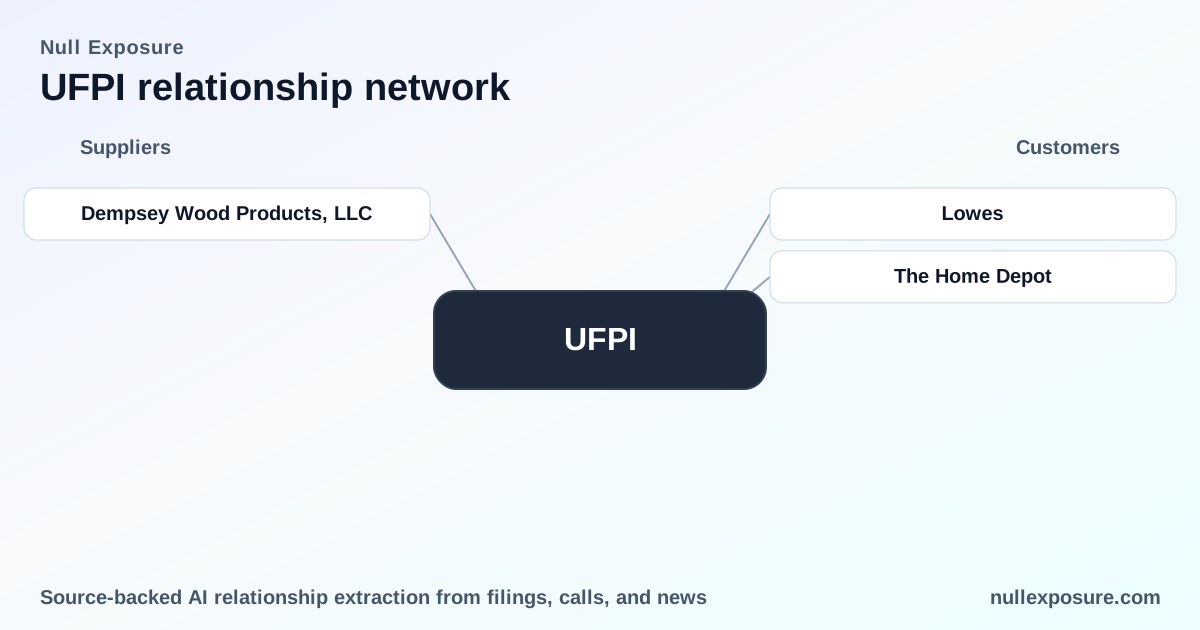
UFP discloses that its Retail segment is dominated by two customers. The Home Depot accounted for approximately 17% of fiscal 2024 net sales and Lowe’s for approximately 11%, making these two retailers collectively responsible for roughly 28% of FY2024 revenue. This level of concentration is a structural feature of the business and therefore a key input to any earnings‑quality or downside‑risk assessment.
- Concentration is material: accounts receivable tied to the two largest customers were reported at $112.1 million and $118.0 million at the end of fiscal 2024 and 2023, respectively, underlining both revenue and working‑capital exposure.
- Contracting posture is mixed but leans seller‑centric: most customer contracts are delivery‑based with title transfer at shipment, while construction and multi‑family supply arrangements include fixed pricing and multi‑month completion windows.
These features drive both the upside (scale, repeatable orders) and the principal risk (customer loss or pricing pressure). For a deeper dive into customer-level disclosures and citations, continue below or visit NullExposure.
Customer relationship summaries (complete coverage)
The following covers every customer relationship identified in UFP’s public materials provided.
- The Home Depot — UFP’s Retail segment lists The Home Depot as one of its two largest customers, responsible for approximately 17% of UFP’s FY2024 net sales, reflecting a significant, longstanding national retail relationship. According to UFP’s FY2024 Form 10‑K, The Home Depot and Lowe’s together comprised ~28% of net sales in that year (FY2024 10‑K, filed 2026).
- Lowe’s — Lowe’s is identified in the FY2024 Form 10‑K as another principal retail customer, representing approximately 11% of fiscal 2024 net sales, and forming the other half of the two‑customer concentration cited by the company (FY2024 10‑K, filed 2026).
- Home Depot (third‑party coverage) — A trading‑view/GuruFocus commentary repeated UFP’s disclosure that Home Depot and Lowe’s together represented approximately 28% of fiscal 2024 net sales, reinforcing the company‑filed concentration metric in a market commentary (TradingView/GuruFocus, May 2026).
- Lowe’s (third‑party coverage) — The same trading commentary amplified the company disclosure on retailer concentration, noting Lowe’s as the second major retail customer in FY2024 (TradingView/GuruFocus, May 2026).
Each relationship above is documented in UFP’s FY2024 10‑K language and subsequently cited by market commentary; together they represent the complete set of customer relationships surfaced in the provided records.
Corporate operating constraints and what they signal for investors
The filings and excerpts provide a clear set of company‑level constraints and characteristics that inform risk/reward and valuation multiple calibration:
- Long‑term and project contract presence: UFP reports construction contracts and multi‑family supply arrangements with durations typically 6–18 months and fixed selling prices, which supports revenue visibility for those segments and creates backlog that underwrites near‑term throughput. This is a company‑level operating signal rather than a customer‑specific one (10‑K excerpts).
- Global manufacturing footprint: UFP operates through subsidiaries across the United States, Mexico, Canada, Spain, India, United Arab Emirates and Australia, signaling geographic diversification of production and market access that reduces single‑country execution risk but increases supply‑chain complexity.
- Material customer concentration: The company explicitly states a material concentration with two customers accounting for a significant portion of sales; accounts receivable concentrated with these customers totaled roughly $112.1m and $118.0m at year‑ends 2024 and 2023 respectively, a balance‑sheet risk for working capital under stressed demand conditions.
- Seller role and revenue recognition: UFP’s revenue is primarily recognized at shipment, with title and control typically passing at shipment, indicating transactional delivery economics rather than service‑based recurring revenue.
- Mature, long‑standing customer relationships: UFP emphasizes multi‑decade relationships with many key customers, which is consistent with relationship maturity and stickiness that supports renewal probability and cross‑sell of engineered products.
- Manufacturing segment exposure: The company’s core competency is manufacturing: supplying wood, composite and other materials into retail, construction and packaging channels, which implies capital intensity and sensitivity to raw‑material and logistics costs.
Collectively, these signals define an operating model that trades higher revenue predictability from long contracts and major retail programs against concentrated counterparty and input‑cost risk. Use these as primary levers when stress‑testing cash flows or setting downside scenarios.
Investment implications and risk checklist
- Upside case: Durable retail placements and scale in engineered wood products support margin expansion when housing and renovation cycles are constructive; long‑term construction contracts provide backlog visibility.
- Downside case: Loss of shelf space or pricing pressure from The Home Depot or Lowe’s would compress revenue materially; concentrated receivables represent liquidity and credit exposure.
- Valuation anchors: UFPI’s listed EV/EBITDA and P/E multiples should be considered alongside concentration; the business earns better multiples with proven multi‑year retail programs and stable working capital dynamics.
Key takeaway: UFP is a manufacturing‑led, retailer‑exposed compounder with meaningful customer concentration that both stabilizes revenue and concentrates counterparty risk—investors should underwrite that duality explicitly.
If you want a structured spreadsheet of the customer exposures and constraint signals for modeling, visit NullExposure for the source links and document references used in this analysis.