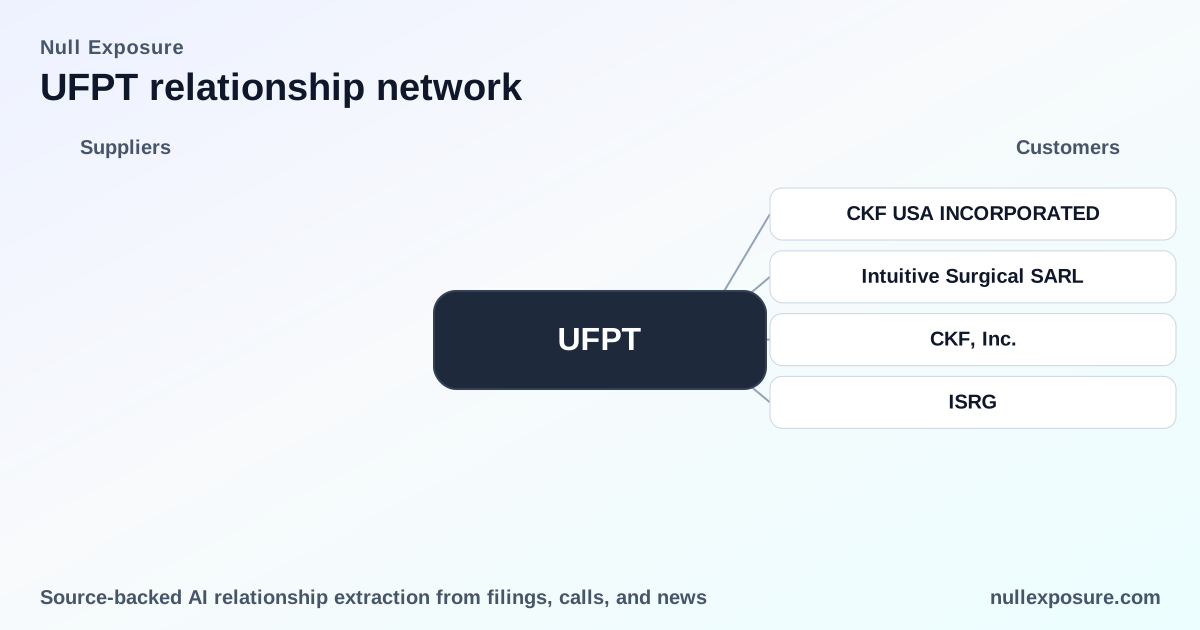
UFP Technologies (UFPT): Customer Relationships That Drive Revenue and Risk
UFP Technologies converts engineered foams, films and plastics into finished components, selling primarily to OEMs across medical, aerospace, industrial and consumer markets; the company monetizes through direct sales of manufactured parts and assemblies, with a mix of short-duration manufacturing contracts and supply agreements that capture value on a per-shipment basis. Investors should view UFPT as a specialized contract manufacturer whose revenue is concentrated by a small number of large customers and whose margins are driven by scale in advanced manufacturing and medical device supply relationships. For more context on supplier-counterparty exposures, see https://nullexposure.com/.
The core investor thesis in one paragraph
UFPT scales by converting engineered materials into mission-critical components for high-value end markets, capturing margins through product design-to-production continuity and direct sales. Its revenue profile is concentrated—two customers represented roughly 44% of 2024 sales—so revenue growth is high‑leverage to the retention and expansion of those key relationships. Capital allocation and risk assessment should prioritize customer continuity, contract renewal cadence and the operational flexibility to reallocate capacity across end markets.
Customer relationships: what the filings and press reveal
CKF USA INCORPORATED (CKF)
UFP sold its former molded fiber subsidiary and related Iowa real estate to CKF USA Incorporated for roughly $31.5 million, exiting that line of business via an outright sale in July 2022. According to UFP’s FY2024 Form 10‑K, the transaction closed pursuant to a share purchase agreement and related documents dated July 26, 2022 (ufpt-2024-12-31).
CKF, Inc. (citybiz report)
Public reporting noted the same sale to CKF, labeling the consideration at approximately $32 million and confirming UFP’s strategic divestiture of the molded fiber business as of FY2022. A CityBiz article covering the transaction emphasized the cash proceeds and strategic refocus (CityBiz report, FY2022 coverage).
Intuitive Surgical SARL (largest customer disclosure)
Intuitive Surgical SARL was UFP’s largest customer in 2024, representing 28.8% of net sales for the year—firm evidence that Intuitive is a revenue driver and a single point of concentration for collections and demand planning. This figure is disclosed in UFP’s FY2024 Form 10‑K (ufpt-2024-12-31).
ISRG — extended manufacturing supply agreement (news)
In late February 2026 UFP extended and expanded its manufacturing supply agreement with Intuitive Surgical through December 31, 2029, signaling a multiyear relationship extension that secures a major portion of revenue tied to Intuitive’s product cadence. News coverage of the deal extension was reported by Simply Wall St in early March 2026 (SimplyWall.St, February–March 2026).
Intuitive Surgical (news summary)
Press coverage reiterated that UFP expanded and extended manufacturing supply terms with Intuitive Surgical and tied the agreement to improved 2025 sales and earnings versus the prior year, underscoring both the revenue impact and the strategic importance of the Intuitive partnership. Industry news outlets highlighted the extension in early 2026 alongside UFP’s quarterly results (SimplyWall.St, March 2026).
Intuitive Surgical Surgical Sarl (CI amendment notice)
A filings summary reported that a UFP subsidiary and Intuitive Surgical Surgical Sarl entered into Amendment No. 27 to the Manufacturing Supply Agreement—formal contract paperwork confirming iterative amendments and long-term operational alignment between the parties. This detail appears in investor event filings and press in February 2026 (MarketScreener summary, Feb 24, 2026).
What the constraints reveal about UFPT’s operating model
The disclosure set reads as a compact profile of how UFPT contracts and where risk concentrates, and investors should interpret these constraints as company-level operating signals rather than relationship-specific claims.
-
Contracting posture — short‑term orientation. UFP reports that many contracts have an original expected duration of one year or less, and revenue recognition is often tied to shipment or invoicing rights, indicating a transactional, order-driven revenue model rather than long-term subscription pricing. This short-term posture increases revenue volatility but also gives management flexibility to reprice and reallocate capacity quickly (FY2024 10‑K).
-
Geographic footprint — global but U.S.-centric. Net sales outside the U.S. were approximately 16.7% in 2024, and UFP operates in Ireland, Mexico, Central America and the Caribbean—enough international exposure to introduce cross-border execution and FX considerations, but not so large as to dominate the revenue base (FY2024 10‑K).
-
Concentration risk — material. Two customers accounted for roughly 28.8% and 15.4% of consolidated net sales in 2024; one customer represented about 34% of gross accounts receivable at year-end, creating meaningful earnings and balance-sheet sensitivity to a small set of counterparties (FY2024 10‑K).
-
Seller role and recognition mechanics. UFP markets and sells principally through a direct salesforce and recognizes a significant portion of product sales upon shipment—this underlines the company’s role as a supplier rather than a service partner and the operational focus on manufacturing efficiency and delivery reliability (FY2024 10‑K).
-
Scale and spend signal. With net sales increasing to $504.4 million in 2024 and major customers accounting for material percentages of revenue, the company’s customer relationships fall into a high-dollar spend band, supporting the classification of certain customers as strategically important from both revenue and supplier-resource perspectives (FY2024 10‑K).
Investment implications: growth levers and risk controls
-
Growth levers: Extended supply agreements with Intuitive through 2029 provide a multi-year revenue base for medical-device volumes and support margin expansion via scale economics; continued wins in medical OEMs and cross-selling into aerospace/industrial can diversify the top line. The Intuitive extension materially de‑risks 2026–2029 revenue projections.
-
Principal risks: Customer concentration and short contract durations increase earnings volatility if large customers reprice, shift sourcing, or reduce volume. Geographic exposure introduces execution risk but is moderate relative to total sales.
-
Execution checklist for investors: Monitor renewal cadence and amendment activity with top customers, watch accounts receivable concentration as a proximate credit signal, and track management commentary on capacity redeployment across end markets.
For a broader view of counterparty and supplier exposures across public companies, visit https://nullexposure.com/.
Bottom line
UFP Technologies is a manufacturing-centric growth story underpinned by high-value medical supply relationships and a concentrated revenue base. The company’s short-term contracting posture and reliance on a small number of large customers create both upside from contract extensions (as evidenced by the Intuitive deal through 2029) and downside if customer demand softens. Investors should weight the strengthened Intuitive arrangement and the strategic divestiture of lower-margin businesses against the continuing concentration risk documented in the FY2024 reporting.