Urban-Gro (UGRO): Customer Relationships Drive Revenue Today — and Define Risk Through Transition
urban-gro, Inc. operates as an engineering-led design-build firm for Controlled Environment Agriculture (CEA), monetizing through project fees for architectural, engineering and construction management services plus margins on value‑added resale (VAR) of horticulture equipment; the company is simultaneously redeploying parts of its IP and contractual capacity into sports media and experiential rights via its IPG unit. Investors should evaluate UGRO by two lenses: the cashflow profile and concentration of legacy CEA projects, and the execution risk of the newly announced sports/media strategy. Learn more at https://nullexposure.com/.
What the headline customer relationships look like (concise investor view)
urban-gro’s disclosed customer engagements span traditional CEA clients and new sports/right‑holder arrangements. Below I summarize each reported relationship and link to the reporting source for verification.
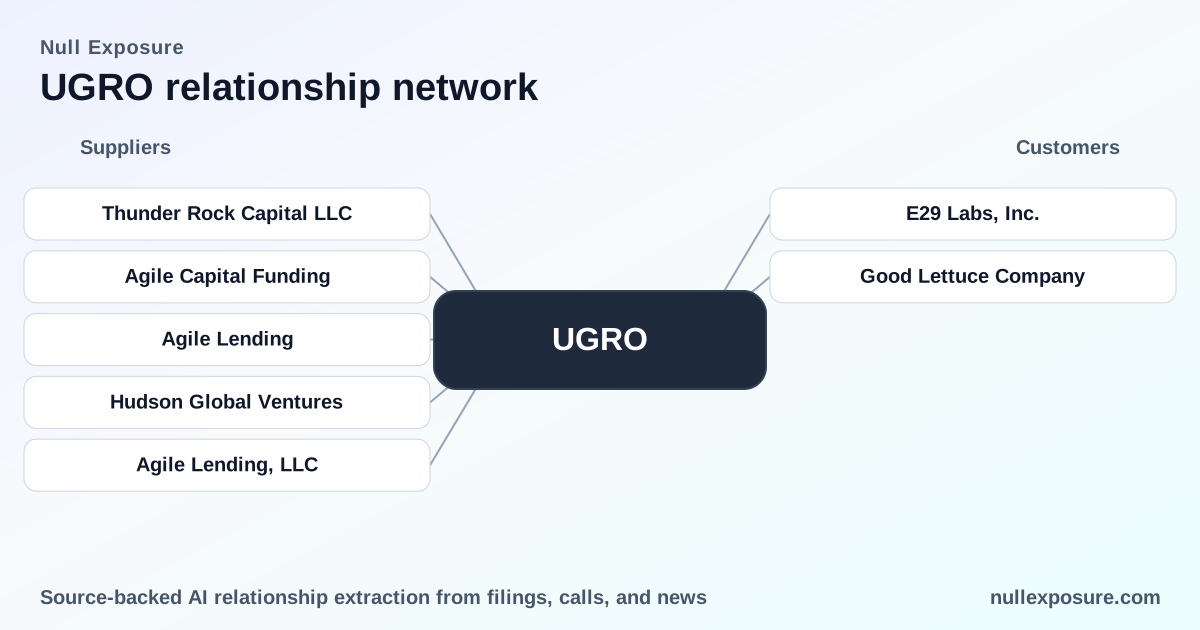
E29 Labs, Inc.
urban-gro signed a design-build agreement to provide full architecture, engineering and design services for an approximately 100,000 square foot cannabis production facility in New York State. This is a classic UGRO design‑build engagement that represents the firm’s core CEA work. (New Cannabis Ventures, March 10, 2026) — https://www.newcannabisventures.com/urban-gro-signs-mou-for-the-turn-key-design-build-of-a-100k-sq-ft-cultivation-facility-in-new-york-with-e29-labs-a-minority-owned-business/
Good Lettuce Company
urban-gro partnered with Good Lettuce Company on the design and construction of a Pennsville, New Jersey cultivation facility, reflecting continued engagement with large-scale produce and cannabis operators. This reinforces UGRO’s role as both design contractor and construction manager in CEA projects. (New Cannabis Ventures, March 10, 2026) — https://www.newcannabisventures.com/bradley-nattrass-chairman-and-ceo-at-urban-gro-inc-honored-as-a-2022-colorado-titan-100/
Sri Lanka Cricket
Through its IPG unit, urban-gro is the event rights holder for an established T20 franchise league owned by Sri Lanka Cricket, signaling a strategic pivot where the company monetizes media and experiential rights rather than engineering services. This transforms part of UGRO’s revenue model toward licensing and event‑level income. (The Globe and Mail press release update, May 4, 2026) — https://www.theglobeandmail.com/investing/markets/stocks/UGRO/pressreleases/1532877/urban-gro-inc-nasdaq-ugro-issues-comprehensive-business-update-strategic-transformation-from-controlled-environment-agriculture-to-sports-media-and-experiential-platform-restored-nasdaq-listing-compliance-cricket-strategy-aligned-with/
Lanka Premier League (LPL)
urban-gro’s involvement with the Lanka Premier League is contractual services through IPG only, and the company clarified it does not hold franchise ownership — indicating a supplier/rights-manager posture rather than an equity proprietor of teams. This emphasizes revenue from contractual rights and services within sports events. (Sahm Capital report, March 30, 2026) — https://www.sahmcapital.com/news/content/urban-gro-eyes-massive-cricket-gold-rush-as-lpl-auction-nears-2026-03-30
How urban-gro contracts for work, and why that matters to investors
urban-gro operates with an EPC (engineering, procurement, construction) design-build posture for CEA clients while simultaneously acting as a value‑added reseller of specialized horticulture hardware. The company invoices clients for employee time on projects and realizes equipment margins on hardware sales, producing a mix of service‑driven and product margin revenue.
- Contracting posture: Predominantly project-based, fixed-price or time-and-materials design‑build contracts that produce lumpy revenue and backend concentration.
- Role mix: Both service provider (design, construction management) and reseller (lighting, irrigation, fans, benching systems).
- Revenue mechanics: Project billing (professional services) plus hardware margins; IPG contracts generate licensing/rights revenue for sports content.
These characteristics drive two investor-relevant dynamics: revenue seasonality and project concentration, and gross-margin pressure when hardware sales dominate in lower-margin projects.
Company-level constraints and risk signals investors must weigh
The public disclosures and filings provide clear company-level signals about the profile of UGRO’s customer base and the financial sensitivity of those relationships:
- Geographic footprint: UGRO historically services North America and Europe, with explicit client work in the United States, Canada and Europe — a cross-border operator footprint consistent with multinational CEA projects.
- Concentration risk: The company has historically depended on a small number of clients for a substantial portion of revenue, which amplifies the impact of any single project delay or cancellation.
- Materiality: Related-party revenue disclosures show project-level receipts in the hundreds of thousands up to roughly $1 million, indicating many engagements are mid‑sized but can be material to total annual revenues.
- Segment mix and maturity: UGRO’s business is split between services (design-build) and hardware resale, with services representing repeatable professional-fee income but hardware sales increasing exposure to inventory and margin compression.
- Spend bands: Public reporting shows related-party revenues that fall primarily in the $100k–$1m band with some engagements approaching $1m, underscoring the mid-market scale of many contracts.
These signals combine to make client execution risk and contract pipeline management the primary drivers of near-term performance.
Financial context: why each relationship matters more than it would for a larger firm
urban-gro’s latest public metrics show Market Capitalization roughly $6.96 million and TTM Revenue $17.4 million, with negative EBITDA (~$17.1 million) and a substantial operating loss. When a company at this scale signs multi-hundred-thousand‑dollar to million-dollar contracts, each client materially moves the income statement and cash flows. Institutional ownership is low, and operational leverage is high — a single project swing can determine quarterly results.
Given this scale, the sports/media pivot via IPG introduces both upside (recurring licensing and event revenue potential) and execution risk: converting event rights into predictable cashflows requires different competencies than engineering and project delivery.
Investor takeaways and next actions
- Key takeaway: UGRO is a small‑cap company with core strengths in CEA design-build and VAR hardware, but the company is actively repositioning part of the business toward sports/media rights via IPG; both legacy and new revenue streams matter materially to valuation and cash flow prognosis.
- Risk profile: High client concentration, project lumpy revenue, and negative EBITDA create sensitivity to contract timing and execution; hardware resale exposes margins to supplier and inventory dynamics.
- Near-term priorities for investors: Monitor contract backlog and timing of the E29 and Good Lettuce projects, watch IPG revenue recognition for Sri Lanka Cricket and LPL engagements, and review subsequent filings for updates on concentration metrics and cash runway.
For a deeper diligence brief and ongoing monitoring, visit https://nullexposure.com/ for proprietary summaries and follow-up that focus on contract-level implications and counterparty risk.
Bold, concrete monitoring of project flows and IPG commercialization milestones will determine whether urban-gro’s customer relationships are a stabilizing cash engine or a source of heightened volatility as the company executes its strategic transition.