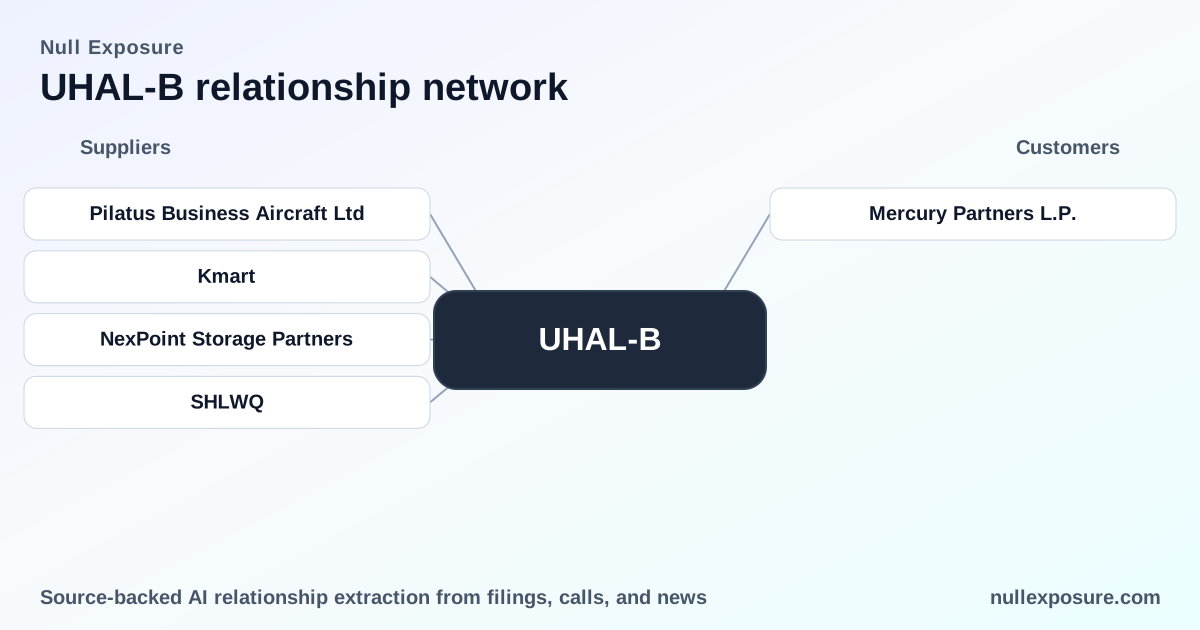
U-Haul (UHAL-B): Customer Relationships Drive a High-Frequency, Asset-Light Service Franchise
U-Haul monetizes through high-frequency rentals, ancillary product sales, and third-party management fees: the company rents trucks and trailers to individual “do-it-yourself” movers, sells branded moving supplies and protection packages, and manages self-storage properties for institutional owners on a fee basis. Revenue is driven by short-term contracts with broad retail scale and recurring low-margin services, supplemented by stable management fees from third-party property owners. Visit https://nullexposure.com/ for a concise view of this relationship profile.
What U-Haul’s commercial model actually looks like for investors
U-Haul operates as a high-turnover, retail-facing rental and services company across the United States and Canada. The core economics come from frequent, short-duration rentals and point-of-sale product sales (boxes, tape, towing accessories, propane), while a parallel revenue stream originates from management fees for self-storage assets owned by others. The company’s customer base is heavily concentrated in individual consumers and households rather than large corporate fleets, yielding high transaction volumes, predictable seasonality, and relatively low per-transaction monetization.
- Contracting posture: U-Haul’s contracts are primarily short-term rental agreements that start and finish within a single fiscal year, producing rapid cash conversion but limited long-term contractual lock-in.
- Concentration and counterparty type: The principal counterparty cohort is individual consumers across North America, not a small set of corporate customers, which lowers counterparty concentration risk but increases sensitivity to consumer mobility and macro trends.
- Criticality and materiality: Premiums receivable and similar insurance-linked balances are immaterial to reported results, and a currency move of 10% between USD and CAD is reported as immaterial to net income—indicating operational resilience to modest FX swings.
- Maturity and stage: The company runs mature retail operations with active third-party management arrangements for storage properties, generating stable management fee income alongside the transactional rental business.
Customer relationships — the full list you need to know
Below I cover every named relationship returned for UHAL-B in the provided results.
Mercury Partners L.P.
U-Haul transitioned 78 branded self-storage locations to managed-property status after Mercury Partners exercised an option to purchase those assets in February 2024, shifting revenue recognition from direct ownership to management fees for those sites. A Yahoo Finance summary of U-Haul’s 2Q FY2025 results reported that the purchase caused part of a revenue decrease because the 78 locations are now treated as managed properties. (Source: Yahoo Finance coverage of U-Haul 2Q FY2025 results, published March 2026.)
Why the Mercury Partners relationship matters to valuation
The Mercury transaction exemplifies U-Haul’s dual monetization model: converting capital ownership into ongoing fee income. U-Haul discloses it manages properties owned or leased by Mercury under a standard management agreement that pays between 4% and 10% of gross receipts plus expense reimbursement, and management fees from these third-party owners were about $37.1–$37.2 million annually across FY2023–FY2025. This indicates a stable, fee-like revenue stream that replaces asset-level volatility with predictable scale economics. (Source: U-Haul fiscal disclosures for FY2025.)
Operational constraints that shape the customer book
The relationship data and company disclosures create a coherent operational picture:
- Short-term contracting dominates. The bulk of revenue flows from rental contracts that conclude quickly; this underpins high working-capital turnover and sensitivity to utilization rather than long-term contract revenue.
- Retail counterparty base. U-Haul’s customers are predominantly individuals and households, which means revenue is volume-driven and sensitive to cyclical mobility trends and consumer confidence.
- North American footprint. Operations are conducted throughout the U.S. and Canada; roughly 5.1% of revenue is Canadian, so the business is largely exposed to U.S. domestic demand dynamics with limited international currency impact.
- Service-plus-product economics. The company’s segment mix pairs core rental activity with services (insurance protection packages, claims handling via related property & casualty operations) and point-of-sale product sales that improve per-transaction margins.
- Immaterial credit and FX exposure. Premiums receivable are small and judged immaterial to earnings; currency exposure to CAD is not material to net income under current tolerance ranges.
- Active, mature third-party management relationships. Management fees are recurring and stable, reflecting a mature capability to operate third-party storage assets; Mercury is a concrete example of this operating posture.
All of these constraints combine into a business that is capital-intensive at fleet and property scale but operationally standardized, where margin expansion hinges on utilization, ancillary sales attachment rates, and efficiencies in fixed-cost absorption.
Key risks and what investors should watch
- Utilization sensitivity: Because contracts are short-term, earnings are highly sensitive to weekly and monthly utilization trends; downturns in moving activity transmit quickly to revenue and margins.
- Retail demand concentration: Heavy reliance on individual movers exposes U-Haul to cyclical housing markets, university enrollments, and migration patterns.
- Asset-to-fee transitions: Converting owned properties into managed assets (as with Mercury) changes cash flow timing and capex needs—this reduces asset volatility but also caps upside from direct property appreciation.
- Insurance and liability: While premiums receivable are immaterial today, property & casualty underwriting and claims handling are operationally important and require continued control to protect margins.
Bottom line and investor action
U-Haul is a high-frequency service franchise with diversified revenue channels: retail rentals and product sales provide volume-driven cash flow, and third-party management contracts deliver recurring fee income that smooths asset volatility. The Mercury Partners relationship is an explicit example of U-Haul’s strategy to monetize operations through management fees while retaining brand and operational scale.
For investors and operators sizing counterparty exposure or modeling revenue resilience, prioritize utilization trends, ancillary attachment rates, and the pace of asset-to-management conversions. For a compact, actionable summary of U-Haul’s relationship map and constraints, see https://nullexposure.com/.