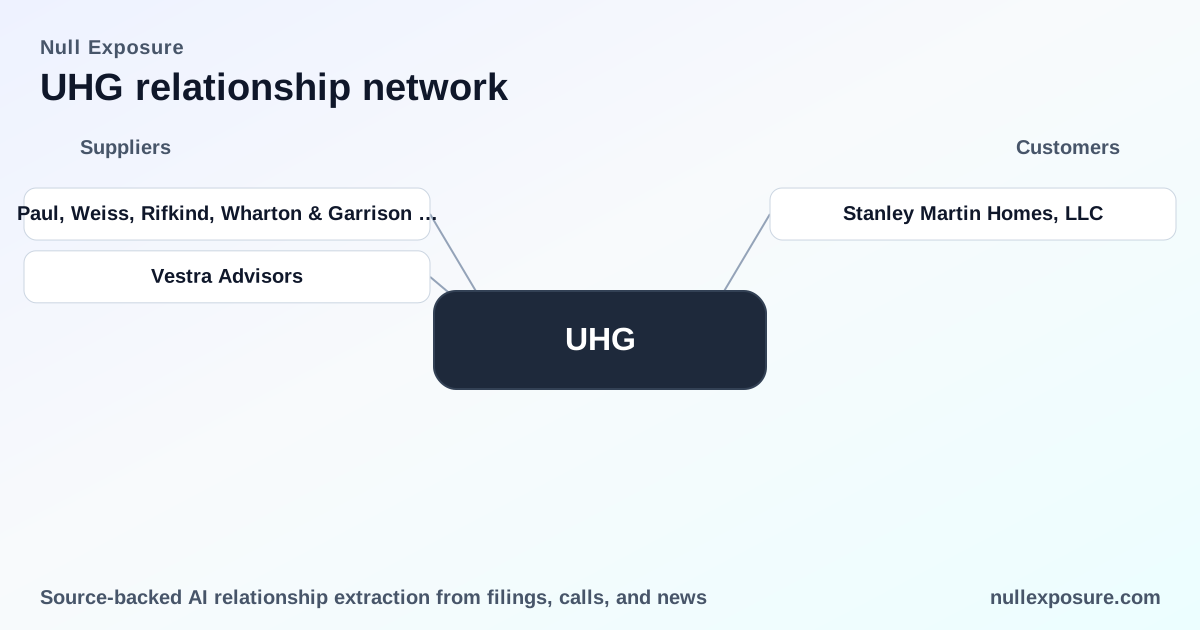
United Homes Group (UHG) — Customer relationships and the Stanley Martin buyout investors must price in
United Homes Group builds and sells entry-level and first move-up single-family homes across the Southeast and monetizes through one-time home sale closings, ancillary construction services, and shared-cost arrangements with related parties; the company operates a land-light model focused on design and construction rather than land ownership. The strategic fact investors must confront is that UHG’s customer franchise — largely individual homebuyers in South Carolina, North Carolina and Georgia — has been superseded by a corporate buyer transaction: Stanley Martin Homes agreed to acquire UHG in an all-cash deal announced February 23, 2026. For premium finance and counterparty analysis, this changes counterparty risk from a dispersed retail base to a single corporate acquirer and triggers litigation and governance scrutiny. For more on data-driven counterparty discovery and alerts, visit https://nullexposure.com/.
The Stanley Martin transaction re-frames customer risk overnight
United Homes reported that it will become a wholly owned subsidiary of Stanley Martin Homes, LLC for $1.18 per share, reflecting an enterprise value of about $221 million. Multiple investor notices and plaintiff-lawyer alerts followed the announcement, characterizing the deal as a steep discount to pre-announcement trading levels and prompting inquiries into whether shareholders received fair value. This acquisition effectively collapses the public shareholder counterparty into a single corporate counterparty for any remaining commercial relationships and creates short-term legal and reputational risk. Sources reporting the deal include PR Newswire and several investor-rights firms in March–May 2026.
How homebuilder economics translate into customer contracts
United Homes’ core revenue stream is the sale of completed homes with a single performance obligation satisfied on transfer of control at closing; buyers are typically individual households rather than commercial purchasers. The company also recognizes revenue from related-party general contracting and cost allocations when shared services are provided. That structure produces predictable recognition at closing but concentrates cash flow timing and sensitivity to housing-cycle volatility.
All reported mentions of Stanley Martin Homes, LLC in the dataset
Below are every relationship mention returned in the source set; each entry is summarized in plain English with a concise source reference.
-
A PR Newswire investor notice (first seen May 4, 2026) reported that United Homes agreed to be acquired by Stanley Martin Homes, LLC in an all-cash transaction valuing the company at approximately $221 million and offering $1.18 per share to stockholders. (PR Newswire, May 2026)
-
Sahm Capital published the same transaction detail (first seen May 4, 2026), stating United Homes will become a wholly owned subsidiary of Stanley Martin Homes for $1.18 per share in cash. (Sahm Capital commentary, May 2026)
-
A PR Newswire legal alert (first seen March 10, 2026) described a shareholder investigation focused on United Homes’ sale to Stanley Martin Homes, indicating securities litigation interest tied to the transaction. (PR Newswire legal release, March 2026)
-
Halper Sadeh’s investor-alert write-up (first seen March 10, 2026) announced an investigation into whether United Homes shareholders received a fair price in the $1.18-per-share sale to Stanley Martin Homes. (Halper Sadeh reporting, March 2026)
-
GlobeNewswire coverage (first seen May 4, 2026) described the February 23, 2026 acquisition announcement and characterized the purchase price as representing a discount exceeding 50% to the prior trading day's close. (GlobeNewswire, April–May 2026)
-
GlobeNewswire (April 27, 2026 posting; first seen May 4, 2026) reiterated that United Homes agreed to a $1.18 per share cash-out acquisition by Stanley Martin Homes, noting the price represented a large discount to recent trading. (GlobeNewswire, April 2026)
-
PR Newswire (April notice; first seen May 4, 2026) again reminded investors of the Stanley Martin buyout and the $1.18 per share cash consideration. (PR Newswire, April 2026)
-
Sahm Capital (April 24, 2026; first seen May 4, 2026) relayed complaint language alleging the February 23 announcement that UHG would become a wholly owned subsidiary of Stanley Martin Homes for $1.18 per share. (Sahm Capital legal notice, April 2026)
-
GlobeNewswire (April 23, 2026; first seen May 4, 2026) issued a deadline alert for shareholders and referenced the February 23 acquisition agreement with Stanley Martin Homes at $1.18 per share. (GlobeNewswire, April 2026)
-
Sahm Capital’s March 2, 2026 posting (first seen March 10, 2026) again reported Halper Sadeh’s investigation into whether the $1.18-per-share buyout by Stanley Martin Homes was fair to shareholders. (Sahm Capital, March 2026)
-
A Globenewswire/Levi Korsi notice (April 20, 2026; first seen May 4, 2026) labeled the February 23 deal a “fire sale,” citing the $1.18-per-share offer and highlighting investor loss claims. (GlobeNewswire/Levi Korsi legal alert, April 2026)
Each of these items references the same buyer—Stanley Martin Homes—and the same transaction economics; collectively they document market and plaintiff-lawyer reaction across March–May 2026.
Operating-model constraints and what they mean for contract risk
Several company-level signals shape UHG’s contracting posture and counterparty profile:
-
Retail-focused counterparty mix: Contract language and revenue recognition indicate that many counterparties are individual homebuyers with a single performance obligation recognized at closing. This makes revenue timing lumpy and concentrated by closings rather than long-term recurring contracts. (Company disclosures, FY2024–FY2025)
-
Regional concentration: UHG operates in South Carolina, North Carolina and Georgia, which concentrates geographic demand risk to Southeastern housing markets. (Company regional disclosures)
-
Mixed role exposure: UHG acts as a seller of homes, a service provider to related parties (shared office space and allocated costs), and a general-contractor seller to related parties; these multiple roles increase related-party complexity without changing the fundamental retail cash flow profile. (Related-party disclosures)
-
Active backlog signal: The company reports a backlog of homes sold but not yet closed, indicating active near-term revenue visibility but also sensitivity to cancellation or closing delays.
-
Core product focus and land-light posture: The firm’s emphasis on design, construction and sale of entry-level and move-up houses under a land-light approach reduces balance-sheet land exposure but also transfers supply-chain and execution risk to contractors and partners.
Collectively, these constraints imply high timing risk, concentrated geographic exposure, and operational dependence on closing activity, which are critical for financiers underwriting receivables, warranty exposures, or post-closing liabilities.
Investment implications and risk checklist
-
Shareholder outcome: The $1.18-per-share cash-out converts future public-equity upside into immediate cash for public holders, but activist and plaintiff-lawyer notices argue the price was deeply discounted relative to recent market levels. (PR Newswire; Halper Sadeh; GlobeNewswire, March–May 2026)
-
Counterparty consolidation: Post-closing, many counterparty and contractual interactions will be managed by Stanley Martin as parent, reducing public-company governance visibility but centralizing counterparty credit risk at Stanley Martin. (Transaction filings and press coverage)
-
Operational continuity versus legal friction: Homebuilding operations will continue under new ownership, but litigation and reputational scrutiny create near-term distraction and potential cost. (Investor-lawyer communications, April 2026)
-
For premium finance providers: Underwrite against closing schedules and backlog conversion, account for warranty and indemnity carve-outs in the acquisition agreement, and size concentration limits for Southeast regional exposure.
Final takeaways for investors
- The Stanley Martin acquisition is the dominant counterparty event for UHG in 2026 — it converts a dispersed retail counterparty set into a single controlling buyer and triggers material governance and legal risk.
- Operational signals — regional concentration, land-light model, and single-obligation home sales — create timing and execution risk that financiers must underwrite carefully.
For ongoing monitoring of counterparty events and legal alerts affecting homebuilders and related counterparties, visit https://nullexposure.com/.