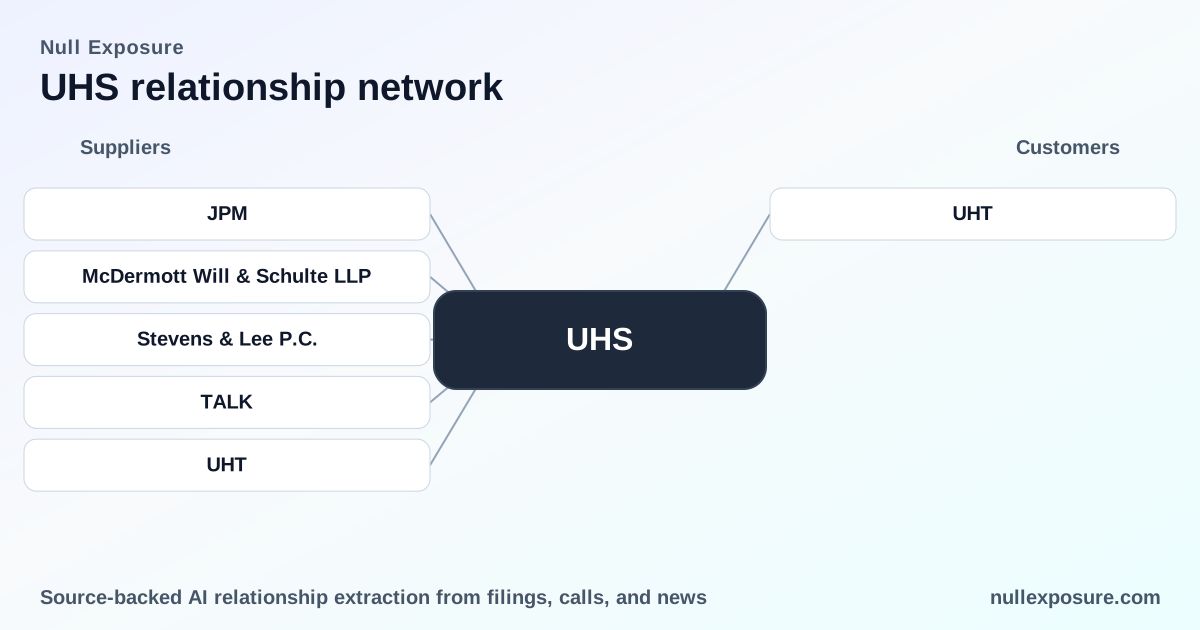
Universal Health Services (UHS): How customer ties shape cash flow and risk
Universal Health Services operates and monetizes by owning and operating acute-care hospitals, behavioral health facilities and outpatient centers while collecting revenues from private insurers, Medicare, Medicaid and patient-pay sources; the company also earns recurring advisory fees from a publicly traded real estate trust. These revenue lines create a mix of high fixed-cost operations with material government payer exposure and modest, but recurring, fee income from real estate advisory activities. For a quick snapshot of relationship intelligence and implications, visit https://nullexposure.com/.
Why UHS’s customer relationships matter to investors
UHS is a hospital and services operator whose revenue profile is driven by payer mix, geographic concentration and service intensity. Company disclosures and media coverage together indicate several operating constraints that define capital allocation and credit dynamics:
- Contracting posture: short-term sensitivity to supplemental payments. Company filings state Medicaid supplemental payments are subject to annual approvals, which creates a recurring short-term revenue risk to near-term cash flows.
- Counterparty concentration: government and individuals dominate collections. UHS collects material revenue from Medicare and Medicaid as well as from private insurers and direct patient payments, making public payer policy changes a first-order risk to earnings.
- Geographic concentration but national scale. UHS reports significant revenue concentration in specific markets (Las Vegas hospitals contributed ~15% of consolidated net revenues in 2024), yet the enterprise operates across 39 U.S. states plus the U.K., providing both diversification and pockets of local exposure.
- Service-provider business model with active relationships. The company’s operating model is service-centric (acute care, behavioral health, outpatient services) and relationships are largely ongoing and operationally critical to revenue conversion.
- Spend and fee signals: material state Medicaid receipts and modest advisory fees. Filings indicate UHS receives annual Medicaid receipts of approximately $100M+ from individual states and records advisory fee income on the order of several million dollars annually—small relative to total revenue but relevant to cash flow diversification and corporate-affiliate economics.
These characteristics make UHS sensitive to reimbursement policy, local market dynamics and regulatory shifts, while also benefiting from scale, high institutional ownership and stable inpatient service demand.
Media-cited customer relationships — granular press references
Below are every relationship result in the public coverage set, with a two-sentence plain-English take and a source pointer.
-
Universal Health Realty Income Trust (UHT) — The Globe and Mail press release (May 4, 2026) reported that advisory fees paid to UHS increased 2.9%, while depreciation and amortization also rose slightly, signaling ongoing fee flows from the REIT to the operator. Source: The Globe and Mail press release (May 2026) — https://www.theglobeandmail.com/investing/markets/stocks/UHT-N/pressreleases/1626834/universal-health-realty-stock-slips-post-q1-earnings-ffo-rises/
-
UHT — Leaders Magazine profile (January 2025) described Universal Health Services as acting as adviser to Universal Health Realty Income Trust, noting UHS’s scale (reported 2023 revenues ~ $14.3 billion) and the advisory relationship as part of the corporate footprint. Source: Leaders Magazine interview/profile (Jan 2025) — https://www.leadersmag.com/issues/2025.1_Jan/PUR/LEADERS_Miller_UHS.html
-
Universal Health Realty Income Trust — A second Globe and Mail item (FY2026 coverage) reiterated advisory fees to UHS ticked higher, reinforcing the recurring advisory-fee line reported in quarterly results. Source: The Globe and Mail press release (FY2026) — https://www.theglobeandmail.com/investing/markets/stocks/UHT-N/pressreleases/1626834/universal-health-realty-stock-slips-post-q1-earnings-ffo-rises/
-
UHT — Another Globe and Mail press release covering FY2026 (press id 515342) noted advisory fees to UHS rose 2.7% in the quarter and 2.1% for the full year, underscoring modest, stable growth in asset-management-style fees. Source: The Globe and Mail press release (FY2026) — https://www.theglobeandmail.com/investing/markets/stocks/UHT/pressreleases/515342/universal-health-realty-stock-gains-post-q4-earnings-revenue-slips/
-
UHT — InsiderMonkey coverage (FY2026 commentary) highlighted that UHS is the Trust’s largest tenant and serves as the REIT’s manager, affirming the economic and operational linkage between the operator and the real estate vehicle. Source: InsiderMonkey article (Mar 2026) — https://www.insidermonkey.com/blog/universal-health-realty-uht-delivers-steady-income-with-four-decades-of-dividend-growth-1693522/
-
UHT — A QuantiSnow earnings synopsis (FY2026) reported that a wholly owned subsidiary of UHS acts as adviser to Universal Health Realty Income Trust (NYSE: UHT), reiterating the formal advisory channel between UHS and the REIT. Source: QuantiSnow insight (May 2026) — https://www.quantisnow.com/insight/universal-health-services-inc-announces-financial-results-for-the-three-month-6516487
-
Universal Health Realty Income Trust — The Globe and Mail press release (FY2026, press id 515342) also appears in the results under the Trust’s full name and again documents advisory fees increasing modestly, consistent with quarterly and annual reporting. Source: The Globe and Mail press release (FY2026) — https://www.theglobeandmail.com/investing/markets/stocks/UHT/pressreleases/515342/universal-health-realty-stock-gains-post-q4-earnings-revenue-slips/
Operating implications drawn from constraints and relationships
Combine the relationship coverage with the company-level constraints and you get a clear operational picture for investors:
- Revenue durability is mixed. Medicare and Medicaid comprise a large share of payments; Medicaid supplemental payments are approved on a short-term (annual) basis, which elevates near-term volatility in cash flow despite long-run demand for inpatient services.
- Concentration risk is tangible but manageable at scale. Local markets can represent double-digit shares of consolidated revenue, so adverse local policy or competition can move margins materially, even though national diversification reduces system-wide tail risk.
- Affiliate economics are stable but immaterial to enterprise scale. Advisory fees from the Trust are recurring and have in recent years been in the low single-digit millions; they provide a predictable but small non-patient revenue stream relative to UHS’s multi-billion-dollar top line.
- Counterparty mix creates policy sensitivity. Large Medicaid receipts (reported at roughly $100M+ per state in several states) make UHS exposed to state budget cycles and Medicaid program changes, while direct patient and private insurer receipts preserve revenue plurality.
Bottom line for allocators and operators
UHS is a high-fixed-cost hospital operator whose credit and equity profile is driven by payer policy, local market share and operational execution. The advisory relationship with Universal Health Realty Income Trust provides a stable supplementary fee stream but is not a material revenue driver versus government and commercial payer receipts. Investors should weight policy/regulatory risk and regional concentration more heavily than the modest earnings contribution from real-estate advisory activity.
For a fuller view of how these relationship signals affect enterprise risk and to monitor changes in UHS’s customer links, visit https://nullexposure.com/.