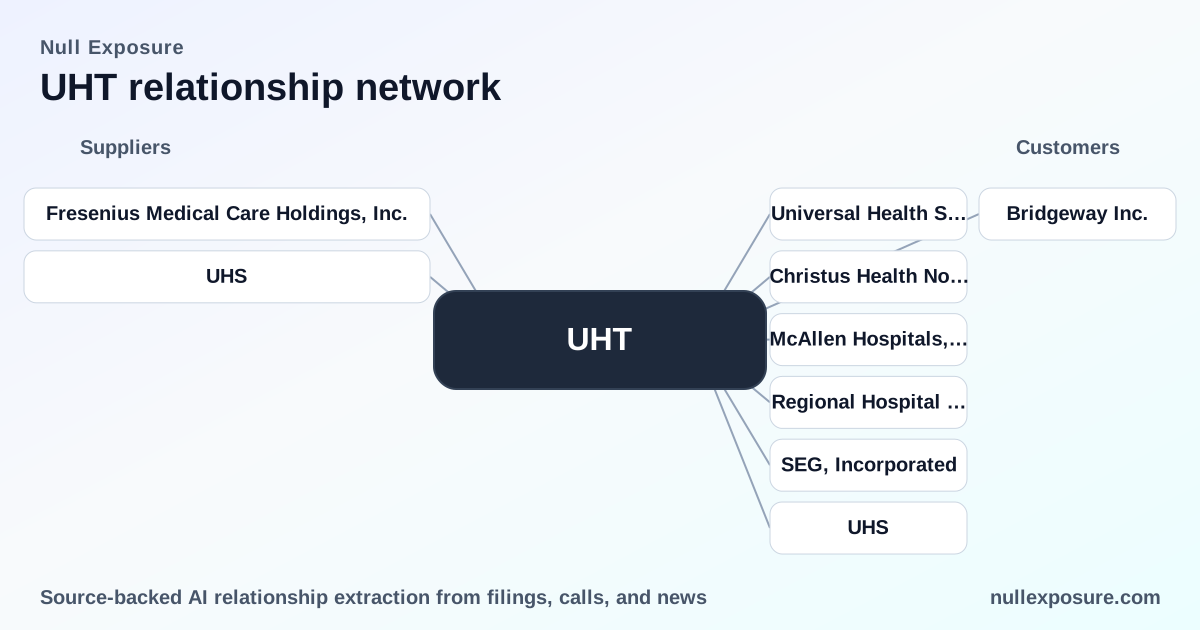
Universal Health Realty Income Trust (UHT): tenant concentration, contract tenure, and what customers tell investors
Universal Health Realty Income Trust (UHT) is a healthcare-focused REIT that owns and leases medical buildings, hospitals, behavioral health facilities, emergency departments and childcare centers and monetizes by collecting long‑term lease payments—often under triple‑net or master lease structures—and recurring bonus rent linked to operator performance. The portfolio’s cash flow profile is dominated by a single operator relationship that provides both management and leasing stability, while a diversified set of smaller operator leases fills out the remainder of the revenue base. For a closer look at UHT’s customer relationships and contract structure, see the Null Exposure coverage at https://nullexposure.com/.
Why the tenant map matters to returns
UHT’s business model is infrastructure-like: long-term leases, NNN economics, and a concentrated tenant base that converts real estate ownership into predictable distributions. This is a classic REIT monetization model: buy or develop healthcare real estate, place it under long‑dated leases (often with renewal options), then extract stable rent and bonus rent upside. Investors should weigh the yield stability from long tenure against concentration risk when a handful of operators supply a large share of revenue.
If you want the full customer-level export and contract detail, the Null Exposure platform provides the annotated source material: https://nullexposure.com/.
The dominant relationship: Universal Health Services (UHS)
Universal Health Services (UHS) is UHT’s largest tenant and its advisor, and the economic exposure is material. According to UHT’s FY2024 10‑K, UHS-related tenants comprised about 40% of consolidated revenues, and subsidiaries of UHS serve as both lessees and the company’s advisor. UHT’s filings document multiple long‑dated master leases and hospital leases that underpin that contribution to revenue (FY2024 10‑K). News coverage in 2026 corroborates that a UHS subsidiary has executed multi‑year master leases (including a 10‑year commitment covering ~75% of a new Palm Beach Gardens project) and that lease revenue from UHS‑related facilities remains a core revenue driver (multiple press releases and articles, 2025–2026).
- Universal Health Services / UHS — UHT’s largest tenant and manager; UHS‑related tenants generated roughly 38–40% of consolidated revenue across recent years, and UHS subsidiaries are frequently the master lessees on long‑term triple‑net leases (Source: UHT FY2024 10‑K; Globe and Mail and company press releases, 2025–2026).
Other named customers in the filings and press
UHT’s filings list a set of other operators and master‑lessee arrangements that fill out the portfolio. Each relationship below is summarized with the supporting source.
Universal Health Services, Inc. (10‑K excerpt)
UHT’s FY2024 10‑K lists specific hospital leases — McAllen Medical Center, Wellington Regional Medical Center, Aiken Regional Medical Center/Aurora Pavilion, Canyon Creek Behavioral Health, and Clive Behavioral Health — including disclosed annual minimum rents and multi‑decade initial lease terms in some cases. This supports the claim that several hospital facilities are on long‑dated lease schedules (Source: UHT FY2024 10‑K, FY2024).
Regional Hospital Partners
UHT’s 10‑K cites a medical office building (Haas Medical Office Park, Ottumwa, IA) that is 100% leased to Regional Hospital Partners, indicating an operator‑leased MOB relationship in Iowa (Source: UHT FY2024 10‑K, FY2024).
SEG, Incorporated
UHT’s filings list several Chesterbrook Academy preschool/childcare centers in Pennsylvania 100% leased to SEG, Incorporated, demonstrating UHT’s exposure to non‑acute health and childcare operators as part of its tenant mix (Source: UHT FY2024 10‑K, FY2024).
Christus Health Northern Louisiana
The 10‑K identifies a Family Doctor’s Medical Office Building in Shreveport, LA 100% leased to Christus Health Northern Louisiana, showing UHT’s engagement with regional health system tenants outside the UHS franchise (Source: UHT FY2024 10‑K, FY2024).
McAllen Hospitals, L.P.
UHT disclosed the acquisition of McAllen Doctor’s Center (approx. $7.6 million purchase in Q3 2023), 100% master‑leased to McAllen Hospitals, L.P., a wholly owned UHS subsidiary, under a twelve‑year triple‑net master lease scheduled to expire in 2035, which contributes to the company’s bonus rental dynamics (Source: UHT FY2024 10‑K, FY2024).
Bridgeway Inc.
Local news archives note that Bridgeway Inc., an affiliate of UHS, has been involved in past property transactions with UHT (a 2015 Bridgeway purchase referenced in Arkansas Business), documenting historical property transfers between UHT and UHS affiliates and underscoring the long standing corporate link between the REIT and the operator group (Source: Arkansas Business report, 2015).
Operating model constraints and what they signal for investors
UHT’s public disclosures and the extracted relationship evidence create a coherent view of the REIT’s constraints and operational posture:
- Contracting posture: long‑term, often triple‑net master leases. Filings document 12‑year to multi‑decade initial terms, and a number of leases include lengthy renewal options, which provide cash‑flow visibility and lower near‑term leasing risk (company 10‑K excerpts, FY2024). Where long terms are disclosed, they act like infrastructure concessions: low turnover, predictable base rent, upside from bonus rent.
- Geographic footprint: United States only. UHT reports a portfolio concentrated across 21 U.S. states, and management does not report segmented geographic performance beyond U.S. operations, making UHT a domestic healthcare‑real‑estate play (UHT 10‑K, Feb 26, 2025 disclosure).
- Concentration risk: material. UHS‑related tenants generated approximately 38–40% of consolidated revenues through 2024, which is a material dependency and the dominant single counterparty risk in the model (UHT FY2024 10‑K).
- Role dynamics: seller/lessor and originator. UHT historically acquired properties from UHS subsidiaries and other sellers and immediately leased them back; this carve‑out and sale‑leaseback origin creates embedded contractual relationships and intercompany linkage that persist today (UHT FY2024 10‑K historical disclosures).
- Relationship stage and maturity: active and operational. Filings list multiple operating hospital and MOB leases that continue to generate base and bonus rental income, indicating an active, mature portfolio rather than an early‑stage development pipeline (UHT FY2024 10‑K; FY2025–FY2026 press coverage).
Investment implications and risk framing
- Stability vs. concentration: The long‑dated, NNN master lease structure produces stable cash flows and supports UHT’s multidecade dividend track record; the tradeoff is concentrated operator exposure, principally to UHS, which accounts for ~40% of revenue.
- Visibility into pipeline cash flow: Recent 2025–2026 project deals (for example, the Palm Beach Gardens project with a 10‑year UHS subsidiary commitment covering ~75% of rentable space) provide near‑term revenue visibility once construction completes (press releases and coverage, 2025–2026).
- Operational leverage to healthcare volumes: Although contracts are long, bonus rent and occupancy ultimately link returns to hospital operator performance and patient volumes; macro deterioration in healthcare utilization would transmit to UHT via lower bonus rent and slower roll‑forward leasing.
Bottom line and next steps
UHT is a classic, infrastructure‑style healthcare REIT: long‑tenor leases, stable base rent, and meaningful concentration to a single operator that both manages and leases properties. That structure produces predictable distributed cash flows with operator concentration as the principal idiosyncratic risk. For a closer customer map and source‑level documentation that underpins these conclusions, explore Null Exposure’s UHT coverage at https://nullexposure.com/.