Unisys’ customer relationships: federal contracts, cloud work, and the SAIC divestiture
Unisys is an IT services and enterprise computing company that monetizes through long-duration services agreements, licensing and point-in-time hardware/software sales across Enterprise Computing Solutions (ECS), Digital Workplace Services (DWS) and Cloud, Applications & Infrastructure (CA&I). The company generates revenue from an installed base of clients under multi-year performance obligations (approximately $1.0 billion of remaining performance obligations at 12/31/2024, with recognizable revenue spread through 2028), and it supplements that recurring profile with software license events and discrete hardware transactions. For investors, the core investment thesis is straightforward: visibility from contracted work and recurring services underpins cash flow, while software and hardware transactions inject cyclical upside; the sale of the federal contracting arm to SAIC materially reshapes the company’s customer footprint.
Learn more about our coverage at https://nullexposure.com/.
How Unisys contracts and where revenue comes from
Unisys operates with a long-term contracting posture and a mixed delivery model. Public filings show roughly $1.0 billion of remaining performance obligations with recognition spread across multiple years (38% into 2025, 25% into 2026, 21% into 2027, 11% into 2028, and 5% thereafter), which signals meaningful revenue visibility from existing contracts. Revenue recognition practice differs by segment: ECS recognizes software and hardware largely at a single point in time, while DWS and CA&I recognize revenue over time as services are delivered. Software licensing is recognized at license inception, creating discrete revenue events on top of the recurring service stream.
Company-level signals from filings and disclosures:
- Contracting posture: Predominantly long-term engagements with an explicit “land-and-expand” go-to-market that drives renewals and scope growth.
- Customer mix: Balanced across large enterprise, government, mid-market and not-for-profit clients, with a global footprint and foreign-currency exposure.
- Concentration: No single customer accounts for more than 10% of revenue, so revenue concentration risk is limited at the top-customer level.
- Delivery criticality: High for public sector and mission-critical enterprise clients because many services support operations and infrastructure.
- Revenue profile maturity: A mix of mature, renewals-driven services and intermittent license/hardware transactions that create periodic revenue spikes.
These characteristics make Unisys a company with visible recurring cash flows blended with transactional upside—a profile investors can value for stability while monitoring the pace of license and hardware sales for growth acceleration.
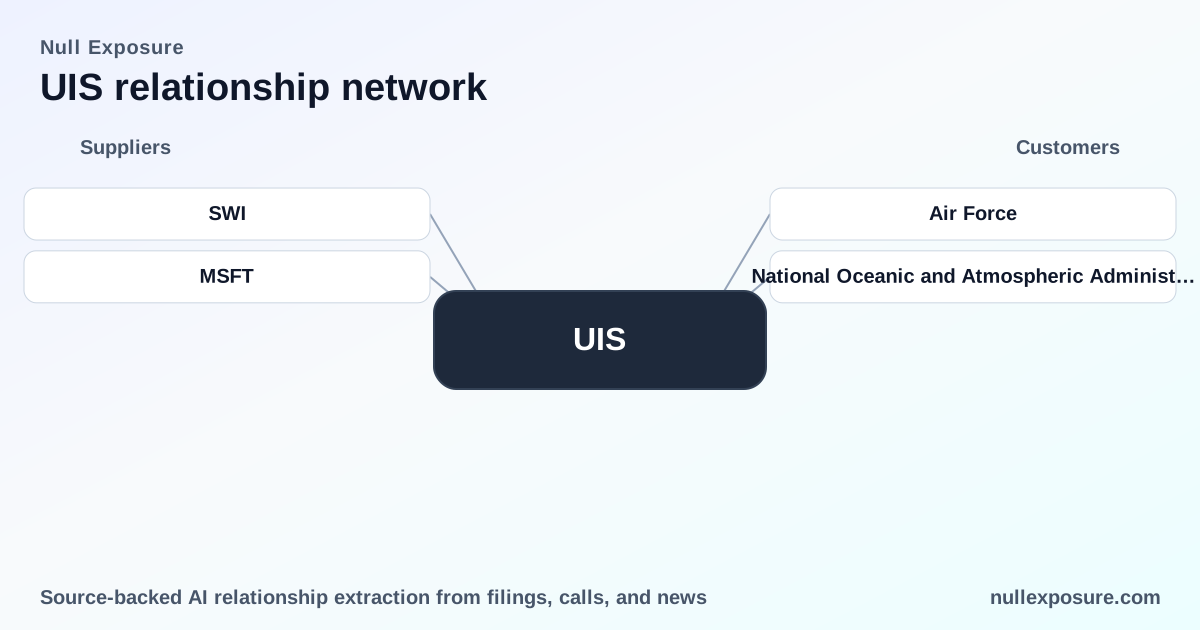
Federal client: U.S. Air Force
Unisys has secured sizeable federal contracts in recent years, including a $76.3 million EITaaS (Enterprise IT-as-a-Service) award with the U.S. Air Force. This contract demonstrates Unisys’ role as a services provider for mission IT modernization and underscores the company’s capabilities in delivering layered IT services to federal clients. According to FedScoop reporting (FY2020), the Air Force deal is one of several federal engagements that anchored Unisys’ public-sector pipeline (https://fedscoop.com/unisys-federal-acquired-saic/).
Public-sector cloud migration: NOAA
Unisys executed a $144 million cloud migration project for the National Oceanic and Atmospheric Administration, highlighting the company’s position in large-scale cloud and modernization programs for civilian agencies. This NOAA engagement is an example of how Unisys combines application and infrastructure services in multi-year projects for government entities, per FedScoop coverage (FY2020) (https://fedscoop.com/unisys-federal-acquired-saic/).
Strategic transactional change: SAIC acquisition of the federal business
In a material strategic transaction, Unisys agreed to sell its federal government contracting division to SAIC for $1.2 billion, which produced a sharp market reaction—documented as a more than +60% weekly rise in UIS shares following the announcement. The SAIC deal fundamentally alters Unisys’ customer mix by transferring federal prime relationships and large federal contracts to SAIC, while Unisys retains its enterprise, software and cloud-focused commercial operations. Market commentary and reporting captured the transaction and stock move (TradingView summary, FY2026) (https://www.tradingview.com/symbols/NYSE-UIS/).
What each relationship implies for revenue, risk and strategy
- Air Force engagement: Large, multi-year services contract that contributes to revenue visibility and demonstrates operational capability in defense IT modernization; such contracts reinforce renewal and expansion potential in the public sector. (FedScoop, FY2020 — https://fedscoop.com/unisys-federal-acquired-saic/)
- NOAA engagement: A sizable cloud migration project that illustrates Unisys’ technical scope in civilian modernization programs and contributes to the services backlog recognized over time. (FedScoop, FY2020 — https://fedscoop.com/unisys-federal-acquired-saic/)
- SAIC transaction: The $1.2 billion sale of Unisys’ federal contracting division to SAIC removes a cluster of federal prime relationships from Unisys’ portfolio, generating immediate proceeds and reshaping the company into a more commercially oriented IT services and software vendor. (TradingView reporting, FY2026 — https://www.tradingview.com/symbols/NYSE-UIS/)
Investor implications — what to watch next
Unisys’ customer fabric and the SAIC divestiture create a clear set of monitorables for investors:
- Revenue visibility vs. growth cadence: The ~$1.0 billion of remaining performance obligations gives short- to medium-term revenue visibility; investors should reconcile this RPO schedule with post-divestiture revenue guidance to understand recurring base erosion or retention.
- Margin mix: Services recognized over time deliver steadier margins and cash conversion, while point-in-time software/hardware sales create episodic margin contributions—monitor the relative cadence of each segment for margin trajectory.
- Concentration and customer risk: With no single customer over 10% of revenue, top-customer concentration is low; however, the federal divestiture removes a cluster of high-value government contracts, changing the risk/return profile toward commercial clients.
- Renewal and expansion mechanics: The company’s “land-and-expand” strategy and explicit focus on renewals make renewal rates and cross-sell velocity key operating metrics to validate the business model post-divestiture.
- Currency and geography exposure: Global operations leave Unisys exposed to FX movements—management commentary on hedging and foreign-currency impacts will be relevant for forward earnings.
Key takeaways for investors: Unisys combines durable service contracts with software and hardware transactional opportunities; the SAIC sale monetizes federal assets and materially reshapes the customer base; and the remaining performance obligations provide multi-year revenue visibility but require close monitoring of post-deal growth strategy.
For a concise briefing on how these relationship shifts affect valuation and risk, visit https://nullexposure.com/.
- Strong signals: long-term contract book, global client mix, low single-customer concentration, and a balanced services/software/hardware revenue model.
- Primary risk vector: reprofiling of revenue and margins after divestiture of federal contracts, and the company’s ability to replace transactional federal revenue with commercial growth.
This analysis covers every customer relationship disclosed in the provided sources (Air Force, NOAA, SAIC transaction) and places them into the broader operating and monetization context investors need to assess Unisys going forward.